Finding Your Chamberlain NP Preceptor in Alabama
Alabama licenses nurse practitioners as CRNPs and pairs each one with a collaborating physician, which shapes who can precept you and how sites say yes. Here is how the Chamberlain practicum works on the ground in Alabama, and how to get matched without losing weeks to cold calls.
Start your Chamberlain placement
Start your placement
A free placement review. No payment until you're matched.
Reduced practice, and what it means day to day
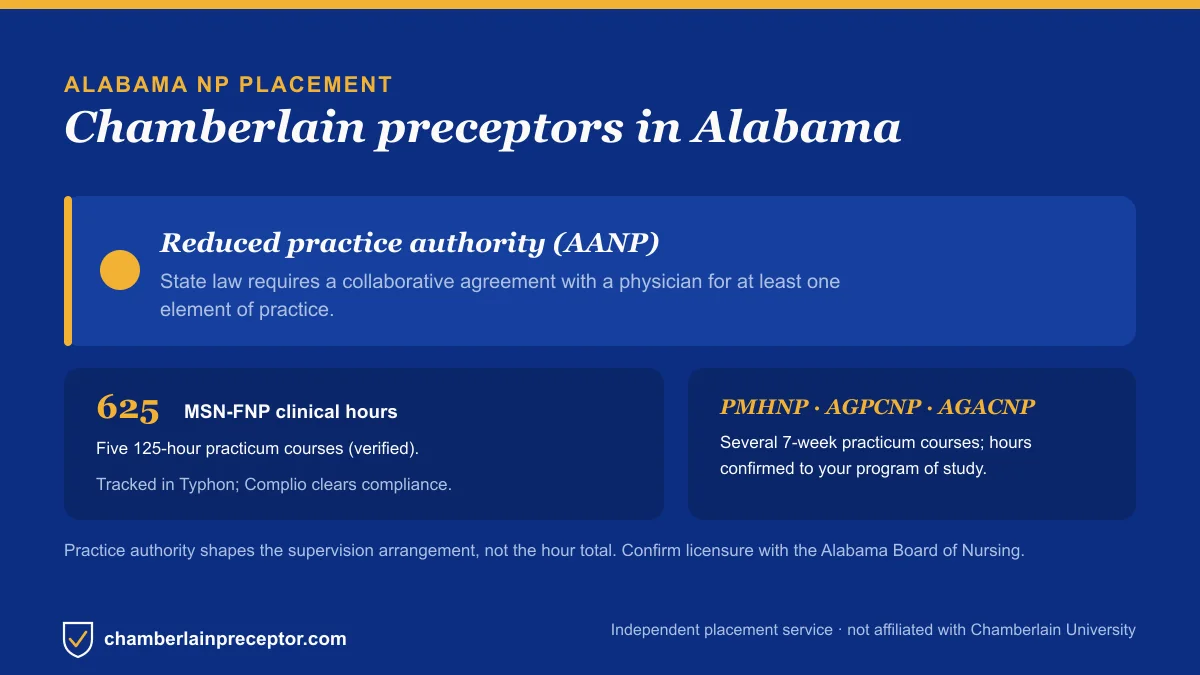
The American Association of Nurse Practitioners classifies Alabama as a reduced practice state. Nurse practitioners here are licensed as Certified Registered Nurse Practitioners, CRNPs, and every one of them practices under a career long collaborative agreement with an Alabama licensed physician.
That agreement is real paperwork, not a formality. It includes a standard protocol describing what the CRNP may do and a quality assurance plan, and it is approved jointly by the Alabama Board of Nursing and the Alabama Board of Medical Examiners. The collaborating physician spends required time on site during a CRNP's early years of practice, and after that the two keep meeting at least quarterly for quality assurance reviews.
None of this changes your Chamberlain hour requirements. It does change your search. The CRNPs you approach are accountable to a physician and a written protocol, so many will ask to see your course syllabus and your Typhon paperwork, and will want to know an affiliation agreement can be signed, before they commit to precepting.
The Alabama Board of Nursing
The Alabama Board of Nursing licenses the state's RNs and approves its advanced practice nurses. For NP students the board matters in three practical ways.
- CRNP approval rests on an active RN license, graduate NP education, and current national certification, followed by collaborative practice approval handled with the Board of Medical Examiners.
- The board publishes license verification online. Before you nominate a preceptor in Typhon, look them up and confirm the license is active and unencumbered.
- Its advanced practice pages explain collaboration, prescribing, and continuing education rules, useful context for understanding what your preceptor can let you do in clinic.
Questions about your own future Alabama licensure belong to the board directly, not to any placement service, ours included.
Chamberlain practicum requirements, seen from Alabama
The requirements travel with the program, not the state, so an Alabama placement carries the same structure as anywhere else.
FNP hours
The MSN FNP track requires 625 supervised clinical hours across five 125 hour practicum courses. Each course needs an approved site and preceptor before it opens. See the FNP placement page.
Other tracks
PMHNP, AGPCNP, and AGACNP students complete several 7 week practicum courses, with hours confirmed to the program of study. DNP students secure a scholarly project site and mentor instead.
Typhon nomination
Chamberlain runs site and preceptor nomination through Typhon. Submit early, because your preceptor's license, the site details, and specialty fit all get reviewed before approval.
Complio and the affiliation agreement
Compliance onboarding, background check, drug screen, immunizations, runs through Complio, and every Alabama site must hold an affiliation agreement with Chamberlain before you log a single hour.
The full checklist lives on our preceptor requirements page.
Where Alabama placements actually happen
Birmingham is the state's largest health care market and its deepest bench of family practice, psychiatric, and acute care sites. Huntsville has grown quickly alongside its hospital systems, and Montgomery, Mobile, and Tuscaloosa each carry a steady base of clinics. Smaller but workable markets include Dothan in the Wiregrass, Auburn and Opelika, Florence and the Shoals, Gadsden, and the Baldwin County towns of Daphne, Fairhope, and Foley along the Gulf Coast.
Rural Alabama, including much of the Black Belt, has far fewer eligible preceptors. Students there usually widen their search radius, plan around a commute, or ask their program whether a telehealth rotation can cover part of a course.
The three denial rule, and why waiting on it hurts
Chamberlain students secure their own preceptors. The university's formal backstop, the Practicum Commitment through the Experiential Learning Team, engages only after three documented preceptor denials. Collecting three written denials takes real calendar time, and it starts the official help late, often with your course start already in sight. We run the same search from denial zero instead, so the backstop becomes something you never need. If you are already stuck, start with what to do when you cannot find a preceptor or, if the clock is loud, the fast track.
Virtual or in person in Alabama
Telehealth is part of everyday care in Alabama, and some practicum experiences can happen through it, most often in psychiatric and primary care settings. Acceptability varies by course and by specialty, so confirm with your program before nominating a virtual site in Typhon. A virtual site still needs a signed affiliation agreement and an approved preceptor, exactly like a clinic on the ground.
If you would rather not spend your evenings cold calling clinics from Birmingham to Mobile, hand us the list. We start with a free placement review, we work under a 14 day match commitment, and you pay when matched. Tell us your track and course dates at the consult form below, or read how it works and what it costs first.
Answered.
Is Alabama a full practice state for nurse practitioners?
No. The AANP lists Alabama as a reduced practice state. CRNPs hold a career long collaborative agreement with an Alabama licensed physician, approved jointly by the Board of Nursing and the Board of Medical Examiners. The category is explained on the AANP state practice environment page.
Who can precept a Chamberlain NP student in Alabama?
Typically an actively licensed CRNP or physician whose specialty matches your course, who meets Chamberlain's preceptor criteria and passes Typhon review. The site must also sign an affiliation agreement with Chamberlain. Our requirements page walks through the full checklist.
How many clinical hours does the Chamberlain MSN FNP require in Alabama?
625 supervised clinical hours, completed across five 125 hour practicum courses, the same in every state. PMHNP, AGPCNP, and AGACNP students complete several 7 week practicum courses with hours confirmed to the program of study. Details by track start at our FNP page.
What is Chamberlain's three denial rule?
Chamberlain's Experiential Learning Team steps in to assist with placement only after you document three preceptor denials. Until then the search is yours. We run it for you from day one, so most students never reach denial one. Start at this guide or the consult form.
Can I complete a virtual practicum while living in Alabama?
Sometimes. Telehealth acceptability varies by course and specialty, so confirm with your Chamberlain program before nominating a virtual site. The site still needs Typhon approval and an affiliation agreement, wherever its clinicians sit.
Get your Chamberlain practicum handled.
A free placement review. No payment until you're matched. Tell us your track and term, and we map the whole placement.