When Your Practicum Hours Fall Behind the Calendar
Hour shortfalls build quietly, a light week here and a cancelled day there, until the remaining math suddenly looks impossible. Here is how Chamberlain NP students can count exactly where they stand, catch up without guessing, and recognize the moment a new preceptor becomes the faster path.
Start your Chamberlain placement
Start your placement
A free placement review. No payment until you're matched.
Why a slow start compounds so quickly
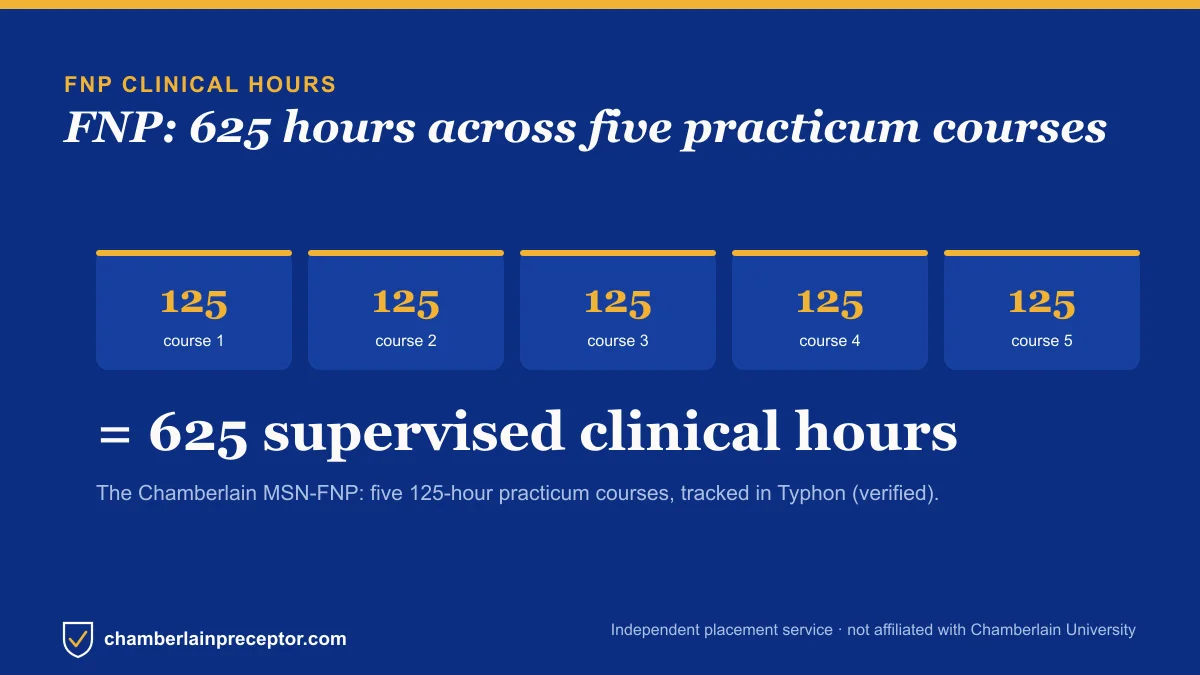
Chamberlain's MSN-FNP program requires 625 supervised clinical hours, earned across five practicum courses of 125 hours each. Every course carries its own 125-hour clock, and that clock does not pause while paperwork clears.
That structure is what makes a slow start expensive. If credentialing, the site's affiliation agreement, or your preceptor's schedule eats the opening weeks of a course, the hours you missed do not disappear. They stack onto the weeks that remain, and every quiet week raises the weekly load your site has to carry from that point forward.
PMHNP, AGPCNP, and AGACNP students face the same dynamic across several 7-week practicum courses, with required hours confirmed to your specific program of study, so check your syllabus for the exact target. Whatever your track, the working rule is identical: the weeks you have left must absorb everything the early weeks did not. For a fuller breakdown of how the requirements fit together, see our clinical hours guide.
Step one: get an exact count, then call your program
Guessing keeps students stuck. Open Typhon and reconcile two numbers: the hours you have logged, and the hours your preceptor has actually approved. The gap between them matters, because unapproved time is not yet real progress.
Then do the plain arithmetic. Take the hours still outstanding and divide by the weeks left on the course calendar. If you are 40 hours short with four weeks remaining, you need 10 extra hours per week on top of whatever you already planned, which is roughly one added clinic day every single week.
Before acting on that number, talk to your practicum faculty and advisor. They can confirm which activities count toward your hours, flag anything in your log that will not be accepted, and explain the options your program allows in your exact situation. Students who surface a shortfall early almost always have more paths open than students who report it in the final week.
Catch-up moves that actually work
Add a day, not just hours
Ask your preceptor for one more full clinic day each week rather than tacking an hour onto existing shifts. Whole days come with full patient flow. Leftover minutes at the end of a shift usually do not.
Follow the clinic's busy days
If you can choose your days, choose the ones when the schedule is full. One packed Monday can be worth more than two slow Thursdays, and busier days bring richer cases for your evaluations too.
Confirm what counts before you log it
Programs treat orientation, charting time, and observation-only activities differently. Ask faculty before logging borderline time. Hours that get questioned later are worse than hours you never counted, because you planned around them.
Log daily, reconcile weekly
Enter time in Typhon the day you earn it and ask your preceptor to approve entries weekly. Approval backlogs hide your true position, and you cannot manage a number you cannot see.
One caution: adding a second site mid-course is rarely the quick fix it sounds like. A new site needs its own affiliation agreement and compliance clearance through Complio before you can see a single patient there, and that setup time is exactly what you do not have.
When a rematch is the smarter call
Sometimes the honest answer is that the site cannot deliver the hours no matter how well you schedule. Watch for these patterns:
| What you are seeing | What it usually means |
|---|---|
| Repeated same-week cancellations | Your preceptor's availability has changed and may not recover this session |
| The clinic caps you at one or two days | The weekly ceiling sits below what your remaining hours require |
| Low patient volume on your days | Hours accrue slowly and the learning value weakens with them |
| Your preceptor stops responding or steps back | You likely need a replacement, not a schedule tweak |
If your preceptor has already stepped away entirely, start with our guide to replacing a preceptor who dropped. If the site is technically active but cannot carry your remaining hours, treat it with the same urgency, because every week spent hoping is a week of hours you will not get back. Our fast placement page walks through what a compressed timeline looks like.
Keep the official process in view while you decide. Chamberlain students are expected to secure their own preceptors, and the Practicum Commitment through the Experiential Learning Team assists only after three documented denials. That support is real, but it engages late by design. Mid-course, with a shortfall already building, waiting on a third denial is often the most expensive choice on the table.
If the math no longer works, we can move fast
This is the exact situation our service was built for. You do not have to run a cold outreach campaign while juggling clinic days, coursework, and a job, and you do not have to wait for the formal process to catch up with your calendar. We run the preceptor search from denial zero, vetting every candidate against Chamberlain's preceptor requirements so nominations do not bounce.
Tell us your track, your state, and the hours you have left, and we will review your situation at no charge. When we take your case, we work under a 14-day match commitment, and you pay when matched, not before. Start with a free placement review, or read how the process works and how pricing works first.
Answered.
How do I know if I can still finish my practicum course on time?
Divide your outstanding approved hours by the weeks left in the course, then compare that weekly number with what your site can realistically give you. If the required pace fits inside your preceptor's availability, a tighter schedule can close the gap. If it exceeds the clinic's ceiling, raise it with your faculty right away and start weighing a rematch.
Do extra hours in one practicum course carry over to the next?
Each MSN-FNP practicum course is built around its own 125-hour requirement, so do not assume hours can be banked ahead or shifted between courses. How your program treats an overage or a shortfall is a faculty and program decision, and the safe move is to confirm with your practicum team before you count on anything.
Will switching preceptors mid-course put me further behind?
There is a transition cost: a new site needs an affiliation agreement, compliance clearance through Complio, and a preceptor nomination in Typhon. Weigh that against the cost of staying, which is more low-yield weeks at a site that cannot carry your remaining hours. Our 14-day match commitment exists to keep that transition as short as possible.
Should I wait for three denials before asking for help?
No. The three documented denials are the threshold at which Chamberlain's Practicum Commitment assists through the Experiential Learning Team. Nothing stops you from getting outside help earlier, and we start searching from denial zero. Do keep documenting every denial along the way, since that record matters if you ever use the school process.
Get your Chamberlain practicum handled.
A free placement review. No payment until you're matched. Tell us your track and term, and we map the whole placement.