Precepting a Chamberlain NP Student: What It Really Involves
Every Chamberlain nurse practitioner student needs a clinician willing to teach them in a real clinical setting. Here is what precepting actually asks of you, who qualifies, and what experienced preceptors say they get back.
Start your Chamberlain placement
Start your placement
A free placement review. No payment until you're matched.
What a preceptor actually does
A preceptor supervises one nurse practitioner student inside your normal clinical day. The student sees patients with you, presents findings, and gradually carries more of each visit while you keep full authority over care.
Chamberlain practicum work comes in defined blocks, not open-ended commitments. MSN-FNP students complete five practicum courses of 125 supervised hours each, 625 hours across the program. Students in the PMHNP, AGPCNP, and AGACNP tracks complete several 7-week practicum courses, with hours confirmed to their program of study. You are never signing up for a whole degree. Most preceptors agree to one course, see how it goes, and decide about the next one afterward.
Supervise
Direct the student's patient care on site. You decide how much they do and when, and every plan runs through you.
Verify
Approve the hours and case logs the student records in Typhon, Chamberlain's practicum portal. Brief, periodic sign-offs.
Evaluate
Complete short structured evaluations of the student's clinical performance during and at the end of the course.
Asked to support a DNP student instead? That is a different role: DNP students need a project site and a mentor for a scholarly project rather than a traditional clinical preceptor. See the DNP page.
The paperwork, honestly
Precepting for Chamberlain involves a known set of documents. None of it is difficult, but the sequence matters, and starting early keeps a course from slipping. Here is the full list and what each item asks of you.
| Item | What it is | Your part |
|---|---|---|
| Typhon nomination | The student submits your name, credentials, and practice details in Typhon for Chamberlain's review. | Share a current CV, your license number, and practice contact information. |
| Affiliation agreement | A legal agreement between your site and the university that must be in place for each practicum site. | Route it to whoever signs contracts at your practice. If your site already has one, this step may be done. |
| Complio clearance | Chamberlain's compliance system for the student's background check, drug screen, and immunizations. | Nothing. The student clears it. Ask for confirmation if your site wants proof on file. |
| Hour logs and evaluations | The student logs hours and cases in Typhon throughout the course. | Approve entries on a regular rhythm and complete the evaluations when prompted. |
Students who work with us arrive with this sequence already organized, in the order Chamberlain expects. Our practicum portal checklist shows the student side of the same process.
Who qualifies to precept
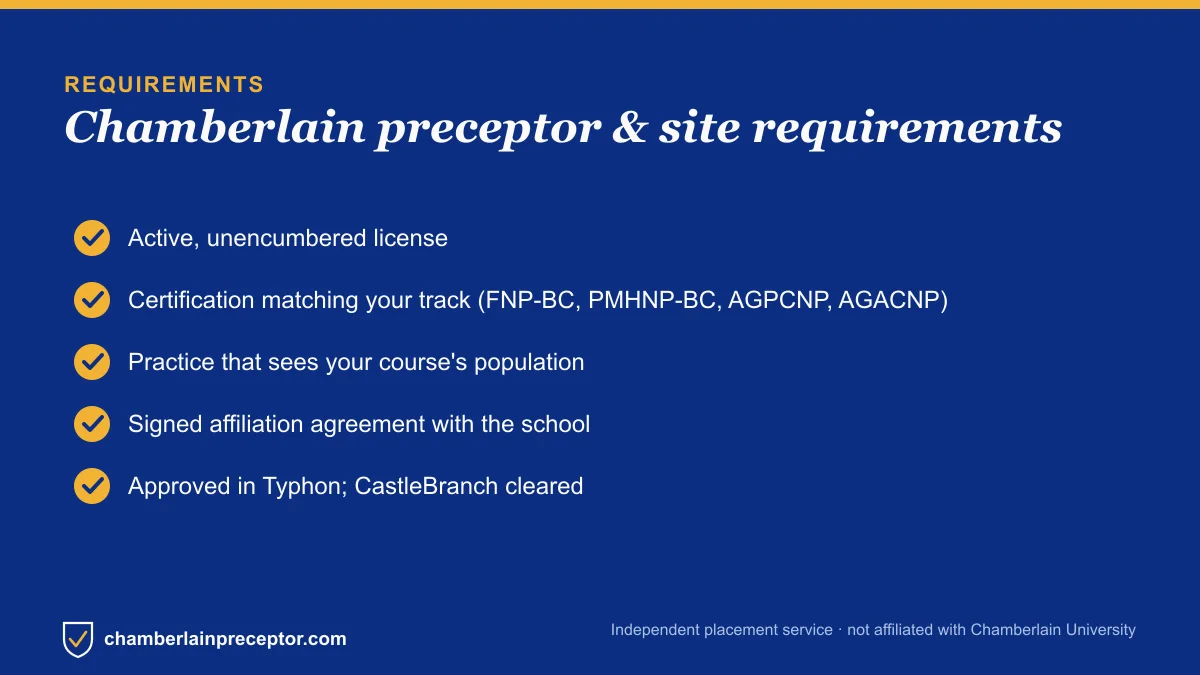
Chamberlain accepts nurse practitioners, physicians (MD or DO), and physician assistants as preceptors, depending on the course and the student's track. The essentials are an active, unencumbered license, real practice experience, and a clinical setting that matches the course objectives. An FNP student in a primary care course needs a primary care setting; a PMHNP student needs psychiatric practice.
Final approval always rests with Chamberlain, which reviews every nomination through Typhon. The program holds HLC and CCNE accreditation, which is why the vetting is thorough rather than a formality. The full picture, including per-track detail, is on our preceptor requirements page.
The honest time cost
Anyone who tells you precepting costs nothing is selling something. Here is the realistic shape of it.
The first week or two slow you down. The student is learning your charting, your patient flow, and your expectations, and visits take longer while they present findings and you confirm them. By mid-course, a well-matched student previews charts before clinic, presents concisely, and drafts notes for your review, and many preceptors find the day runs close to normal speed.
The recurring commitments are small: approving Typhon logs takes minutes on a regular rhythm, evaluations are short structured forms at set points in the course, and the student's Chamberlain faculty member may check in during the term. The habit that makes the biggest difference is a few minutes of debrief at the end of each clinic day. If your schedule genuinely cannot absorb a slower first fortnight, it is better to say no than to under-supervise, and we would rather hear that than place a student badly.
Why clinicians say yes
Teaching sharpens practice
Explaining your reasoning out loud, case after case, keeps your own clinical thinking current. Most longtime preceptors name this first.
The pipeline runs through you
Every practicing NP trained under a clinician who said yes. Preceptor scarcity, not classroom seats, is the tightest constraint in NP education right now.
A months-long working interview
A practicum shows you how a future colleague actually works, thinks, and treats patients. Practices that precept meet their best hires this way.
Recertification credit
AANPCB allows precepting to replace up to 25 non-pharmacology CE credits toward NP recertification, with a maximum of 120 preceptor hours converted. See the conversion table in the Recertification Handbook.
A further note for clinicians in certain states: Georgia, Maryland, and Colorado operate preceptor tax credit programs, generally for uncompensated precepting, each with its own eligibility rules and caps. Check your state's program page before counting on it.
Join our preceptor network
Chamberlain students are responsible for finding their own preceptors, which is why cold calls and messages may already reach your practice. We make that traffic orderly.
Tell us once that you are open to a student. We keep your specialty, schedule, patient volume, and preferred cadence on file, and we only bring you students who match your setting and arrive with paperwork already moving. You review each request, you accept course by course, and there is no standing obligation. You can read how the matching process works from the student side at how it works.
If you are ready, or just curious what a first placement would look like, start with the consult form or reach us through the contact page. A short conversation about your practice is all it takes to get listed.
Answered.
Do I have to be a nurse practitioner to precept a Chamberlain student?
No. Chamberlain accepts NPs, physicians (MD or DO), and physician assistants as preceptors, depending on the course and the student's track. What matters most is an active, unencumbered license and a practice setting that matches the course objectives. Details by track are on our preceptor requirements page.
How many hours would a student spend with me?
An MSN-FNP practicum course is 125 supervised hours, completed over the course term on a schedule you and the student agree on. The FNP program totals 625 hours across five courses, but you commit one course at a time. PMHNP, AGPCNP, and AGACNP courses run in 7-week blocks with hours set by the student's program of study.
What is Typhon, and how much work is it for me?
Typhon is Chamberlain's practicum portal. The student uses it to nominate you as their preceptor and to log hours and cases during the course. Your part is supplying a CV and license details at nomination, then approving logged entries and completing short evaluations. Once the course is running, it is minutes at a time, not hours.
Does my clinic need a contract with Chamberlain University?
Yes. An affiliation agreement between your site and the university must be in place before the student can start, and it is required per site. If your practice has hosted a Chamberlain student before, an agreement may already exist. If not, route the document to whoever signs contracts early, because this step takes the longest.
Is precepting paid?
We do not promise payment or quote figures, and any clinician should be wary of a service that does. What we can point to concretely: AANPCB recertification credit for precepting, preceptor tax credit programs in some states, and the practical value of a working interview with a potential hire. Bring the question to a consult and we will be straight with you about your situation.
Get your Chamberlain practicum handled.
A free placement review. No payment until you're matched. Tell us your track and term, and we map the whole placement.