Chamberlain NP Preceptor Placement Across Arizona
Arizona grants nurse practitioners full practice authority, and that shapes your practicum search here in mostly good ways. This page covers what the Arizona State Board of Nursing expects, where Chamberlain students actually find preceptors across the state, and how our team runs the search for you from day one.
Start your Chamberlain placement
Start your placement
A free placement review. No payment until you're matched.
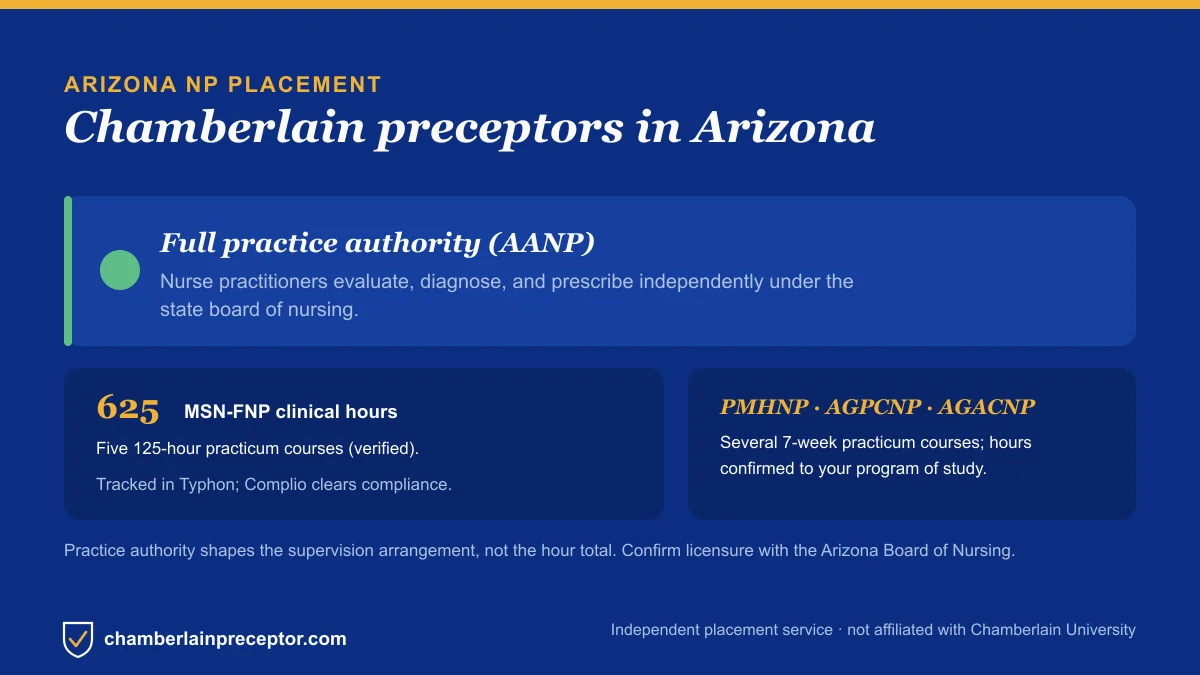
Full practice authority, and what it changes for you
The AANP classifies Arizona as a full practice state. Licensed NPs here evaluate patients, diagnose, order and interpret diagnostic tests, and initiate and manage treatments, including prescribing medications and controlled substances, under the exclusive licensure authority of the Arizona State Board of Nursing.
No collaborative agreement. No physician supervision requirement written into your practice authority. Arizona was among the earlier states to adopt this model, so it is mature here: NP-owned primary care practices, NP-led behavioral health clinics, and NP-staffed rural health centers are ordinary parts of the state's care map, not experiments.
For a Chamberlain student, that matters in two practical ways. First, the pool of clinicians who can precept is deep, because NPs practicing independently work everywhere from Phoenix urgent care to solo practices in Yuma. Second, the professional ceiling you are training toward is visible in the exam room. Your preceptor is not routing decisions through a supervising physician, and you get to learn that decision-making rhythm firsthand.
Full authority belongs to licensed, certified NPs. As a student you practice under your RN license and your preceptor's supervision, the same as in any state.
The Arizona State Board of Nursing, in brief
The Arizona State Board of Nursing (AZBN) at azbn.gov governs nursing in the state: RN and LPN licensure, advanced practice certification, nursing education program approval, and discipline. Arizona certifies you as a registered nurse practitioner in your role and population focus on top of your RN license.
- RN license first. Certification requires a current Arizona RN license in good standing, or an RN license with multistate privileges from another Nurse Licensure Compact state. Arizona participates in the compact, which helps students who live near a border.
- Graduate education plus national certification. You must complete a qualifying graduate NP program and hold national certification in the role and population focus you intend to practice.
- Prescribing is its own step. Prescribing and dispensing privileges are requested separately and carry recent pharmacology coursework requirements.
Requirements change. Treat azbn.gov as the source of record for applications, forms, and license verification, and confirm anything time-sensitive directly with the board.
Where Chamberlain students actually match in Arizona
Phoenix and the Valley
Phoenix, Mesa, Chandler, Gilbert, Scottsdale, Glendale, Tempe, and Peoria hold most of the state's clinical volume: family practice groups, urgent care, community health centers, and a dense behavioral health network for PMHNP students.
Tucson and the south
Tucson offers community health centers plus internal medicine and geriatrics settings suited to AGNP tracks, with border-region clinics in Sierra Vista, Nogales, and Yuma where preceptors see remarkable case variety.
Northern and western Arizona
Flagstaff, Prescott, Kingman, and Lake Havasu City run leaner. NP-owned practices and rural health clinics carry much of the primary care load, which makes for strong teaching sites, and for preceptors whose calendars fill early.
Here is the Chamberlain reality behind all of it: the university expects you to secure your own preceptor, then nominate the site and preceptor in Typhon for approval. The Practicum Commitment, through the Experiential Learning Team, steps in only after you document three preceptor denials. Nothing about that structure is hidden, but plenty of students discover it the hard way, one unanswered email at a time, with a semester deadline closing in.
We run the search from denial zero instead. Our coordinators contact Arizona sites directly, confirm eligibility against your course requirements, and hand you a preceptor ready for Typhon nomination. Already stuck? Start with what to do when you cannot find a preceptor.
Practicum requirements, program by program
| Program | Clinical structure |
|---|---|
| MSN-FNP | 625 supervised clinical hours across five 125-hour practicum courses |
| PMHNP | Several 7-week practicum courses; hours confirmed to your program of study |
| AGPCNP and AGACNP | Several 7-week practicum courses; hours confirmed to your program of study |
| DNP | Scholarly-project site and mentor rather than a stated hour total |
Every Arizona placement also clears three administrative gates: your Typhon nomination must be approved, your Complio compliance file must be complete (background check, drug screen, immunizations), and Chamberlain must hold an affiliation agreement with the site. New agreements take time to execute, so a site that has never hosted a Chamberlain student needs a longer runway than one that has. The full checklist lives at Chamberlain preceptor requirements.
Virtual or in person?
Telehealth is a routine part of Arizona care delivery, and some practicum experiences can happen virtually. Whether telehealth hours count toward a given course depends on your program, not the state, so confirm with Chamberlain before nominating a virtual site. Many students blend a telehealth preceptor with an in-person site to keep hours moving.
Spend the semester learning, not cold-calling
You can absolutely find an Arizona preceptor on your own, and this page is meant to help you do exactly that. If you would rather hand off the outreach, we offer a free placement review, you pay only when matched, and we work under a 14-day match commitment. See how it works and what it costs, or request your free placement review and tell us your course and target start date.
Answered.
Is Arizona a full practice authority state for NPs?
Yes. The AANP State Practice Environment lists Arizona as a full practice state, meaning licensed NPs evaluate patients, diagnose, order and interpret tests, and manage treatment including prescribing, under the sole authority of the Arizona State Board of Nursing. As a student you still train under your preceptor's supervision.
Who can serve as my preceptor in Arizona?
Eligibility is set by your Chamberlain course, not by the state. Depending on the course and population focus, your preceptor may be a nurse practitioner, a physician, or another qualified clinician, and every preceptor must pass Typhon nomination review. The details are collected at Chamberlain preceptor requirements.
When will Chamberlain find a preceptor for me?
Only after the 3-denial rule is met: you must document three preceptor denials before the Practicum Commitment, through the Experiential Learning Team, engages. That help arrives late in the game, which is why we start searching from denial zero. Close to a deadline? See need a preceptor fast.
Do I need an Arizona RN license for practicum?
You practice under your RN license during practicum, so it must be valid in Arizona, either an Arizona license or multistate privileges under the Nurse Licensure Compact. Confirm current requirements with the board at azbn.gov and with your program before your first clinical day.
How fast can you place me in Arizona?
We work under a 14-day match commitment once your free placement review is complete, and you pay only when matched. Phoenix and Tucson usually move fastest because the site pool is deepest. Start with the placement review form on this page.
Get your Chamberlain practicum handled.
A free placement review. No payment until you're matched. Tell us your track and term, and we map the whole placement.