Finding a Chamberlain NP Preceptor in Arkansas
Arkansas licenses nurse practitioners under a reduced practice model, so most of the NPs who could precept you keep a collaborative practice agreement on file with the state. Here is how those rules, the Arkansas State Board of Nursing, and your Typhon nomination fit together, and how Chamberlain students get matched here without weeks of cold calls.
Start your Chamberlain placement
Start your placement
A free placement review. No payment until you're matched.
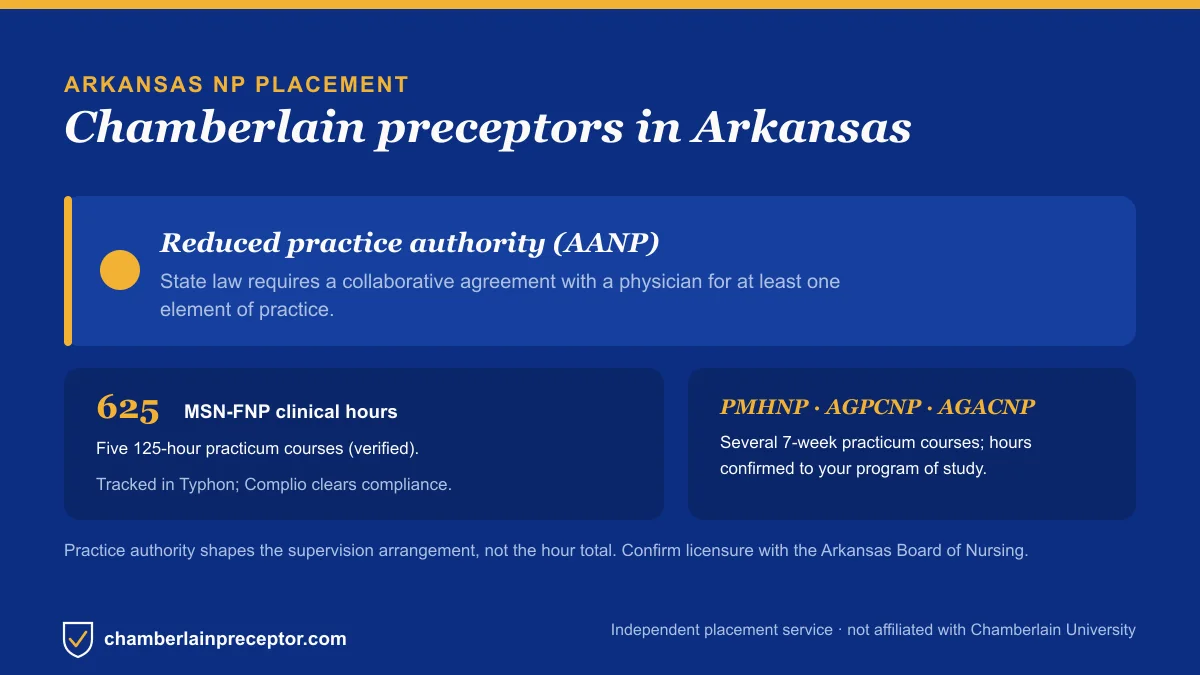
Reduced practice in Arkansas, in plain terms
The AANP lists Arkansas as a reduced practice state. Nurse practitioners here evaluate patients, diagnose, order and interpret tests, and manage treatment, but prescribing runs through a collaborative practice agreement, a CPA, with an Arkansas licensed physician.
The collaborating physician does not sit in the clinic reading charts over anyone's shoulder. The CPA is a filed document that describes the relationship, the specialty overlap, and a quality assurance plan, and the board must approve it before the NP prescribes under it. Day to day, an Arkansas NP visit looks the way it looks in most states: the NP owns the encounter.
Arkansas also built an exit ramp. Act 412 of 2021 lets certified nurse practitioners apply for full independent practice after 6,240 practice hours under a CPA, credentialed through the board's Full Independent Practice Credentialing Committee. So the preceptor pool you are drawing from includes CPA-based NPs and fully independent ones, alongside physicians.
For a Chamberlain student, none of this changes your practicum structure. It changes the character of the sites you will train in, and it is worth understanding before you interview a potential preceptor.
The Arkansas State Board of Nursing
Arkansas places its nursing board inside the Arkansas Department of Health, so the board's pages live on the department website rather than a standalone domain. The Arkansas State Board of Nursing licenses RNs and APRNs, approves collaborative practice agreements, and administers prescriptive authority, which in Arkansas is a separate application rather than an automatic part of the APRN license.
- Licensure, renewals, and CPA submissions run through the Arkansas Nurse Portal.
- APRNs keep current national certification on file with the board to hold an active license.
- Arkansas participates in the Nurse Licensure Compact for RNs, which matters if you hold a multistate RN license. Confirm your own licensure situation with the board.
As a student you will not file any of this yourself, but your preceptor's license status is something you can verify through the board before you nominate them in Typhon. Ten minutes of checking beats a rejected nomination.
Where placements actually happen in Arkansas
Chamberlain students secure their own preceptors. You find the clinician, they agree, you nominate them in Typhon, and the site signs an affiliation agreement with the university. Chamberlain's Experiential Learning Team steps in through the Practicum Commitment only after three documented preceptor denials, which makes it a late backstop when a course start is bearing down on you. We run the search from denial zero instead, so the 3-denial clock never becomes your plan.
Central Arkansas
Little Rock, North Little Rock, and Conway hold the state's densest cluster of clinics and health systems, with steady family practice and psychiatric outpatient volume.
Northwest corridor
Fayetteville, Springdale, Rogers, and Bentonville form the fastest growing part of the state, and new clinics mean preceptors who have not been asked yet.
The rest of the map
Jonesboro, Fort Smith, Hot Springs, Pine Bluff, and the Delta lean on NP-led primary care, and community clinics there often welcome students.
Rural Arkansas is where reduced practice gets real. NPs anchor primary care in towns without a resident physician, practicing under CPAs with collaborators who may be a county away. Those clinics can be excellent FNP placements, high autonomy and a broad case mix, but the affiliation agreement takes longer when a site has never hosted a student. Start early, or hand the paperwork chase to us.
Chamberlain practicum requirements, seen from Arkansas
Your program's clinical structure is the same in Arkansas as anywhere Chamberlain places students. What changes locally is the paperwork chain around each site.
| Program | Clinical structure |
|---|---|
| MSN-FNP | 625 supervised clinical hours across five 125-hour practicum courses. See FNP placement. |
| PMHNP | Several 7-week practicum courses, hours confirmed to your program of study. See PMHNP placement. |
| AGPCNP and AGACNP | Several 7-week practicum courses, hours confirmed to your program of study. See AGPCNP and AGACNP. |
| DNP | A scholarly project site and mentor rather than a preceptored hour total. See DNP support. |
Every Arkansas site follows the same sequence: the preceptor agrees, you nominate the site and preceptor in Typhon, Chamberlain reviews the nomination, and an affiliation agreement is executed with the site. In parallel, Complio carries your compliance file, background check, drug screen, and immunizations, and Arkansas sites can stack their own onboarding on top. Full detail sits on our requirements page.
Virtual or in person in Arkansas
Telehealth is a normal part of Arkansas practice, especially for psychiatric care reaching the Delta and the Ozarks. Whether telehealth hours count toward a given practicum course is a program decision, not a state one, so confirm with your Chamberlain program before you accept a virtual-heavy site. Our default is in-person placement, with virtual as a deliberate choice where the course allows it.
If Arkansas is where you need a preceptor
We match Chamberlain NP students with vetted Arkansas preceptors, run the outreach, and keep the Typhon and affiliation paperwork moving. The placement review is free, you pay when matched, and we work under a 14-day match commitment. If a start date is close, see urgent placement, or begin at the consult form below. Pricing is on the cost page, and the whole process is laid out in how it works.
Answered.
Is Arkansas a full practice state for nurse practitioners?
No. The AANP classifies Arkansas as reduced practice, meaning prescribing requires a collaborative practice agreement with a physician. Act 412 of 2021 added a pathway to full independent practice for NPs who complete 6,240 hours under such an agreement, so you will meet both CPA-based and independent NPs across the state.
How many clinical hours does Chamberlain's FNP program require in Arkansas?
The MSN-FNP requires 625 supervised clinical hours across five 125-hour practicum courses, and that number does not change by state. PMHNP, AGPCNP, and AGACNP practicum hours are confirmed to your program of study. Details are on our requirements page.
Who can serve as my preceptor at an Arkansas site?
Preceptor eligibility is set by your Chamberlain course, and approval happens through your Typhon nomination, so check the course requirements before you commit to anyone. Arkansas fields physicians, CPA-based NPs, and fully independent NPs. We only propose preceptors who fit your specific course, see how it works.
What happens if Arkansas preceptors keep telling me no?
Chamberlain's Practicum Commitment brings in the Experiential Learning Team after three documented preceptor denials. That is real help, but it engages late. If you are already hearing no, or want to skip that stage entirely, our team runs the search from day one, see can't find a preceptor.
What does Arkansas placement cost with your service?
The placement review is free, and you pay when matched. We work under a 14-day match commitment, and pricing is published on the cost page. If your practicum start is close, ask about urgent placement.
Get your Chamberlain practicum handled.
A free placement review. No payment until you're matched. Tell us your track and term, and we map the whole placement.