Find a California Preceptor as a Chamberlain NP Student
California certifies nurse practitioners through its Board of Registered Nursing and still ties most NP practice to physician-linked standardized procedures, so preceptored hours here come with real structure. Here is how Chamberlain students land FNP, PMHNP, AGPCNP, AGACNP, and DNP placements across the state, and how we shorten the search.
Start your Chamberlain placement
Start your placement
A free placement review. No payment until you're matched.
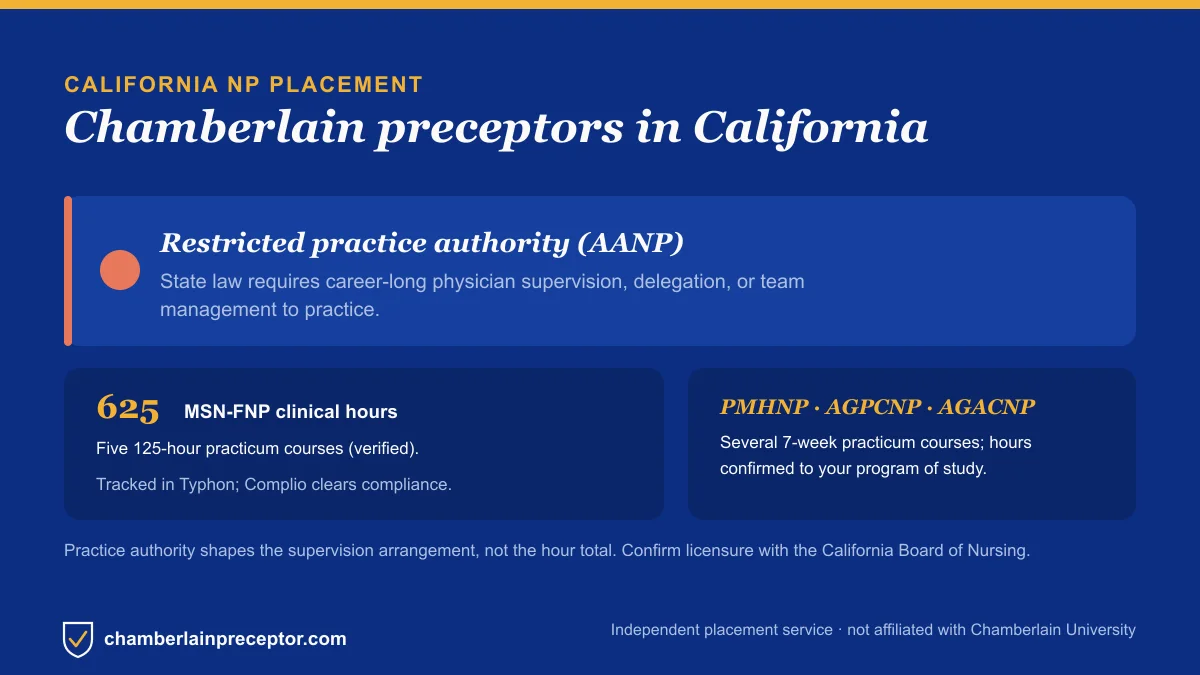
California is a restricted practice state. Here is what that means
The AANP classifies California as restricted: state law requires career-long supervision, delegation, or team management by another health provider for standard NP practice. Most California NPs work under standardized procedures, written protocols developed with a physician and the facility, and they prescribe under a BRN furnishing number tied to those procedures.
Assembly Bill 890 opened two newer paths. A 103 NP may practice without standardized procedures inside a group setting that includes at least one physician, after a transition to practice of three full-time years or 4600 hours. A 104 NP may practice outside a group setting after three more years in good standing as a 103 NP. None of this changes your student role: as a Chamberlain practicum student you always work under an approved preceptor, and California sites read supervision paperwork closely.
For placement purposes, restricted status cuts two ways. Because physician oversight is built into daily practice, many California clinics already host learners and understand precepting. It also means an NP who wants to take you on works inside employer protocols, so the practice itself usually has a formal say. Expect site-level signoff, not just a willing preceptor.
Where placements actually happen in California
California is enormous, and the preceptor market changes character by region. Knowing where to aim saves weeks.
Southern California
Los Angeles, Long Beach, Orange County, San Diego, and the Inland Empire around Riverside and San Bernardino hold the deepest bench of primary care and psychiatric practices, but competition from local NP programs is fierce. Start early and cast wide.
Bay Area and Sacramento
San Francisco, Oakland, San Jose, and Sacramento are dominated by large health systems where credentialing and affiliation paperwork move slowly. A strong lead time matters more than a long list of contacts here.
Central Valley and the north
Fresno, Bakersfield, Modesto, and communities up through Redding lean on community clinics and health centers that genuinely need NP help. Preceptors here often say yes faster, especially for FNP students.
Chamberlain expects you to secure your own preceptor, then nominate the site and preceptor in Typhon for approval. The university's Practicum Commitment, through the Experiential Learning Team, engages only after three documented preceptor denials. We run the California search from day one instead, so the 3-denial rule becomes a backstop you never need.
The Board of Registered Nursing, in practice
Nurse practitioners in California are certified by the Board of Registered Nursing (BRN), part of the Department of Consumer Affairs. The BRN issues RN licenses and NP certification, grants the furnishing number that lets an NP order drugs and devices under standardized procedures, and publishes the practice explanations most clinics rely on when they ask what a student may and may not do.
- Verify any California RN or NP through the Department of Consumer Affairs license search, useful when you are vetting a potential preceptor.
- California does not participate in the Nurse Licensure Compact, so plan on holding an active California RN license before logging clinical hours in the state. Confirm the exact requirement with your program and the BRN.
- The BRN's AB 890 page explains 103 and 104 NP status if a preceptor mentions practicing without standardized procedures.
Chamberlain practicum requirements, viewed from California
The program structure travels with you no matter which state you sit in. What changes in California is the paperwork gravity around it.
| MSN-FNP hours | 625 supervised clinical hours across five 125-hour practicum courses. See the FNP placement page. |
|---|---|
| PMHNP, AGPCNP, AGACNP | Several 7-week practicum courses; hours are confirmed to your program of study. See PMHNP, AGPCNP, and AGACNP. |
| DNP | A scholarly-project site and mentor rather than a set hour total. See DNP preceptor help. |
| Typhon | Nominate your California site and preceptor in Typhon and wait for approval before hours count. |
| Complio | Compliance onboarding: background check, drug screen, and immunization records. |
| Affiliation agreement | Required between Chamberlain and each California site before you begin. |
Enrollment and clinical placement availability can change by state. Confirm your eligibility to complete practicum hours in California with Chamberlain and the BRN before you commit to a site. The full checklist lives on our requirements page.
Virtual or in person
Telehealth is woven deeply into California care delivery, and some practicum experiences can include virtual visits alongside your preceptor. Acceptability varies by course and population focus, so confirm with your program before counting on virtual hours. Most California students end up with a blend: an in-person home site plus telehealth days that reflect how the clinic actually runs.
Ready when you are
If your Typhon deadline is closing in and the cold emails are going nowhere, we can take the search off your plate. The placement review is free, you pay only when matched, and we work under a 14-day match commitment. See how it works and what it costs, or request your free California placement review now.
Answered.
Is California a full practice state for nurse practitioners?
No. The AANP classifies California as a restricted practice state, meaning standard NP practice requires career-long physician involvement through standardized procedures. AB 890 created 103 and 104 NP pathways toward practice without standardized procedures after a supervised transition period, but as a student you always train under an approved preceptor either way.
Do I need a California RN license before starting clinicals there?
California does not participate in the Nurse Licensure Compact, so an out-of-state RN license generally will not cover you. Plan on an active California RN license before logging hours, and confirm the specifics with the Board of Registered Nursing and your program.
How many clinical hours will I complete in California as a Chamberlain FNP student?
The MSN-FNP program requires 625 supervised clinical hours across five 125-hour practicum courses, wherever you live. PMHNP, AGPCNP, and AGACNP students complete several 7-week practicum courses with hours confirmed to the program of study. Details are on our FNP page.
What happens if three California preceptors turn me down?
After three documented denials, Chamberlain's Practicum Commitment through the Experiential Learning Team can assist with your search. That help arrives late in the timeline, which is why we start from denial zero. If you are already stuck, see what to do when you cannot find a preceptor.
Does my California site need an affiliation agreement with Chamberlain?
Yes. Every site needs an affiliation agreement with Chamberlain before you begin, on top of your Typhon nomination and Complio compliance clearance. California health systems can be slow to countersign, so build in lead time. Our requirements page walks through each step.
Get your Chamberlain practicum handled.
A free placement review. No payment until you're matched. Tell us your track and term, and we map the whole placement.