Finding a Chamberlain Preceptor in Colorado, a Full Practice State
Colorado gives nurse practitioners full practice authority, which widens the preceptor pool for Chamberlain students but does not make the search easy along the crowded Front Range. Here is how practicum placement works in Colorado, and how we run the search for you from day one.
Start your Chamberlain placement
Start your placement
A free placement review. No payment until you're matched.
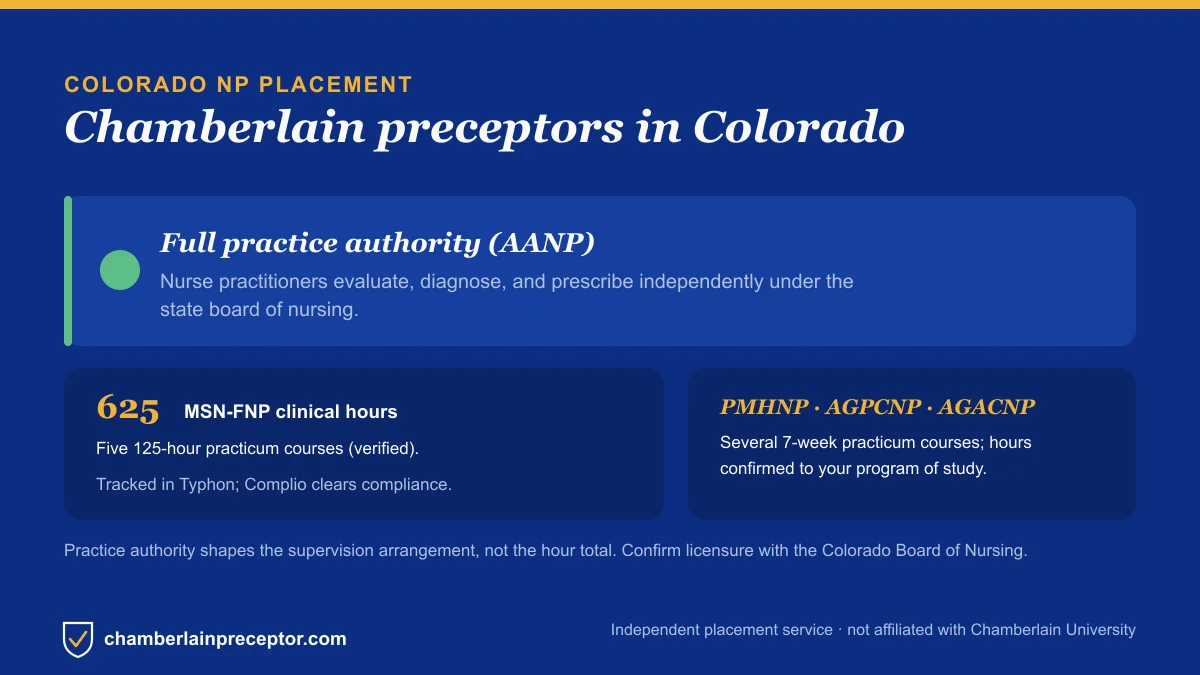
Colorado is a full practice state, and it shapes your search
The American Association of Nurse Practitioners lists Colorado as a full practice state. Licensure law lets NPs evaluate patients, diagnose, order and interpret diagnostic tests, and initiate and manage treatments, including prescriptions, under the exclusive authority of the state nursing board.
For a Chamberlain student, that changes who can say yes to you. In restricted states, most precepting happens inside physician led clinics. In Colorado, experienced NPs run their own family practices, psychiatric clinics, and telehealth panels, and many of them precept. Your potential preceptor list includes independent NP owned practices in Denver, Colorado Springs, and Fort Collins, not just the big hospital systems.
One Colorado wrinkle worth knowing: prescriptive authority is a separate credential here, and newly registered advanced practice nurses complete a defined mentorship period before they prescribe fully on their own. That does not affect your student rotations, but it is part of the licensure picture waiting for you after graduation, and the Board of Nursing publishes the current requirements.
Who regulates NPs in Colorado
The Colorado Board of Nursing sits inside the Division of Professions and Occupations at the Department of Regulatory Agencies, which locals shorten to DORA. The board licenses registered nurses, maintains the Advanced Practice Registry, and processes prescriptive authority applications.
- APRN structure. Colorado does not issue a standalone APRN license. Advanced practice recognition rides on your Colorado RN license through the registry, so the RN underneath it has to stay current.
- Verification. DORA runs an online license lookup. Use it to confirm a prospective preceptor's credential before you nominate them, and to check your own record when licensure time comes.
- Forms and questions. Advanced Practice Registry and prescriptive authority applications live on the board's site at dpo.colorado.gov/Nursing.
Chamberlain reviews preceptor eligibility during nomination, but a two minute DORA lookup before you ask can save you a wasted request.
Where placements actually happen in Colorado
Most Coloradans live along the Front Range, and that is where preceptor competition is sharpest. Several universities place NP students into the same Denver metro clinics, so the strongest preceptors book their calendars two or three terms ahead.
Front Range corridor
Denver, Aurora, Lakewood, Boulder, Colorado Springs, Pueblo, Fort Collins, and Greeley hold the deepest bench of family practice, psychiatric, and acute care sites, and the longest waiting lists.
Western Slope
Grand Junction, Montrose, and Durango run on smaller networks where a warm introduction matters more than a cold email. Fewer students compete here, and sites remember reliable ones.
Mountain and rural Colorado
The San Luis Valley, the Eastern Plains, and the high country are shortage areas where clinics often welcome students, and where telehealth already carries part of the visit load.
Chamberlain expects you to secure your own preceptor and nominate the site in Typhon. The university's Practicum Commitment, run through the Experiential Learning Team, assists only after three documented preceptor denials. That backstop is real, but it engages late in the timeline. We start outreach from denial zero, so the 3 denial rule stays a safety net you never have to use.
Chamberlain practicum requirements, seen from Colorado
Wherever in the state you rotate, the program structure is the same.
| Program | What placement looks like |
|---|---|
| MSN-FNP | 625 supervised clinical hours across five 125 hour practicum courses, each needing an approved site and preceptor. |
| PMHNP | Several 7 week practicum courses. Total hours are confirmed to your program of study. |
| AGPCNP and AGACNP | Several 7 week practicum courses with hours confirmed to the program of study, in primary or acute adult gerontology settings. |
| DNP | A scholarly project site and mentor rather than a course by course hour total. |
Before your first hour counts, three things must be in place: an approved Typhon nomination, a clear Complio record covering the background check, drug screen, and immunizations, and an affiliation agreement between Chamberlain and the site. Colorado's large health systems often have agreements on file already. A small independent clinic in Alamosa or Craig may be starting from zero, which can add weeks. The full checklist is on our Chamberlain preceptor requirements page.
Virtual visits and Colorado rotations
Telehealth is woven into Colorado care, especially across the mountains and the Eastern Plains where the nearest specialist can be hours away. Some preceptors see a meaningful share of their panel by video, and a rotation that includes virtual visits can be a lifeline if you live far from the Front Range.
Whether virtual hours count toward a specific practicum course varies by program and course. Confirm with your Chamberlain program before you build a rotation around telehealth, and treat in person hours as the default plan.
Get matched in Colorado
If your Typhon nominations keep stalling or Denver clinics have stopped answering, you do not have to wait for three denials to get help. We run a free placement review, you pay only when matched, and our match commitment is 14 days. Tell us your program, your courses, and where in Colorado you can rotate, and we take the search from there. Start at the consult form, or see how it works and what it costs first.
Answered.
Is Colorado a full practice state for nurse practitioners?
Yes. The AANP State Practice Environment map lists Colorado as full practice, meaning NPs evaluate, diagnose, order and interpret tests, and manage treatment, including prescriptions, under the Board of Nursing alone. New APRNs do complete a separate prescriptive authority process with a mentorship period, so check the board's current rules before you plan your first job.
How many clinical hours do Chamberlain FNP students complete in Colorado?
The MSN-FNP program requires 625 supervised clinical hours across five 125 hour practicum courses, and that total is the same in every state. PMHNP, AGPCNP, and AGACNP students complete several 7 week practicum courses, with hours confirmed to the program of study.
What happens after three preceptor denials at Chamberlain?
After three documented denials, Chamberlain's Practicum Commitment through the Experiential Learning Team assists with the search. That help arrives late in the term clock, which is why many students ask us to run the search from day one instead of waiting to qualify for the backstop.
Does my Colorado clinical site need an affiliation agreement?
Yes. Every site needs an affiliation agreement with Chamberlain, on top of an approved Typhon nomination and a complete Complio compliance record. Large Colorado systems often have agreements on file, while small independent clinics need extra lead time. Details are on the requirements page.
Can I complete Chamberlain practicum hours by telehealth in Colorado?
Sometimes. Telehealth is common in rural Colorado, and some rotations include virtual visits, but whether those hours count varies by program and course. Confirm with your Chamberlain program first, and treat in person hours as the default.
Get your Chamberlain practicum handled.
A free placement review. No payment until you're matched. Tell us your track and term, and we map the whole placement.