Preceptor Placement Across Connecticut for Chamberlain NP Students
Connecticut gives nurse practitioners full practice authority, and its clinical map runs from academic medicine in New Haven to solo primary care offices in the Quiet Corner. Here is what that means for a Chamberlain MSN or DNP student who needs a preceptor in the state, and how to keep the search from eating a semester.
Start your Chamberlain placement
Start your placement
A free placement review. No payment until you're matched.
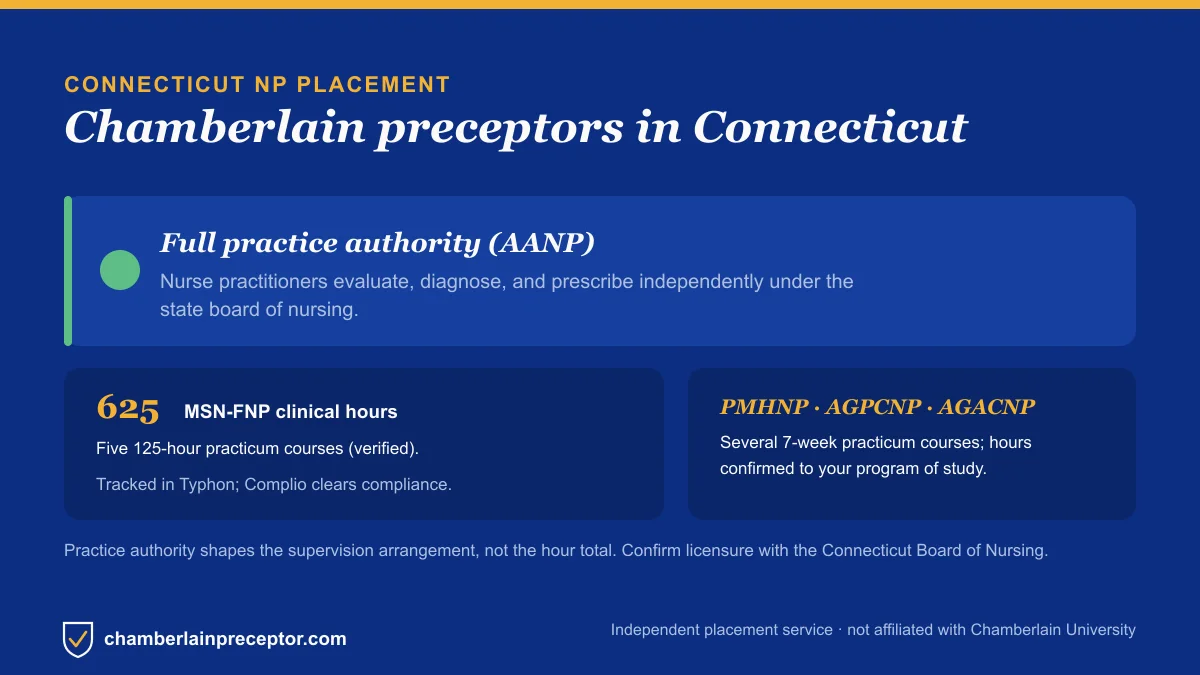
Full practice authority, with a Connecticut catch
The AANP classifies Connecticut as a full practice state. Licensed APRNs evaluate patients, diagnose, order and interpret tests, and manage treatment, including prescribing controlled substances, under the licensure authority of state nursing regulation.
There is one wrinkle worth knowing before you start emailing clinics. Connecticut phases independence in. A newly licensed APRN spends the first three years, and at least 2,000 practice hours, working in collaboration with a Connecticut-licensed physician, and the prescriptive side of that collaboration is spelled out in a written agreement. Once past that threshold, the APRN may practice alone. The Department of Public Health lays out both stages on its APRN practice pages.
For a Chamberlain student this cuts two ways, both of them useful. The transition rule means many early-career NPs still work beside physicians, so practices are used to structured oversight and often welcome learners. And the experienced end of the market includes NPs who run their own panels or own their practices outright, which stretches the preceptor pool well beyond the big hospital systems.
Who regulates NPs in Connecticut
Two bodies share the work. The Connecticut Department of Public Health issues and renews APRN licenses, while the Board of Examiners for Nursing sets standards of practice and hears disciplinary matters. If you or your preceptor need to confirm a credential, the Department's online license lookup is the place to check standing before anything goes into Typhon.
To hold an APRN license, Connecticut requires a current state RN license, a graduate degree in nursing or a related recognized field, national certification in the role, and thirty hours of pharmacology education for advanced practice. None of that is your burden as a student, but it shapes who can precept you, so it pays to verify early rather than after a denial.
Where Chamberlain students actually find preceptors here
Connecticut is small enough to drive across in two hours, which is a quiet advantage. A student in Meriden can realistically consider sites in three metro areas at once.
Hartford and the river valley
Hartford, New Britain and Middletown carry large primary care and specialty networks, plus community health centers that host students regularly. Family practice and adult-gerontology sites cluster here.
New Haven and the shoreline
Academic medicine anchors New Haven, and the shoreline towns from Milford out to New London add independent practices. Competition for slots is real near the teaching hospitals, so ask early.
Fairfield County
Stamford, Bridgeport, Norwalk and Danbury form a dense suburban corridor. Behavioral health demand is high, which makes it fertile ground for PMHNP placements.
Waterbury, the northwest and the Quiet Corner
Waterbury, Torrington and the rural northeast around Putnam and Willimantic lean on community health centers and small offices. Fewer students compete here, and preceptors often say yes faster.
Now the Chamberlain reality. You are expected to secure your own preceptor and nominate the site and preceptor in Typhon for approval. Chamberlain's Practicum Commitment through the Experiential Learning Team steps in only after three documented preceptor denials, which is late in the game if your course start is fixed. Our service exists to close that gap: we run the Connecticut search from denial zero, so the 3-denial backstop never has to become your plan. See how the process works or what to do if you cannot find a preceptor.
Chamberlain practicum checkpoints, viewed from Connecticut
| MSN-FNP | 625 supervised clinical hours across five 125-hour practicum courses, the same total in every state. |
|---|---|
| PMHNP, AGPCNP, AGACNP | Several 7-week practicum courses, with hours confirmed to your specific program of study. |
| DNP | A scholarly-project site and mentor rather than a traditional preceptor arrangement. |
| Typhon | Chamberlain's practicum portal. Site and preceptor nomination happens here, and so does hour logging once you start. |
| Complio | Compliance onboarding: background check, drug screen and immunization records, all cleared before day one at a Connecticut site. |
| Affiliation agreement | Required between Chamberlain and each site. Connecticut health systems process these at their own pace, so build in lead time. |
Full detail on preceptor eligibility lives on our Chamberlain preceptor requirements page.
Virtual or in person
Telehealth is an ordinary part of Connecticut practice now, especially in behavioral health, and some rotations can include virtual visit hours. Whether those hours count toward your practicum is a program-level decision, not a state one, so confirm with your Chamberlain program before accepting a telehealth-heavy site. We place for both formats and will tell you plainly which one a given site supports.
If the clock is already running
Connecticut is a friendly state for NP training, but friendly does not mean fast. If your practicum course start is close, request a free placement review. We search from day one, you pay only when matched, and our match commitment is 14 days. Students who need a preceptor fast can start there, and our pricing page explains the pay-when-matched terms.
Answered.
Is Connecticut a full practice state for nurse practitioners?
Yes. The AANP lists Connecticut as full practice. One nuance: newly licensed APRNs practice in collaboration with a Connecticut-licensed physician for their first three years and at least 2,000 hours, and may practice independently after that.
Can an independent Connecticut NP precept Chamberlain students?
Generally yes, provided they meet Chamberlain's preceptor eligibility rules for your course and pass Typhon review. Check our preceptor requirements page before nominating so a technicality does not cost you a denial.
How many clinical hours does Chamberlain's FNP program require in Connecticut?
The same as everywhere: 625 supervised clinical hours across five 125-hour practicum courses. Connecticut does not change the total. Details are on our FNP page.
What if every site I contact in Connecticut turns me down?
Chamberlain's Experiential Learning Team assists after three documented preceptor denials, which can land very close to your course start. We run the search from the first day instead. Start with a free placement review or read what to do when you cannot find a preceptor.
Do Connecticut sites accept telehealth practicum hours?
Some do, particularly in behavioral health, but whether virtual hours count is decided by your Chamberlain program of study. Confirm with your program first, then tell us the answer and we will match to a site that fits it.
Get your Chamberlain practicum handled.
A free placement review. No payment until you're matched. Tell us your track and term, and we map the whole placement.