Securing Your Chamberlain Practicum Preceptor in Florida
Florida trains and employs more nurse practitioners than almost any state, yet it remains a restricted-practice state where most APRNs work under a physician protocol. Here is how that affects your Chamberlain practicum, and how to line up a preceptor in Miami, Orlando, Tampa, or anywhere else in the state.
Start your Chamberlain placement
Start your placement
A free placement review. No payment until you're matched.
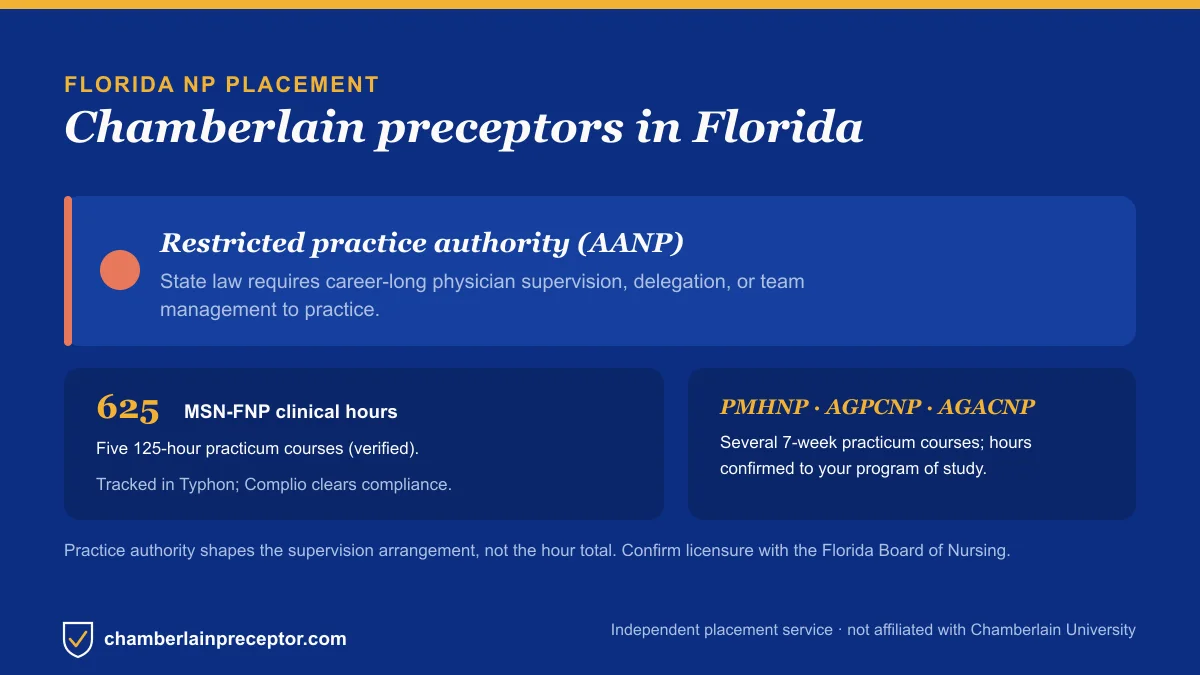
Florida is a restricted-practice state. Here is what that actually means
The American Association of Nurse Practitioners places Florida in its restricted-practice category. In plain terms, state law requires most Florida APRNs to practice under a written protocol with a supervising physician for the length of their career, rather than under the independent authority of the Board of Nursing alone.
Florida did carve out an exception in 2020. Under section 464.0123 of the Florida Statutes, an APRN can register for autonomous practice, but the pathway is narrow. It applies only to primary care, defined as family medicine, general pediatrics, and general internal medicine, and it requires at least 3,000 clinical hours completed under physician supervision within the previous five years, plus graduate coursework in differential diagnosis and pharmacology. Everyone else, including most specialty NPs, continues to practice under a protocol.
For a Chamberlain student, this shapes your practicum in two practical ways. First, nearly every NP who could precept you in Florida works inside a supervisory structure, so site paperwork sometimes involves the collaborating physician as well as the preceptor. Second, none of this changes what Chamberlain requires of you. The hour targets, the Typhon nomination, and the affiliation agreement are the same whether your preceptor practices under a protocol in Hialeah or holds autonomous registration in a Lakeland family practice.
The Florida Board of Nursing
The Florida Board of Nursing operates within the Florida Department of Health. It licenses RNs and APRNs, approves nursing education programs, sets practice rules, and handles discipline. Nurse practitioners are licensed as APRNs on the strength of a graduate degree and national certification, and the autonomous registration described above is a separate add-on credential, not a different license.
- Board site: floridasnursing.gov, with dedicated APRN licensure pages and application checklists.
- License verification: the Department of Health license lookup, linked from the board site, lets you confirm that a prospective preceptor holds a clear, active Florida license.
- Questions about protocols or autonomous registration belong to the board, so point site administrators there rather than guessing.
Verifying a preceptor's license before you nominate them in Typhon saves real time. A lapsed or encumbered license is one of the quieter reasons nominations stall.
Finding a preceptor in Florida without burning weeks
Chamberlain students secure their own preceptors. You search, you ask, and once someone agrees, you nominate the site and preceptor in Typhon for approval. Chamberlain's Experiential Learning Team steps in through the Practicum Commitment only after you document three preceptor denials, which is the 3-denial rule. That backstop exists, but it engages late, and in a market like Florida the waiting is the expensive part.
Florida's size cuts both ways. There are thousands of potential preceptors, and there are also more than a dozen NP programs competing for them. Here is how the search tends to feel by region.
South Florida
Miami, Fort Lauderdale, and West Palm Beach have deep clinician pools but heavy competition from local programs. Bilingual practices are often open to students who ask directly.
Central Florida
Orlando, Kissimmee, Lakeland, and Daytona Beach mix large health systems with independent primary care. System sites usually route students through formal placement offices.
Tampa Bay
Tampa, St. Petersburg, Clearwater, and Sarasota offer strong family practice and psych coverage, with affiliation paperwork that moves at each system's own pace.
Northeast Florida
Jacksonville, Gainesville, and Ocala combine academic health centers with community clinics that are often more approachable for first practicum courses.
Southwest Florida
Fort Myers, Naples, and Port Charlotte skew toward adult and geriatric primary care, a good fit for FNP and AGPCNP rotations.
The Panhandle
Tallahassee, Panama City, and Pensacola have fewer sites overall, so starting the search early matters most here.
Our service exists to compress this. We run the outreach from denial zero, using a vetted network of Florida preceptors, and we work on a pay-when-matched basis with a 14-day match commitment. The review of your placement needs is free. If you have already collected denials, see what to do when you cannot find a preceptor.
Chamberlain practicum requirements, viewed from Florida
| Program | Clinical structure |
|---|---|
| MSN-FNP | 625 supervised clinical hours across five 125-hour practicum courses |
| PMHNP, AGPCNP, AGACNP | Several 7-week practicum courses, with hours confirmed to your program of study |
| DNP | Scholarly-project site and mentor rather than a preceptored hour total |
Whichever program you are in, the mechanics are the same. You clear compliance in Complio, covering the background check, drug screen, and immunizations, before you can begin hours. You nominate the site and preceptor in Typhon and wait for approval before logging anything. And Chamberlain must hold an affiliation agreement with each site where you train, which is often the slowest step with Florida hospital systems, so surface it early. The full checklist lives at Chamberlain preceptor requirements.
Virtual or in-person hours in Florida
Telehealth is well established in Florida practices, and some rotations can include virtual visits under your preceptor's supervision. Whether telehealth hours count, and how many, depends on your specific course and program, so confirm with your program before accepting a placement built around virtual care.
If you want the search off your plate
You can absolutely find a Florida preceptor on your own, and this page should make that search shorter. If you would rather not spend your study weeks cold-calling clinics from Pensacola to Homestead, tell us your program, courses, and city through the consult form. The review is free, you pay only when matched, and our commitment is a match within 14 days. Details on pricing are at our cost page, and the process is laid out under how it works.
Sources
Answered.
Is Florida a full-practice state for nurse practitioners?
No. AANP classifies Florida as restricted practice, meaning most APRNs work under a written protocol with a supervising physician. Florida does offer an autonomous practice registration, but it is limited to primary care and requires 3,000 supervised clinical hours within the previous five years plus specific graduate coursework. See the AANP State Practice Environment map for the current classification.
How many clinical hours does Chamberlain's MSN-FNP require in Florida?
The same as everywhere: 625 supervised clinical hours across five 125-hour practicum courses. Florida law does not change Chamberlain's totals. Our FNP placement page covers how those five courses map to preceptor types.
What does my Florida preceptor need before I can start hours?
A clear, active Florida APRN or physician license you can verify through the Department of Health lookup, an approved nomination in Typhon, and an affiliation agreement between Chamberlain and the site. You also need your own compliance cleared in Complio. The full list is at Chamberlain preceptor requirements.
I already have preceptor denials in Florida. What now?
Document each one. After three documented denials, Chamberlain's Experiential Learning Team assists through the Practicum Commitment. If you would rather not wait for that backstop, we run the search from your first denial, or before it, on a pay-when-matched basis. Start at need a preceptor fast or the consult form.
Can any of my practicum hours in Florida be telehealth?
Sometimes. Florida practices use telehealth widely, and some rotations include virtual visits under supervision. Whether those hours count toward your course depends on your program's rules, so confirm with Chamberlain before committing to a placement built around virtual care.
Get your Chamberlain practicum handled.
A free placement review. No payment until you're matched. Tell us your track and term, and we map the whole placement.