Illinois Preceptor Search Support for Chamberlain NP Students
Illinois is Chamberlain's home state, and it is also a reduced practice state where most nurse practitioners work under a written collaborative agreement. Here is how practice authority, IDFPR licensure, and Chamberlain's practicum process fit together when you are hunting for a preceptor anywhere from Chicago to Carbondale.
Start your Chamberlain placement
Start your placement
A free placement review. No payment until you're matched.
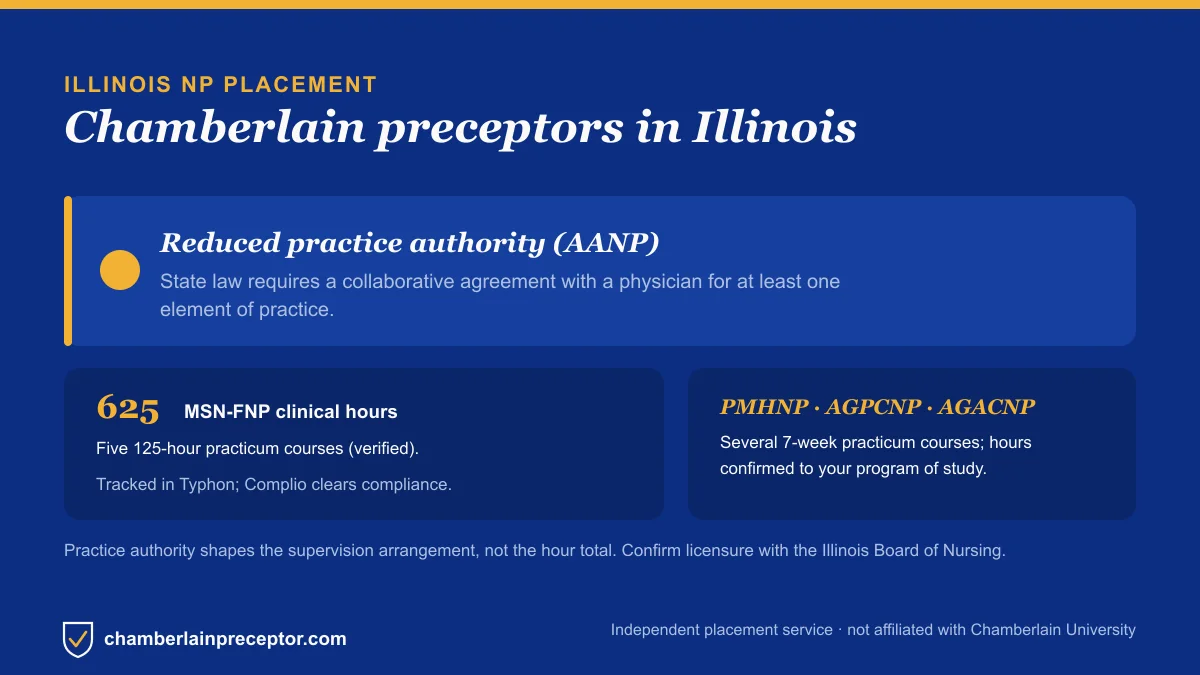
Where Illinois stands on practice authority
The American Association of Nurse Practitioners lists Illinois as a reduced practice state. In plain terms, state law trims at least one element of what an NP can do independently, and for most Illinois NPs that shows up as a written collaborative agreement with a physician.
Illinois also built an exit ramp. Experienced NPs can apply for a Full Practice Authority license, the APRN-FPA, after documenting at least 4,000 hours of clinical practice following national certification plus 250 hours of continuing education or training. An APRN-FPA practices without a collaborative agreement, though some controlled substance prescribing still carries extra conditions.
What does that mean for you as a student? Your coursework does not change, and your required hours stay exactly what Chamberlain publishes. What changes is the environment you train in. Your preceptors practice inside these structures every day, their clinics are used to agreements and oversight paperwork, and a site that already manages a collaborative agreement usually understands exactly what an affiliation agreement with a university involves.
IDFPR and the Illinois Board of Nursing
Nursing in Illinois is regulated by the Illinois Department of Financial and Professional Regulation, usually shortened to IDFPR, with a Board of Nursing operating under it. IDFPR issues the RN, LPN, APRN, and APRN-FPA licenses, along with the controlled substance designations NPs use to prescribe.
Verify before you nominate
IDFPR's public License Lookup shows the status of any Illinois nurse or physician license. Run your own RN license and your prospective preceptor's license through it before you submit a nomination in Typhon. A lapsed or restricted license discovered late can undo a placement weeks in the making.
Know your preceptor's category
An Illinois NP may hold a standard APRN license under a collaborative agreement or an APRN-FPA license with independent authority. Either way, what matters for your practicum is that the license is active, unrestricted, and appropriate for the specialty your course requires.
Finding a preceptor from Chicago to Carbondale
Illinois is home turf for Chamberlain, which is headquartered in Chicago, so the state has a deep bench of alumni NPs. That cuts both ways. Chicagoland has an enormous number of clinics, but it also has one of the densest concentrations of nursing students in the country, and popular primary care sites field preceptor requests weekly.
| Region | Placement picture |
|---|---|
| Chicago and suburbs | Huge volume of sites in the city plus Naperville, Schaumburg, Evanston, and Tinley Park, but heavy competition from multiple NP programs. |
| Rockford and the north | Community health systems and private practices with fewer competing students than the metro core. |
| Peoria, Bloomington, Springfield | Mid-size systems and independent clinics, with strong odds for FNP and PMHNP placements. |
| Champaign-Urbana and the east | College-town clinics plus rural counties where a willing preceptor may be the only NP for miles. |
| Metro East and southern Illinois | Belleville, Edwardsville, Carbondale, and Marion, where community clinics often welcome students. |
Chamberlain expects you to secure your own preceptor and enter the nomination in Typhon. The university's Practicum Commitment, through the Experiential Learning Team, steps in only after you document three preceptor denials. That is the 3-denial rule, and it means the official safety net engages late in the game. We work it the other way around: our team runs the Illinois search from denial zero, so you are not burning weeks collecting rejections to qualify for help. If the clock is already tight, start with our fast-track process or read what to do when you cannot find a preceptor.
Chamberlain practicum requirements, seen from Illinois
The requirements travel with the program, not the state, so an Illinois placement follows the same rules as anywhere else.
- MSN-FNP: 625 supervised clinical hours, completed across five 125-hour practicum courses.
- PMHNP, AGPCNP, and AGACNP: several 7-week practicum courses, with hours confirmed to your program of study.
- DNP: a scholarly-project site and mentor rather than a preceptored hour total.
Every Illinois site you train at needs an affiliation agreement with Chamberlain, and you clear compliance through Complio: background check, drug screen, and immunizations. Large Chicago health systems can add their own onboarding on top, and credentialing queues there run long, so a placement that looks settled on paper still needs lead time. Build a semester of runway when you can. The full checklist lives at Chamberlain preceptor requirements.
Virtual or in person in Illinois
Telehealth is a working reality across Illinois, especially for psychiatric care in the rural south and west of the state. Whether telehealth hours count toward a specific practicum course is a program-level decision, not a state one, so confirm with Chamberlain before you accept a virtual arrangement. In-person training remains the default for assessment-heavy courses, and a hybrid schedule anchored to one site is often the cleanest compromise.
If you want the search off your plate
We place Chamberlain NP students with vetted Illinois preceptors, we start the day you ask instead of after three denials, and you pay when matched, with a free placement review up front and a 14-day match commitment. See how it works and what it costs, or request your free placement review.
Answered.
Is Illinois a full practice state for nurse practitioners?
No. AANP classifies Illinois as a reduced practice state, and most Illinois NPs work under a written collaborative agreement with a physician. Illinois does offer a Full Practice Authority license, the APRN-FPA, to NPs who document 4,000 hours of post-certification clinical practice and 250 hours of continuing education or training. Details are on the IDFPR nursing page.
Who licenses nurse practitioners in Illinois?
The Illinois Department of Financial and Professional Regulation, IDFPR, which houses the state's Board of Nursing. Use IDFPR's License Lookup to verify your RN license and your preceptor's license before nominating a site in Typhon.
How many practicum hours does Chamberlain's FNP program require in Illinois?
625 supervised clinical hours, completed across five 125-hour practicum courses. The total is set by the program, not the state, so it is the same in Illinois as everywhere else. Other tracks such as PMHNP and AGACNP run several 7-week practicum courses with hours confirmed to your program of study. See our FNP placement page for details.
What if Chicago sites keep turning down my preceptor requests?
Chamberlain's Experiential Learning Team assists only after you document three preceptor denials. You do not have to wait that long for help. We begin searching from your first ask, across Chicagoland and downstate, and you pay when matched. Start at can't find a preceptor or book a free placement review.
Can I complete Chamberlain practicum hours through telehealth in Illinois?
Sometimes. Telehealth acceptance varies by course and is decided by your program, not by Illinois. Confirm with Chamberlain before committing to a virtual preceptor, and expect in-person expectations for assessment-heavy courses.
Get your Chamberlain practicum handled.
A free placement review. No payment until you're matched. Tell us your track and term, and we map the whole placement.