Find a Chamberlain Practicum Preceptor in Indiana
Indiana is a reduced practice state with a deep bench of primary care, psychiatric, and acute care sites from Indianapolis to Fort Wayne. Here is how Chamberlain students line up preceptors there, and how we take the search off your plate from day one.
Start your Chamberlain placement
Start your placement
A free placement review. No payment until you're matched.
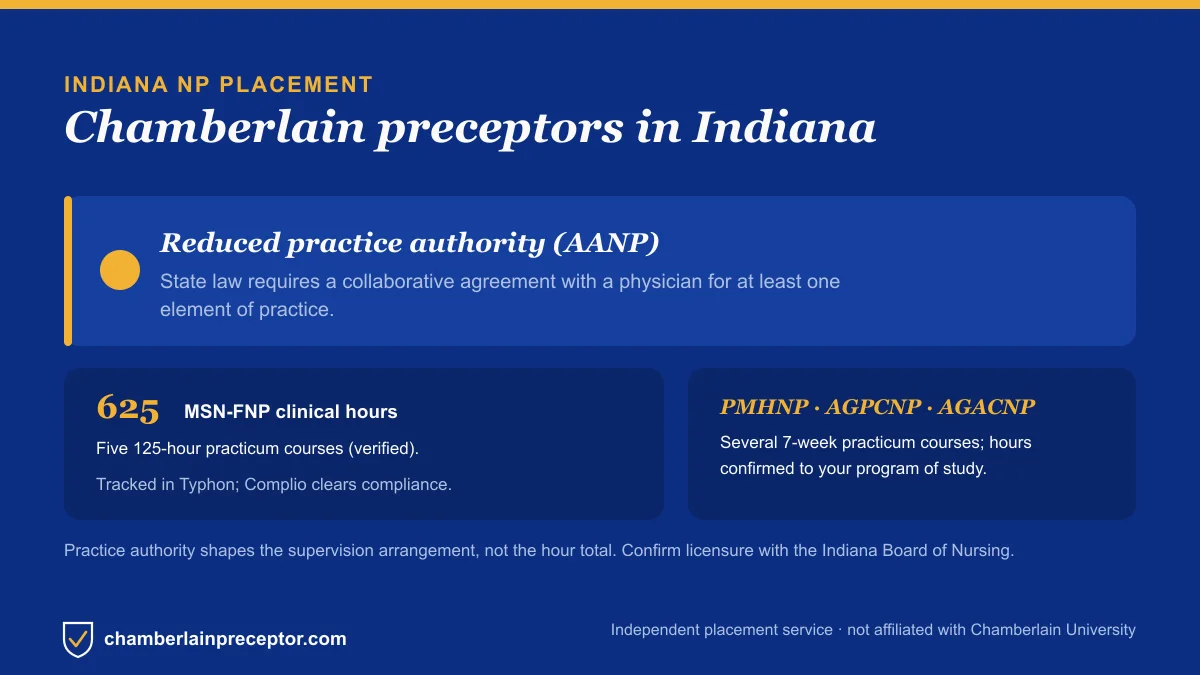
Indiana is a reduced practice state. Here is what that means
The American Association of Nurse Practitioners lists Indiana as a reduced practice environment. NPs are licensed as advanced practice registered nurses through the Indiana State Board of Nursing, and an APRN who wants prescriptive authority must keep a written collaborative practice agreement with an Indiana licensed practitioner who reviews their prescribing.
For a practicing NP, that agreement shapes the business of care: it has to stay current with the board, and the board audits APRN compliance on a recurring cycle. For a Chamberlain student, the day-to-day effect is smaller but real. The preceptors you will learn from, whether an FNP in a Carmel primary care office or a psychiatric provider in South Bend, already handle collaboration paperwork as routine. Clinics that live with that structure tend to have a process for onboarding students too, which works in your favor once an affiliation agreement is on the table.
None of this changes your program requirements. Hours, course structure, and preceptor criteria come from Chamberlain, not from Indiana. The state simply sets the clinical context you will train in.
The Indiana State Board of Nursing, in practice
The board sits inside the Indiana Professional Licensing Agency (PLA) and governs RN licensure, APRN recognition, prescriptive authority, and the collaborative agreements that go with it. Three pointers worth bookmarking as a student:
- Licensure. Indiana APRN recognition builds on an RN license plus advanced education and national certification, and prescriptive authority is a separate application that requires the collaborative practice agreement.
- Verification. The PLA runs a public license lookup. Before you nominate anyone in Typhon, confirm your proposed preceptor's Indiana license is active and unencumbered. It takes two minutes and prevents a rejected nomination weeks later.
- Who answers what. Scope, prescribing rules, and agreement filings are board territory. Practicum policy is Chamberlain territory. Keep the two straight and you will save yourself circular phone calls.
Finding a preceptor across Indiana
Chamberlain students secure their own preceptors. The university's Practicum Commitment, through the Experiential Learning Team, steps in only after three documented preceptor denials, which is a late backstop when a term start is bearing down. We run the search from denial zero instead: you tell us your course, your dates, and how far you can drive, and we work Indiana sites until a qualified preceptor says yes.
Indianapolis metro
The deepest market in the state. Indianapolis, Carmel, Fishers, Noblesville, and Greenwood hold large health systems alongside independent family practices and outpatient psychiatric groups.
Northern Indiana
Fort Wayne, South Bend, Elkhart, and the lakefront corridor through Gary and Hammond. Community clinics here often say yes when big-system credentialing stalls.
Central and southern
Lafayette, Muncie, Terre Haute, Bloomington, Columbus, Evansville, and the New Albany area across from Louisville. Smaller cities, shorter credentialing queues, loyal repeat preceptors.
Competition is real in the Indianapolis metro, where several NP programs place students at once. Students willing to drive 45 to 60 minutes beyond the metro consistently match faster.
Chamberlain practicum requirements, viewed from Indiana
The mechanics are the same in every state, so here is the Indiana view of them. MSN-FNP students complete 625 supervised clinical hours across five 125-hour practicum courses. PMHNP, AGPCNP, and AGACNP students complete several 7-week practicum courses, with hours confirmed to their program of study. DNP students need a scholarly project site and mentor rather than a traditional preceptorship.
| Step | What happens |
|---|---|
| Preceptor search | You, or we, identify an Indiana clinician whose practice fits your course objectives. |
| Typhon nomination | You submit the site and preceptor in Typhon, Chamberlain's practicum portal, for approval before any hours can count. |
| Affiliation agreement | Chamberlain and the Indiana site execute an agreement. An existing agreement speeds this up; a brand new site adds lead time. |
| Complio clearance | Background check, drug screen, and immunizations clear through Complio before you set foot in the clinic. |
| Hour logging | You log supervised hours in Typhon as the rotation runs. |
Lead time is the quiet killer. An Indiana site that has never hosted a Chamberlain student needs that affiliation agreement negotiated from scratch, so start the search a term ahead, not a month ahead. The full checklist lives at Chamberlain preceptor requirements.
Virtual or in person in Indiana
Telehealth psychiatry and primary care are well established across Indiana, especially for rural counties where specialists are thin. Whether virtual hours count toward a given practicum course varies, so confirm with your program before you accept a telehealth preceptor. We place both, and for students outside the Indianapolis metro a hybrid arrangement often shortens the search considerably.
If your term clock is already running, here is our part in one paragraph: a free placement review of your course, dates, and location, then a targeted Indiana search with a 14-day match commitment, and you pay when matched, not before. See how it works and what it costs, or start with the consult form below.
Answered.
Does Indiana's reduced practice status change my Chamberlain hour requirements?
No. Practicum requirements come from Chamberlain, not the state. MSN-FNP students still complete 625 supervised hours across five 125-hour practicum courses, and PMHNP, AGPCNP, and AGACNP hours are confirmed to the program of study. Indiana's reduced practice rules shape how your preceptor practices, mainly through the collaborative practice agreement, not how many hours you log.
Who can precept me in Indiana?
It depends on your practicum course and program of study. Verify any candidate's Indiana license through the PLA lookup, then confirm they meet the criteria at Chamberlain preceptor requirements before nominating them in Typhon.
I have already been denied by several Indiana sites. Now what?
Chamberlain's Practicum Commitment assists after three documented preceptor denials, which can leave you waiting while the term approaches. Keep documenting every denial, then bring the search to us; we start from denial zero and work sites you have not reached. More at can't find a preceptor.
Can I use a telehealth preceptor for my Indiana practicum?
Sometimes. Telehealth acceptability varies by practicum course and program, so confirm with Chamberlain before committing. When virtual hours are approved for your course, they widen the search well beyond your county, which matters in rural Indiana.
How fast can you match me with an Indiana preceptor?
We begin with a free placement review, carry a 14-day match commitment once we take your search, and you pay when matched. If your start date is close, say so up front and see need a preceptor fast or go straight to the consult form.
Get your Chamberlain practicum handled.
A free placement review. No payment until you're matched. Tell us your track and term, and we map the whole placement.