Chamberlain NP Preceptor Help in Kentucky, From Louisville to Pikeville
Kentucky gives nurse practitioners real room to practice, but prescriptive authority still runs through collaborative agreements, and preceptors in Louisville, Lexington, and the Appalachian east book up early. Here is how Chamberlain students line up clinical placements in the Bluegrass State, and how we help from day one.
Start your Chamberlain placement
Start your placement
A free placement review. No payment until you're matched.
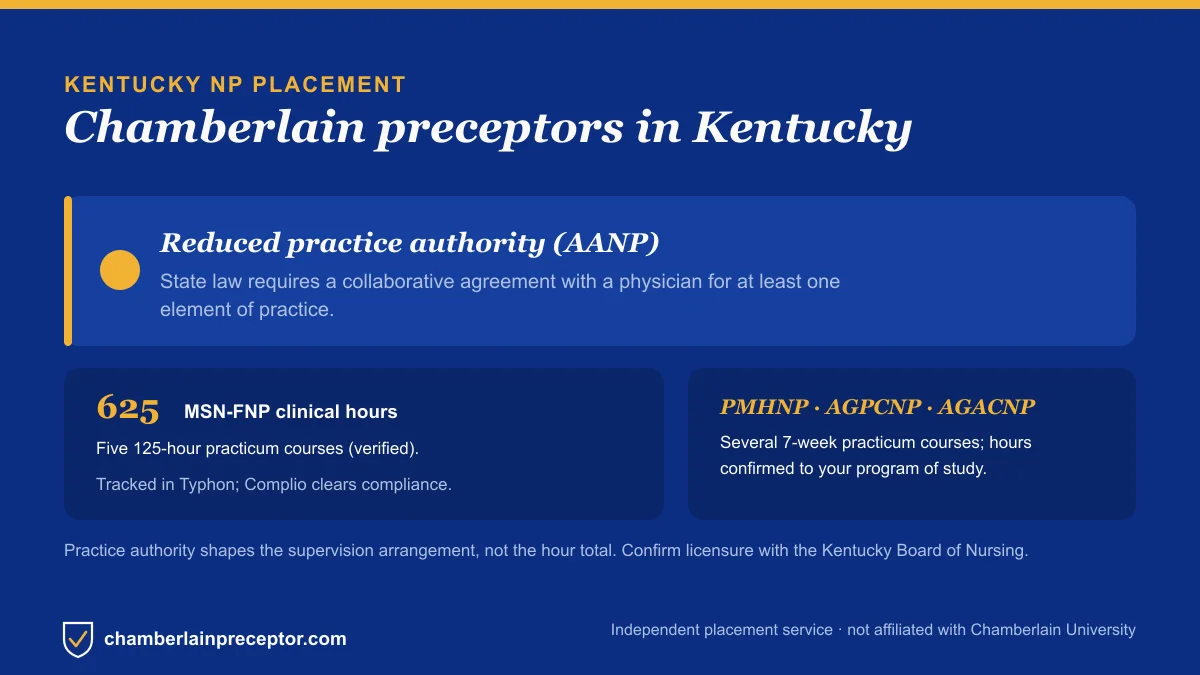
Kentucky is a reduced practice state, and that shapes your search
The American Association of Nurse Practitioners lists Kentucky as reduced practice. Kentucky APRNs assess, diagnose, and manage patients under the licensure authority of the Kentucky Board of Nursing, but prescribing is where the state adds conditions.
Kentucky splits prescriptive authority into two agreements. Knowing the difference helps you talk credibly with potential preceptors, because nearly every prescribing NP you approach is working under one of them or has aged out of the requirement.
CAPA-NS
The collaborative agreement for nonscheduled legend drugs, signed with a Kentucky physician in a same or similar specialty. After four or more years of prescribing, an APRN may notify the board and discontinue it.
CAPA-CS
The collaborative agreement for controlled substances. It involves DEA registration, obligations under KASPER, Kentucky's prescription monitoring program, and documented review meetings with the collaborating physician. After four or more years of controlled substance prescribing, an APRN in good standing may request an exemption through the board's portal.
For a student, the practical takeaway is simple: your Kentucky preceptor practices with real autonomy day to day, and the collaboration rules live mostly in the prescription pad. None of it changes what Chamberlain requires of your rotation. It does mean Kentucky sites are used to agreement paperwork, which usually makes the affiliation conversation easier, not harder.
The Kentucky Board of Nursing, in brief
The Kentucky Board of Nursing (KBN) licenses RNs and APRNs, approves nursing education programs, and handles discipline. Nurse practitioners hold APRN licensure with an NP designation backed by national certification in a population focus. Anything you or a preceptor might need to verify runs through kbn.ky.gov:
- License verification for the NP or physician you hope to work with, worth checking before you nominate anyone in Typhon.
- APRN prescriptive authority pages explaining CAPA-NS and CAPA-CS, including the four-year exemption paths.
- Portal-based collaborative agreement notifications, so a preceptor's prescribing status is a matter of record rather than guesswork.
Chamberlain's placement paperwork never replaces board rules. When a question is about Kentucky law rather than Chamberlain policy, the board's site is the answer.
Where Chamberlain students actually find preceptors in Kentucky
Chamberlain is online, so your clinical map is the state itself. A few realities of the Kentucky search:
- Louisville and Lexington hold the deepest bench of NPs and physicians, anchored by large systems such as Norton Healthcare, UofL Health, UK HealthCare, and Baptist Health. A deep bench also means the most competition from other NP students, local and online.
- Northern Kentucky sits inside the Cincinnati metro. Students there often weigh sites on both sides of the river, and each side brings its own onboarding.
- Bowling Green, Owensboro, Paducah, and Elizabethtown are mid-sized markets where a warm introduction goes further than a cold email.
- Eastern Kentucky's Appalachian counties lean heavily on NPs for primary care. Preceptors there often say yes out of mission, but they are stretched thin, and drive time becomes part of your planning.
Chamberlain expects you to secure your own preceptor and nominate the site and preceptor in Typhon. The university's Practicum Commitment support engages only after three documented preceptor denials, which is help that arrives late in a stressful process. We run the Kentucky search from denial zero instead: we contact clinics, confirm licenses and availability, and hand you a preceptor ready for Typhon nomination. If you are already stuck, start with what to do when you cannot find a preceptor or read how our process works.
Chamberlain practicum requirements, viewed from Kentucky
The requirements below are Chamberlain's and travel with you into any state. Kentucky adds nothing beyond the site's own onboarding.
| Program | Clinical expectation |
|---|---|
| MSN-FNP | 625 supervised clinical hours across five 125-hour practicum courses. See the FNP placement page. |
| PMHNP | A series of 7-week practicum courses; hours are confirmed to your program of study. PMHNP details. |
| AGPCNP and AGACNP | Several 7-week practicum courses; hours per your program of study. See AGPCNP and AGACNP. |
| DNP | A scholarly project site and mentor rather than a traditional preceptor. DNP project support. |
Three systems carry every Kentucky rotation:
- Typhon is where you nominate your site and preceptor and later log hours. Nothing is official until the nomination clears.
- Complio handles compliance onboarding: background check, drug screen, and immunizations, plus anything your Kentucky site layers on top.
- An affiliation agreement must exist between Chamberlain and each clinical site. If your clinic has never hosted a Chamberlain student, build in lead time for contracting.
Virtual or in person in Kentucky
Telehealth is a fixture in Kentucky care, especially for behavioral health and for patients in rural counties far from a clinic. Some rotations can include telehealth hours with an approved preceptor, but acceptability varies by course and specialty, and it is Chamberlain's call, not the site's. Confirm with your program before nominating a virtual arrangement, and treat in-person capacity as the default plan.
If your Kentucky search is stalling, or you would rather not spend twelve weeks cold-calling clinics between shifts, that is the exact gap we fill. The placement review is free, you pay only when matched, and our match commitment is 14 days. Tell us your program, courses, and county in the consult form below. Pricing lives on the cost page, and if your deadline is close, see need a preceptor fast.
Answered.
Is Kentucky a full practice state for nurse practitioners?
No. The AANP classifies Kentucky as a reduced practice state. Kentucky APRNs practice under the Board of Nursing's authority, but prescribing requires a collaborative agreement with a physician: CAPA-NS for nonscheduled drugs and CAPA-CS for controlled substances. Each has a pathway out after four or more years of prescribing.
Does Chamberlain find my preceptor in Kentucky?
Not at first. Chamberlain students secure their own preceptor and nominate the site and preceptor in Typhon. The university's practicum support engages only after three documented preceptor denials. We run the search from day one instead, so most of our students never reach a first denial. See how it works.
How many clinical hours does the Chamberlain FNP require?
625 supervised clinical hours across five 125-hour practicum courses, and the total is the same whether you sit in Louisville or Pikeville. Other NP tracks complete several 7-week practicum courses with hours confirmed to the program of study. Details are on the requirements page.
Can my Kentucky rotation include telehealth hours?
Sometimes. Telehealth acceptability varies by course and specialty, and Chamberlain decides, not the clinical site. Confirm with your program before nominating a virtual preceptor, and keep an in-person option alive as your primary plan.
How fast can you place me in Kentucky?
Our match commitment is 14 days, and the initial placement review is free. You pay only when matched. If your practicum start date is close, begin with need a preceptor fast or the consult form on this page.
Get your Chamberlain practicum handled.
A free placement review. No payment until you're matched. Tell us your track and term, and we map the whole placement.