Finding Your Chamberlain Preceptor in Louisiana
Louisiana is a reduced practice state, and that reality shapes every preceptor conversation a Chamberlain University NP student has here. This guide covers what the rules mean for your practicum, how the Louisiana State Board of Nursing fits in, and how we run your search from day one instead of waiting on three denials.
Start your Chamberlain placement
Start your placement
A free placement review. No payment until you're matched.
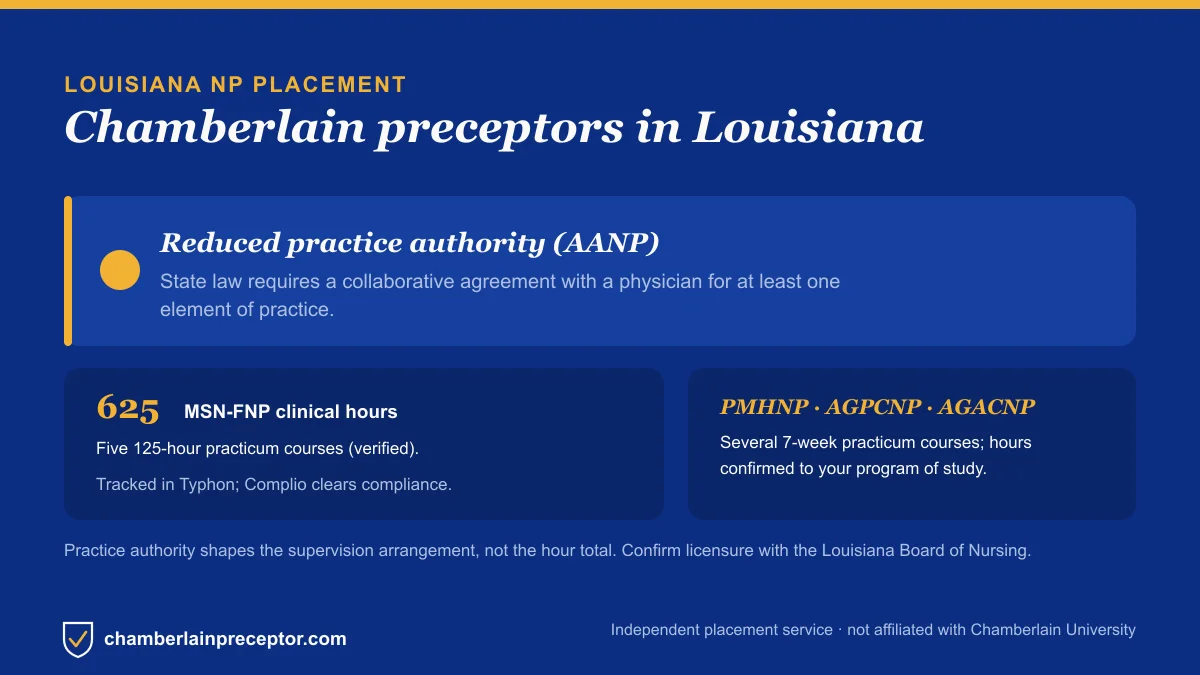
Reduced practice in Louisiana, and what it means day to day
The American Association of Nurse Practitioners classifies Louisiana as a reduced practice state. Nurse practitioners here diagnose, treat, and prescribe under a collaborative practice agreement, a written document signed with one or more Louisiana licensed physicians or dentists on the board's own template.
For a Chamberlain student the effect is practical. Many of the NPs you might approach are tied to a collaborating physician and a specific practice site, so their ability to take a student can depend on the practice arrangement as much as on their willingness. Physicians face no such agreement, which is one reason MD and DO preceptors anchor so many Louisiana placements. Knowing that structure helps you aim your outreach at people who can actually say yes.
One distinction worth keeping straight: Louisiana's practice rules govern how clinicians work, while your Chamberlain program of study governs who may precept each course. They are separate questions, and confusing them is a common way students lose weeks to dead-end asks.
The Louisiana State Board of Nursing
The Louisiana State Board of Nursing, headquartered in Baton Rouge, licenses the state's registered nurses and advanced practice registered nurses. It publishes the collaborative practice agreement template, sets APRN practice rules, and offers license verification, which makes it your first stop when vetting a potential preceptor.
What the board governs
- RN and APRN licensure and renewal
- APRN prescriptive authority within a collaborative practice agreement
- Practice rules and declaratory statements
- Discipline and license verification
How students use it
- Verify a prospective preceptor's Louisiana license before nominating them in Typhon
- Confirm an NP preceptor practices under a current collaborative agreement
- Read the actual APRN rules instead of relying on secondhand summaries
Physicians are licensed separately by the Louisiana State Board of Medical Examiners, so check MD and DO preceptors there. For any scope question, the board's published rules outrank anything you read in a student forum.
Where placements happen across Louisiana
Louisiana's clinical activity clusters along a few corridors, with wide rural stretches between them. Both matter. The metro areas hold the most sites, but also the most competing students, and the rural parishes are often where a well-prepared ask gets the fastest yes.
| Region | Placement notes |
|---|---|
| New Orleans metro and the Northshore | The densest market, from Metairie and Kenner across the lake to Covington, Slidell, and Hammond. Rich in sites, heavy in competition from local programs. |
| Baton Rouge and the capital region | Large primary care and specialty base, plus suburban clinics through Ascension and Livingston parishes. |
| Shreveport and Bossier City | North Louisiana's hub, with hospital systems and independent clinics serving a broad rural draw. |
| Lafayette and Acadiana | Regional systems and community practices, a middle ground between metro density and rural openness. |
| Lake Charles, Monroe, Alexandria, Houma | Smaller regional markets where clinics are often glad to train their future colleagues. |
| Rural parishes statewide | Federally qualified health centers and rural health clinics, frequently the most receptive doors in the state. |
If you live in New Orleans or Baton Rouge and keep hearing no, widening the radius by one parish, or looking toward Monroe, Alexandria, or the bayou region, often changes the answer.
The Chamberlain process, run from Louisiana
Chamberlain students secure their own preceptors. Once you have a willing clinician, you nominate the site and preceptor in Typhon, Chamberlain's practicum portal, and log your hours there through the course. Compliance runs through Complio, covering your background check, drug screen, and immunizations, and Chamberlain must hold an affiliation agreement with each site before you start. Build lead time for that paperwork into your timeline, because even an eager clinic cannot host you until the agreement is executed.
Chamberlain's official backstop, the Practicum Commitment through the Experiential Learning Team, engages only after three documented preceptor denials. That help is real, but it arrives late, after weeks of collecting rejections. Our service flips that sequence: we run the search from denial zero, working Louisiana clinics while you stay on coursework. See how it works and the preceptor requirements before you nominate.
Hours by program, viewed from Louisiana
MSN-FNP
625 supervised clinical hours across five 125-hour practicum courses. Details on the FNP page.
PMHNP and AGNP tracks
Several 7-week practicum courses, with hours confirmed to your program of study. See PMHNP, AGPCNP, and AGACNP.
DNP
A scholarly project site and mentor rather than a course hour total. See DNP preceptor.
Virtual or in person in Louisiana
Telehealth is part of everyday care in Louisiana, especially behavioral health across rural parishes, and some practicum experiences can happen virtually. Whether telehealth hours count for a given course depends on your program of study and course requirements, not on state law alone. Confirm with your program before nominating a virtual site, and treat in-person placement as the default for hands-on assessment courses.
If you would rather not gamble on cold outreach
We place Chamberlain NP students across Louisiana, from the Northshore to Shreveport. The review of your placement situation is free, you pay only when matched, and our match commitment is 14 days. Tell us your course, your parish, and your timeline at the consult form, or read about pricing first. Mid-semester and out of options? Start with need a preceptor fast.
Answered.
Is Louisiana a full practice state for nurse practitioners?
No. The AANP lists Louisiana as a reduced practice state. APRNs practice and prescribe under a collaborative practice agreement with one or more licensed physicians or dentists, using the template published by the state board. Check the AANP state practice map for current status.
How many clinical hours does Chamberlain's FNP program require in Louisiana?
The MSN-FNP requires 625 supervised clinical hours across five 125-hour practicum courses, and that total is the same wherever you live. Other tracks, including PMHNP and the AGNP options, run several 7-week practicum courses with hours confirmed to your program of study.
Can a physician serve as my preceptor in Louisiana?
Often yes, depending on the course. Your program of study defines acceptable preceptor types, so review the requirements and verify the clinician's Louisiana license before you nominate them in Typhon.
What happens if Louisiana preceptors keep saying no?
Chamberlain's Experiential Learning Team assists only after three documented denials. We work from the opposite direction, running your Louisiana search from day one with a free placement review, pay when matched, and a 14-day match commitment. Start at can't find a preceptor or the consult form.
Get your Chamberlain practicum handled.
A free placement review. No payment until you're matched. Tell us your track and term, and we map the whole placement.