Maryland Preceptor Help for Chamberlain NP Students
Maryland gives nurse practitioners full practice authority, and its clinical map runs from Baltimore's big health systems to Eastern Shore family clinics. Here is how practice authority, the Maryland Board of Nursing, and the preceptor search actually play out for Chamberlain students in the Old Line State.
Start your Chamberlain placement
Start your placement
A free placement review. No payment until you're matched.
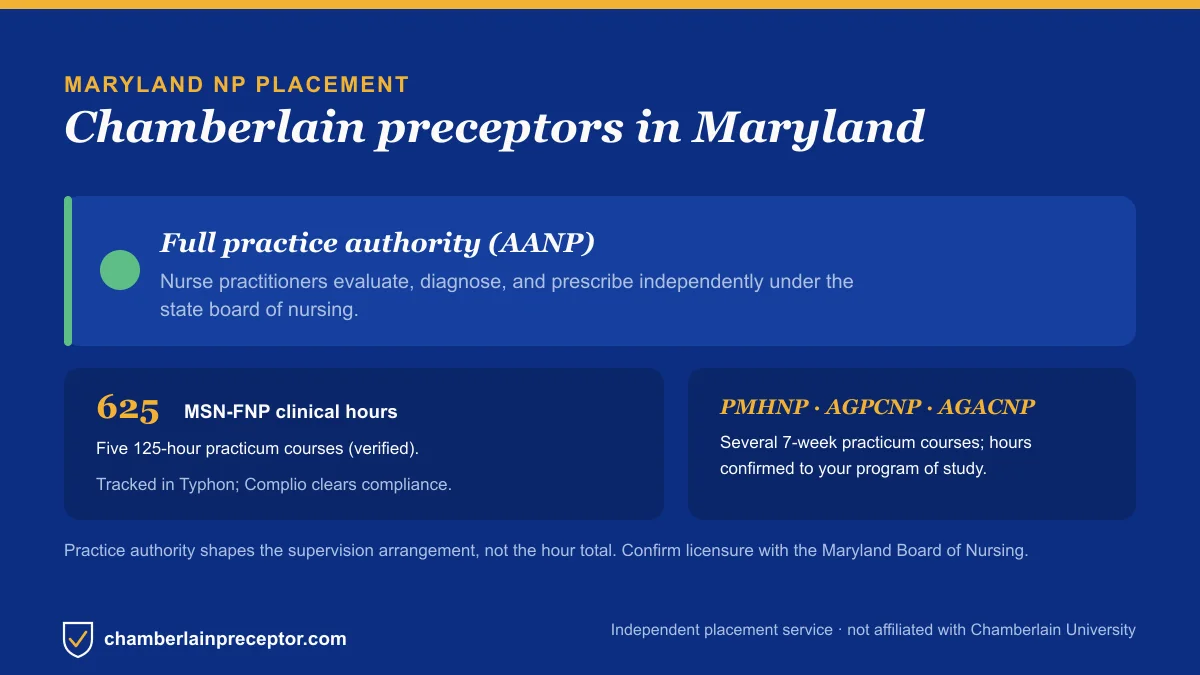
Maryland is a full practice state
The AANP classifies Maryland as full practice. Certified nurse practitioners here evaluate patients, diagnose, order and interpret diagnostic tests, and prescribe medications including controlled substances, all under the licensure authority of the Maryland Board of Nursing. No collaborative agreement with a physician is required to practice.
One Maryland wrinkle is worth knowing. An applicant who has never been certified as an NP in Maryland or any other state names a mentor on the certification application: a Maryland-licensed physician or nurse practitioner with at least three years of clinical experience who stays available for advice, consultation, and collaboration for the first 18 months. That is mentorship for new certificants, not physician supervision, and it applies to you after graduation, not during your practicum. As a student you work under your preceptor and Chamberlain's course requirements.
Day to day, full practice means the clinician who precepts you might own the practice outright, manage the whole panel, and sign charts without a co-signature. That widens the pool of potential preceptors well beyond physician-led groups.
The Maryland Board of Nursing, in practical terms
The Maryland Board of Nursing sits within the Maryland Department of Health in Baltimore. It licenses RNs and certifies nurse practitioners, and it touches your practicum in three ways. First, NP certification runs through board-approved graduate programs, with official transcripts sent directly from the school. Second, applicants complete a fingerprint-based criminal history records check. Third, and most useful right now, the board's Look Up a License tool lets you verify a prospective preceptor's Maryland license in about two minutes before you nominate them in Typhon. A bounced nomination can cost weeks, so make that check a habit. Applications, forms, and the license lookup live at health.maryland.gov/mbon.
Where Chamberlain students actually match in Maryland
Maryland is compact, dense, and clinically busy, which cuts both ways: plenty of sites, plenty of competing students. These are the regions where our searches land placements.
Baltimore metro
Baltimore, Towson, and Glen Burnie. The state's thickest cluster of health systems, specialty groups, and community clinics.
Capital suburbs
Silver Spring, Bethesda, Rockville, and Prince George's County practices serving the Washington, DC region.
Central corridor
Columbia, Ellicott City, and Laurel, with primary care and urgent care groups strung along the I-95 spine.
Frederick and Western Maryland
Frederick, Hagerstown, and Cumberland, where smaller practices often mean closer mentorship.
Annapolis and Southern Maryland
Annapolis, Waldorf, and Lexington Park, growing suburban demand with fewer students in line.
Eastern Shore
Salisbury, Easton, and the coastal towns. Rural clinics here rely on NPs and often welcome students.
Chamberlain expects you to secure your own preceptor: you find the clinician, they agree, you nominate the site and preceptor in Typhon, and the university vets the match. The official safety net, the Practicum Commitment through the Experiential Learning Team, engages only after three documented preceptor denials. In competitive markets like Baltimore and the DC suburbs, where one clinic may hear from students at five universities in a week, that backstop arrives late. We run the search from denial zero instead. See how it works or what to do when you cannot find a preceptor.
Your practicum requirements, viewed from Maryland
| MSN-FNP | 625 supervised clinical hours across five 125-hour practicum courses. |
|---|---|
| PMHNP, AGPCNP, AGACNP | Several 7-week practicum courses; hour requirements are confirmed to your specific program of study. |
| DNP | A scholarly-project site and mentor rather than a course-hour ladder. |
Every Maryland placement passes the same three gates. Typhon is where you nominate the site and preceptor and later log hours. Complio handles compliance onboarding: background check, drug screen, and immunizations. And Chamberlain needs an affiliation agreement with each site, which can take weeks at Maryland's larger health systems, so start the paperwork the moment a preceptor says yes. The full checklist lives at Chamberlain preceptor requirements.
Virtual or in person?
Telehealth care is well established in Maryland, and some preceptors offer hybrid schedules. Whether virtual hours count toward a given practicum course is a program-level call that changes over time, so confirm with Chamberlain before nominating a virtual site. In-person hours remain the safe default, and Maryland's density means most students can reach a site within a reasonable drive.
If you would rather not run the search yourself
Cold-calling Baltimore clinics between care plans is a rough way to spend a term. We start with a free placement review, you pay when matched, and our match commitment is 14 days. Tell us your program, your practicum course, and your corner of Maryland, and we take it from there. Start at the consult form, or see what it costs.
Answered.
Is Maryland a full practice state for nurse practitioners?
Yes. The AANP lists Maryland as full practice, meaning certified NPs evaluate, diagnose, order and interpret tests, and prescribe, including controlled substances, under the Maryland Board of Nursing alone. See the AANP State Practice Environment page for the current map.
Does Maryland's 18-month mentorship rule affect my student practicum?
No. That rule applies to newly certified NPs who have never held NP certification in any state; they name a Maryland-licensed physician or NP mentor with at least three years of experience on the certification application. Your practicum runs on Chamberlain's requirements and your preceptor's supervision.
How many clinical hours will I complete in Maryland as a Chamberlain FNP student?
The MSN-FNP program requires 625 supervised clinical hours across five 125-hour practicum courses, the same in Maryland as anywhere else. Other tracks, like PMHNP, run several 7-week practicum courses with hours confirmed to your program of study.
Can I use a virtual or telehealth preceptor in Maryland?
Sometimes. Telehealth acceptability varies by course and program, so confirm with Chamberlain before nominating a virtual site in Typhon. If time is tight, an in-person match is usually the surer route; see need a preceptor fast.
What if Maryland preceptors keep turning me down?
Chamberlain's Practicum Commitment engages only after three documented denials, which can consume a whole term. Log every denial in writing, keep nominating in Typhon, and consider a search that starts on day one. Our process begins with a free placement review, and you pay when matched.
Get your Chamberlain practicum handled.
A free placement review. No payment until you're matched. Tell us your track and term, and we map the whole placement.