Chamberlain Practicum Preceptors Across Michigan
Michigan is a restricted practice state, which shapes where Chamberlain NP students find preceptors and how clinical sites document supervision. Here is how the rules work, what the Michigan Board of Nursing expects, and how to line up a Typhon-ready preceptor anywhere from Metro Detroit to Marquette.
Start your Chamberlain placement
Start your placement
A free placement review. No payment until you're matched.
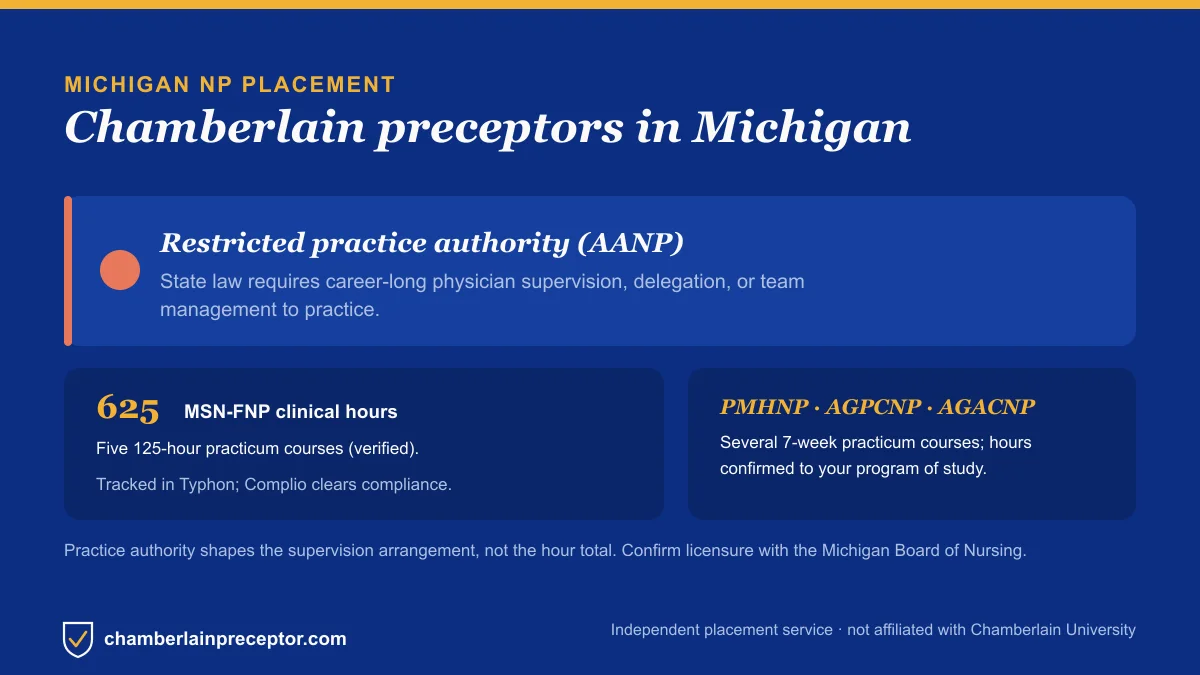
Restricted practice, in plain terms
The AANP places Michigan in its restricted practice category, the tightest of its three classifications. State law keeps at least one element of NP practice tied to physician supervision, delegation, or team management for the length of an NP career.
Day to day, that looks like this. Michigan recognizes nurse practitioners through a specialty certification attached to an RN license rather than a standalone APRN license, and prescribing controlled substances happens under physician delegation. Most NPs here work inside physician-anchored group practices and hospital systems rather than independent NP-owned clinics.
For a Chamberlain student, none of that blocks a practicum. It does mean two practical things. First, the preceptor pool leans toward group practices and health systems, which can be slower to say yes and quicker to ask for paperwork. Second, sites often want the supervising relationships documented before a student ever shadows a visit. Build both realities into your timeline.
The Michigan Board of Nursing, and what it governs
Nursing in Michigan is regulated by the Michigan Board of Nursing, which sits within the Bureau of Professional Licensing at the Department of Licensing and Regulatory Affairs, better known as LARA. The board oversees RN and LPN licensure, the nurse practitioner specialty certification, renewals, and discipline.
To practice as an NP in Michigan, you hold a Michigan RN license and add the nurse practitioner specialty certification, granted on the strength of current national certification from a board-approved certifying organization. Applications and renewals run through MiPLUS, LARA's online licensing portal, and license verification is public, which makes it easy to confirm a prospective preceptor's credential before you nominate them in Typhon.
Scope and supervision questions come up constantly during placement. When they do, the board's own published guidance is the answer of record. Start with LARA's nursing pages rather than a secondhand summary, including ours.
Where Michigan placements actually happen
Chamberlain expects you to secure your own preceptor and nominate them in Typhon. The university's Practicum Commitment, staffed by its Experiential Learning Team, engages only after three documented preceptor denials. That help is real, but it arrives after weeks of rejection. We run the same search from denial zero, so the backstop never has to trigger.
Metro Detroit
Wayne, Oakland, and Macomb counties hold the state's densest cluster of primary care, behavioral health, and acute care sites.
Grand Rapids and West Michigan
A growing health corridor with strong family practice and pediatric options for FNP students.
Ann Arbor and Ypsilanti
Academic medicine territory. Competitive, but rich in specialty and acute care exposure for AGACNP tracks.
Lansing and mid-Michigan
The capital region's community health centers are often open to NP students, especially in primary care.
Flint, Saginaw, and the Thumb
Underserved communities where a well-prepared student is welcome, and where PMHNP demand runs high.
Northern Michigan and the U.P.
Traverse City, Petoskey, and Marquette anchor rural rotations where telehealth questions come up most.
A timing note for the north: the preceptor pool thins quickly above the Traverse City line, so Upper Peninsula students should begin outreach a full semester ahead, or hand the search to someone who already keeps a Michigan pipeline warm.
Chamberlain's practicum requirements, viewed from Michigan
The numbers themselves do not change by state. What changes in Michigan is the paperwork tempo around them.
| MSN-FNP | 625 supervised clinical hours across five 125-hour practicum courses |
|---|---|
| PMHNP, AGPCNP, AGACNP | Several 7-week practicum courses, with hours confirmed to your program of study |
| DNP | A scholarly project site and mentor rather than a published hour total; see DNP placement |
| Every placement | Typhon nomination, Complio clearance, and an affiliation agreement with the site |
Three administrative steps decide your start date. You nominate the site and preceptor in Typhon and wait for approval. You clear Complio, Chamberlain's compliance onboarding, covering the background check, drug screen, and immunizations. And Chamberlain must hold an affiliation agreement with the site. Michigan's larger systems may already have one on file; an independent Kalamazoo or Battle Creek practice usually needs a new one, and that is where timelines slip. Full detail lives on our requirements page.
Virtual visits or in person?
Telehealth is part of everyday care in Michigan, especially across the north, and some practicum experiences can include virtual visits. Acceptability varies by program and course, so confirm with your program before counting telehealth toward a rotation. In-person placements remain the default and the safer plan.
If you would rather not spend a semester cold-calling clinics from Detroit to Marquette, we can carry that load. The placement review is free, you pay only when matched, and we work on a 14-day match commitment. Tell us your track and your county at the consult form, or read how it works and what it costs first.
Answered.
Is Michigan a full practice authority state for nurse practitioners?
No. The AANP classifies Michigan as restricted practice, meaning physician supervision, delegation, or team management is required for at least one element of NP practice throughout a career. See the AANP State Practice Environment map for the current classification.
Do I need a separate NP license from the Michigan Board of Nursing?
Michigan issues a nurse practitioner specialty certification attached to your RN license rather than a standalone APRN license. It requires current national certification from an approved certifying organization, and applications run through LARA's MiPLUS portal.
How many clinical hours does Chamberlain's FNP program require in Michigan?
The MSN-FNP requires 625 supervised clinical hours across five 125-hour practicum courses, the same in Michigan as anywhere else. PMHNP, AGPCNP, and AGACNP students complete several 7-week practicum courses with hours confirmed to the program of study. See our requirements page.
What happens if three Michigan preceptors turn me down?
After three documented denials, Chamberlain's Practicum Commitment through the Experiential Learning Team can step in. We start the search from day one instead, so most students never reach that point. Already at denial three? Start with can't find a preceptor or need a preceptor fast.
Can I count telehealth visits toward my Michigan practicum hours?
Sometimes. Telehealth acceptability varies by program and course, so confirm with your program before planning a rotation around virtual visits. In-person hours are always the safer default.
Get your Chamberlain practicum handled.
A free placement review. No payment until you're matched. Tell us your track and term, and we map the whole placement.