Minnesota Preceptor Help for Chamberlain NP Students
Minnesota pairs full practice authority with one of the strongest health care markets in the Upper Midwest, which makes it a rewarding but competitive place to complete a Chamberlain practicum. Here is how the state's rules actually work, where students tend to train, and how to have a preceptor secured before your course window opens.
Start your Chamberlain placement
Start your placement
A free placement review. No payment until you're matched.
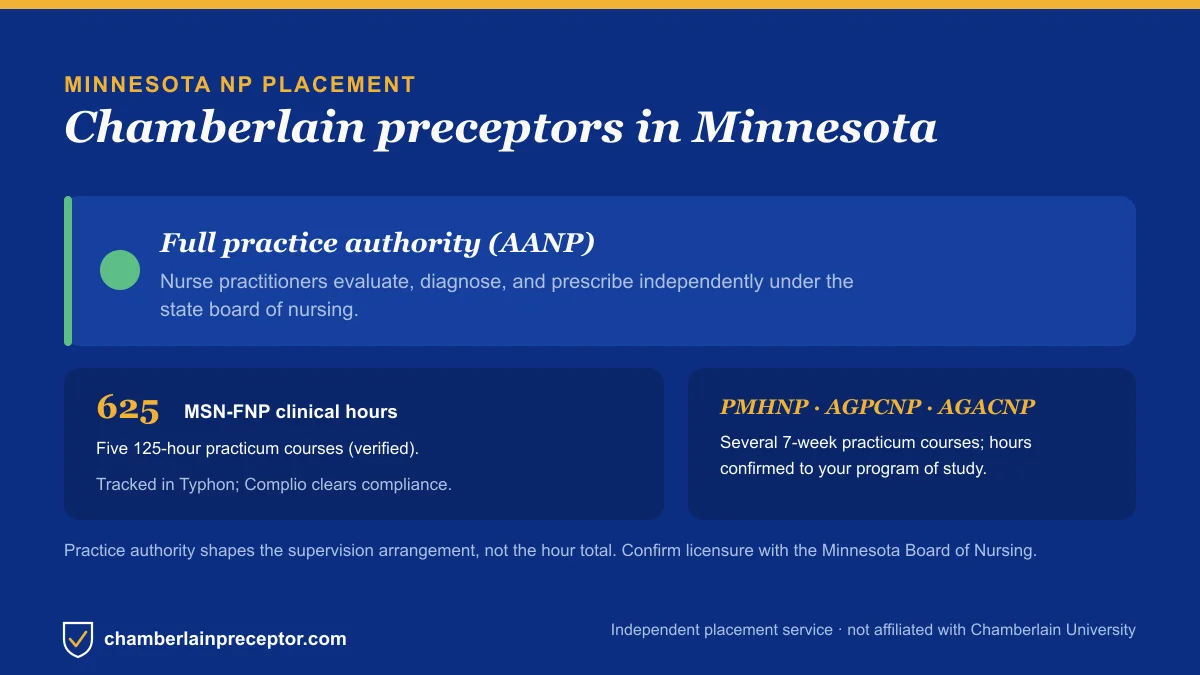
Full practice authority, and what it changes for you
The American Association of Nurse Practitioners classifies Minnesota as a full practice state. Licensed NPs there evaluate patients, diagnose, order and interpret tests, and initiate and manage treatment, including prescriptions and controlled substances, under the licensure authority of the state board of nursing alone.
For a Chamberlain student, that classification does real work. Minnesota NPs can precept you on their own license, with no physician sign-off required on their ability to supervise, so your pool of potential preceptors is wider than it would be in a reduced or restricted state. NP-led clinics, which serve much of rural Minnesota, are fair game alongside the big systems.
One detail worth knowing as you plan a career there: Minnesota expects certified nurse practitioners and clinical nurse specialists who began practice after July 1, 2014 to complete at least 2,080 hours in a collaborative setting where APRNs and physicians work together before practicing fully on their own. That is a post-licensure transition for new graduates. It changes nothing about your student practicum, but it is useful context when preceptors describe how NP careers unfold in the state.
The Minnesota Board of Nursing
APRN oversight sits with the Minnesota Board of Nursing, which licenses advanced practice registered nurses in four roles: certified nurse practitioner, clinical nurse specialist, certified nurse midwife and certified registered nurse anesthetist. Licensure requires a current Minnesota RN license, graduate education in a recognized role and population focus from an accredited program, and current national certification.
Licensed Minnesota APRNs hold prescriptive authority for drugs, therapeutic devices and controlled substances in Schedules II through V. When you want to verify a potential preceptor's license, or confirm your own RN standing before practicum, the board's site at mn.gov/boards/nursing is the authoritative place to check. Verification matters here because Chamberlain's site approval depends on documentation being airtight, and a lapsed or encumbered license surfaces late in the process if nobody looks early.
Where Minnesota placements actually happen
Most Chamberlain students in Minnesota train in one of three broad territories, and each behaves differently when you are cold-contacting sites.
Twin Cities metro
Minneapolis, St. Paul and suburbs like Bloomington, Maple Grove and Eagan hold the deepest bench of family practice, urgent care and specialty clinics, and the most competition from local university cohorts.
Rochester and the southeast
Rochester anchors a dense medical corridor, but large academic systems often route student requests through formal education offices with long lead times. Independent clinics in Winona, Austin and Owatonna answer faster.
Duluth and greater Minnesota
Duluth, St. Cloud, Mankato, Moorhead and the Iron Range communities rely heavily on NPs. Rural sites are often the most receptive, and precepting there shows the exact population health work Minnesota needs.
The Chamberlain reality: the search is yours
Chamberlain students secure their own preceptors. You find a willing NP or physician, nominate the site and preceptor in Typhon, and wait for approval. The Practicum Commitment through the Experiential Learning Team engages only after you document three preceptor denials, which in practice means weeks of unanswered emails before the university's help arrives. If your course start is close, that timeline is the real risk, not the state's rules. Our team runs the Minnesota search from denial zero instead; see how it works or what to do if you cannot find a preceptor.
Chamberlain practicum requirements, viewed from Minnesota
The MSN-FNP requires 625 supervised clinical hours across five 125-hour practicum courses, so a Minnesota student typically needs one or two anchor sites that can carry them across consecutive sessions. PMHNP, AGPCNP and AGACNP students complete several 7-week practicum courses with hours confirmed to the program of study, and DNP students secure a project site and mentor rather than logging a set hour total.
Whatever the track, three administrative gates stand between a handshake and an approved Minnesota site.
| Gate | What happens | What slows it down |
|---|---|---|
| Typhon nomination | You submit the site and preceptor details in Chamberlain's practicum portal for review. | Missing license numbers or vague practice descriptions trigger back-and-forth. |
| Complio compliance | Background check, drug screen and immunization records clear through Complio. | Titers and renewals expire mid-practicum if you do not check dates early. |
| Affiliation agreement | Chamberlain and the site sign a legal agreement before hours can count. | Sites with no existing agreement need legal review, sometimes for weeks. |
Full details live on the Chamberlain preceptor requirements page.
Virtual or in person in Minnesota
Telehealth is well established across Minnesota's rural counties, and some practicum experiences, particularly in psychiatric mental health, may be completed with a preceptor who sees patients virtually. Acceptability varies by course, specialty and site, so confirm with your program before counting on virtual hours. For most FNP students, in-person hours at a Minnesota clinic remain the default, with telehealth as a supplement rather than a substitute.
Ready before the session starts
If you are staring down a Minnesota practicum deadline, we start with a free placement review, commit to a 14-day match, and you pay when matched. Tell us your track, your city and your start date at the consult form, and pricing is on the cost page. Or browse other states if your rotation may cross a border.
Sources
Answered.
Is Minnesota a full practice state for nurse practitioners?
Yes. The AANP classifies Minnesota as full practice, meaning licensed NPs evaluate, diagnose, order and interpret tests, and manage treatment including controlled substances under the Minnesota Board of Nursing's authority alone. New CNPs and CNSs complete a 2,080-hour collaborative transition after licensure, but that does not affect students.
Does Chamberlain find my Minnesota preceptor for me?
Not at first. Chamberlain students secure their own preceptors and nominate them in Typhon. The Experiential Learning Team's Practicum Commitment assists only after three documented preceptor denials. If you would rather not wait for that, see what to do when you cannot find a preceptor.
How many clinical hours does the Chamberlain MSN-FNP require?
625 supervised clinical hours, completed across five 125-hour practicum courses. PMHNP, AGPCNP and AGACNP students instead complete several 7-week practicum courses with hours confirmed to the program of study. Details are on the FNP page.
Does Minnesota's 2,080-hour rule change my practicum?
No. That requirement applies to certified nurse practitioners and clinical nurse specialists after they are licensed, asking new graduates to practice about a year in a setting where APRNs and physicians work together. Student practicum hours are governed by your Chamberlain program, not that rule.
Can my Minnesota practicum hours be completed through telehealth?
Sometimes. Telehealth is common in Minnesota, especially in rural care and psychiatric mental health, and some courses accept virtual precepted hours. Policies differ by course and specialty, so confirm with your program before relying on a virtual site. We place both in-person and telehealth-friendly preceptors; ask at the consult form.
Get your Chamberlain practicum handled.
A free placement review. No payment until you're matched. Tell us your track and term, and we map the whole placement.