A Working Plan for Chamberlain NP Preceptors in Mississippi
Mississippi is a reduced practice state, and its clinical sites know it. Here is how Chamberlain NP students line up preceptors from Jackson to the Gulf Coast, and how we take the search off your plate from day one.
Start your Chamberlain placement
Start your placement
A free placement review. No payment until you're matched.
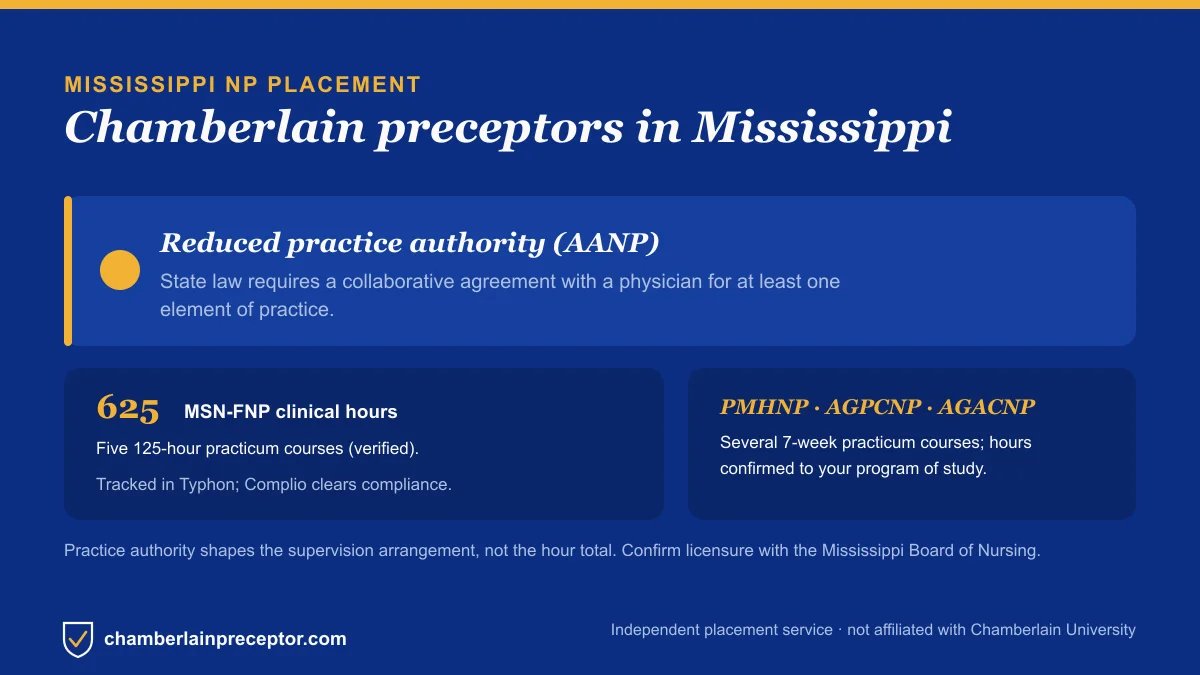
Reduced practice, explained before anything else
The AANP classifies Mississippi as a reduced practice state. Nurse practitioners are licensed by the Mississippi Board of Nursing, but state law requires APRNs to keep a collaborative agreement with a Mississippi licensed physician for as long as they practice.
For working NPs, collaboration is a running obligation: an agreement on file, regular quality assurance meetings with the collaborating physician, and chart review sampling under board rules. For you as a Chamberlain student, it changes the texture of the preceptor search. Every NP who might precept you already answers to a collaborative structure, which means their time is budgeted and their documentation load is real. Preceptors here say yes to students they trust and to programs that make onboarding painless. That is exactly the part we handle.
What the Mississippi Board of Nursing governs
The Mississippi Board of Nursing, at msbn.ms.gov, licenses RNs and APRNs, oversees the nursing side of collaborative practice, and handles discipline and license verification. Its Advanced Practice Registered Nurse pages spell out how NPs are recognized in the state: RN licensure, national certification in a population focus, and the collaborative agreement described above.
Two student-relevant uses of the board’s site:
- Verify your preceptor. Before you nominate anyone in Typhon, confirm their Mississippi license is active and unencumbered through the board’s verification tools.
- Understand the practice you are walking into. The board publishes the rules that govern APRN collaboration, so you can see why your preceptor’s calendar includes quarterly meetings with a physician and routine chart reviews.
Rules change. Treat the board’s site as the current word and this page as orientation.
Where placements actually happen in Mississippi
Mississippi’s clinical capacity clusters in a handful of metros, with long rural stretches between them. Where you live decides how hard the search will be.
Jackson metro
The state’s densest concentration of clinics, specialty practices, and hospital systems. The most preceptor options, and the most competition from other NP programs.
Gulf Coast
Gulfport, Biloxi, and Pascagoula support steady primary care and behavioral health sites serving coastal communities.
North and east hubs
Southaven and Olive Branch draw on the Memphis market, while Tupelo, Oxford, Starkville, and Meridian anchor their own regional networks.
Outside those hubs, in the Delta and across rural Mississippi, clinics are fewer and preceptor bandwidth is thinner, though the sites that do exist often offer the broadest hands-on experience an FNP student can get.
Chamberlain’s process puts the search on you: you find the preceptor, nominate the site and preceptor in Typhon, and clear compliance in Complio. The Practicum Commitment through the Experiential Learning Team steps in only after three documented preceptor denials, and waiting for that third denial can cost you a session. We run the search from denial zero, working our Mississippi contacts while your classmates are still drafting cold emails. If you are already behind, start at need a preceptor fast.
Chamberlain’s practicum mechanics, viewed from Mississippi
The requirements travel with the program, not the state. What Mississippi adds is the collaborative context of the sites themselves.
| Program | Clinical structure |
|---|---|
| MSN-FNP | 625 supervised clinical hours across five 125-hour practicum courses, built around primary care across the lifespan. Details on the FNP page. |
| PMHNP, AGPCNP, AGACNP | Several 7-week practicum courses, with hours confirmed to your program of study. |
| DNP | A scholarly project site and mentor rather than a traditional preceptorship. See DNP support. |
Every placement, wherever it lands in the state, moves through the same three gates:
- Typhon nomination. Your site and preceptor go in for approval before you touch a patient, and your hours are logged there throughout.
- Complio clearance. Background check, drug screen, and immunizations, plus whatever onboarding the Mississippi site adds on top.
- Affiliation agreement. Chamberlain needs one with each site. If a clinic has never hosted a Chamberlain student, the paperwork adds lead time, so start a full session early.
The complete checklist lives at Chamberlain preceptor requirements.
A note on telehealth rotations
Given Mississippi’s rural geography, telehealth looks tempting: precept from anywhere and skip the two hour drives. Some rotations can include virtual visits, but whether telehealth hours count, and how many, varies by course and by program. Confirm with your program before you build a plan around it, and treat in-person hours as the default your practicum courses expect.
If you would rather not gamble a session on cold outreach
We place Chamberlain NP students with vetted Mississippi preceptors across FNP, PMHNP, AGPCNP, and AGACNP tracks, plus DNP project support. The review of your situation is free, you pay only when matched, and our match commitment is 14 days. Tell us your practicum course dates and where in Mississippi you can rotate, and we take it from there. Start at the consult form below, or read how it works and what it costs first.
Answered.
Is Mississippi a full practice state for nurse practitioners?
No. The AANP classifies Mississippi as reduced practice. NPs there hold a career-long collaborative agreement with a Mississippi licensed physician. As a student, this shapes your preceptor’s obligations, not your own license.
How many clinical hours does Chamberlain’s FNP program require in Mississippi?
The same as everywhere: 625 supervised clinical hours across five 125-hour practicum courses. Mississippi does not change the total. Other tracks, like PMHNP, complete several 7-week practicum courses with hours confirmed to the program of study.
Can a Mississippi NP serve as my Chamberlain preceptor?
Often, yes. Mississippi NPs practice under collaborative agreements, which does not disqualify them from precepting. Chamberlain approves each preceptor course by course through Typhon nomination, so check the preceptor requirements for the credentials your specific course accepts.
What if every clinic near me in Mississippi says no?
Chamberlain’s Experiential Learning Team engages only after three documented preceptor denials. Rather than waiting on the 3-denial rule, we start searching on day one. See what to do when you cannot find a preceptor.
Do rural Mississippi rotations count the same as Jackson placements?
Yes. Hours logged in Typhon count wherever the approved site sits, and rural clinics often give broader hands-on scope. The site still needs an affiliation agreement with Chamberlain, and you still need Complio clearance.
Get your Chamberlain practicum handled.
A free placement review. No payment until you're matched. Tell us your track and term, and we map the whole placement.