Chamberlain Practicum Preceptors Across Missouri
Missouri regulates nurse practitioners more tightly than most states, and that shapes every practicum search from St. Louis to Springfield. Here is what restricted practice means for your Chamberlain clinical year, and how to line up a preceptor without losing a session to the hunt.
Start your Chamberlain placement
Start your placement
A free placement review. No payment until you're matched.
The short answer for Missouri
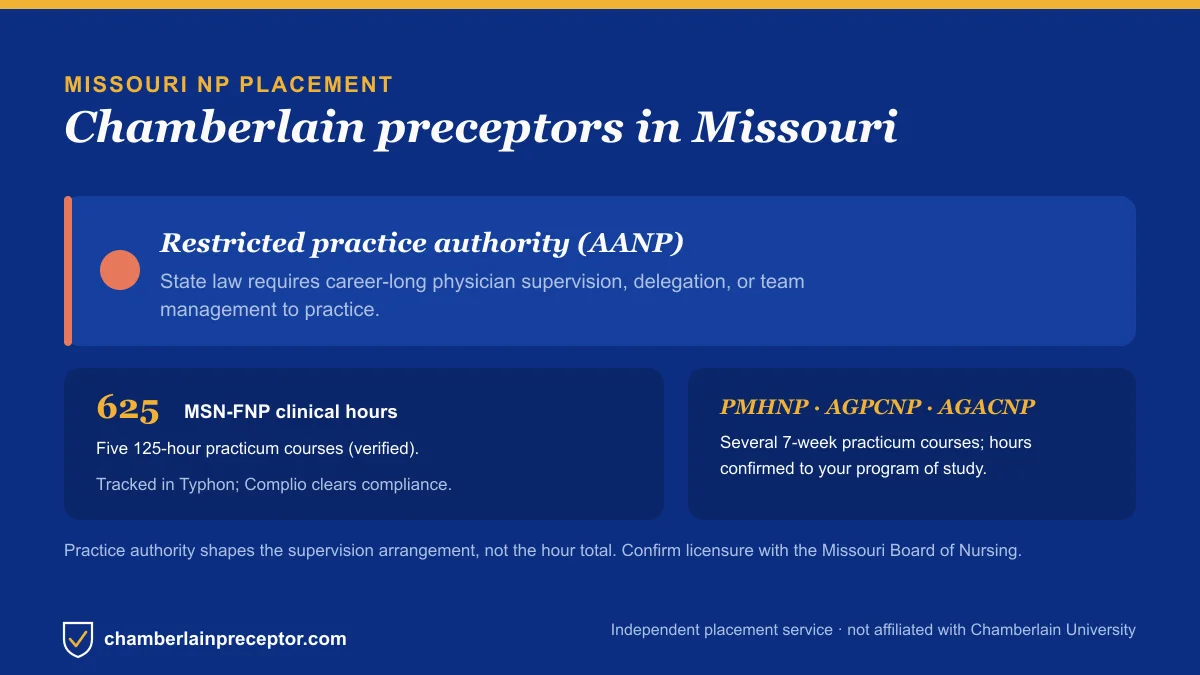
The AANP lists Missouri as a restricted practice state. A nurse practitioner here works under a written collaborative practice arrangement with a physician for the length of their career, and the delegated medical acts that define NP work, including prescribing, flow through that arrangement.
For a Chamberlain student this cuts two ways. The clinicians who might precept you are already carrying collaboration duties, scheduled chart reviews, and limits on how many advanced practice clinicians one physician can work with, so a yes tends to come slower here. At the same time, Missouri has teaching-minded NPs and physicians in family practice, psychiatry, and adult care who take students every session. The difference between a lost term and a signed preceptor is usually how early and how widely you ask.
What restricted practice looks like day to day
What Missouri asks of an NP
An active RN license plus a Document of Recognition from the Missouri State Board of Nursing, then a written collaborative practice arrangement with a physician under section 334.104 of Missouri statute. The collaborating physician reviews at least 10 percent of the charts, and at least 20 percent where controlled substances are prescribed.
What that means for your search
Prospective preceptors weigh their existing collaboration load before adding a student. Sites want the affiliation agreement moving early, not the week before your course opens. And because both NPs and physicians precept Chamberlain students where the program allows it, asking only one profession cuts your pool in half.
Geographic proximity rules also apply to collaborating teams, with allowances for certain rural and underserved settings, and the legislature revisits these details from time to time. Check the board's advanced practice pages for the current rule before building assumptions into your plan.
The Missouri State Board of Nursing
Nursing in Missouri is regulated by the Missouri State Board of Nursing, part of the state's Division of Professional Registration in Jefferson City. The board administers the Nursing Practice Act, licenses RNs, grants the APRN Document of Recognition that lets a nurse practice in an advanced role, and publishes the collaborative practice rules that shape NP work statewide.
- Verify any Missouri RN or APRN through the board's online licensee search before you count on a preceptor's credentials.
- Missouri participates in the nurse licensure compact for RN licensure, but APRN recognition is Missouri specific, so an out-of-state NP moving in still goes through the board.
- Questions about collaborative practice arrangements belong to the board's advanced practice section, and its published pages are the primary source.
Finding a preceptor across Missouri
Chamberlain expects you to secure your own preceptor, then nominate the site and clinician in Typhon for approval. The Practicum Commitment through the Experiential Learning Team only engages after three documented preceptor denials, and gathering three formal denials can eat most of a search season.
We run the search from denial zero instead, working outreach across the state while you stay in coursework. Where you search matters as much as when:
St. Louis metro
The state's largest concentration of clinics and health systems, plus suburban primary care in St. Charles and O'Fallon. Competitive, so early asks win.
Kansas City side
Kansas City, Independence, Lee's Summit, and up to St. Joseph. Watch state lines: a Kansas site means different rules and a separate agreement.
Springfield and the Ozarks
A strong family practice and behavioral health corridor serving a wide rural draw, often friendlier to student placements than the big metros.
Mid-Missouri
Columbia and Jefferson City pair academic medicine with community clinics, a good fit for FNP and adult-gerontology rotations.
Southeast and the Bootheel
Cape Girardeau anchors care for the region. Fewer sites, but preceptors here often welcome students and remember what the shortage feels like.
Rural Missouri
Much of the state is designated shortage area. Rural sites can be the fastest yes you will get, and the learning is broad by necessity.
Chamberlain practicum requirements from a Missouri seat
| MSN-FNP | 625 supervised clinical hours across five 125-hour practicum courses. See the FNP placement page. |
|---|---|
| PMHNP, AGPCNP, AGACNP | Several 7-week practicum courses. Hours are confirmed to your program of study, so verify totals there rather than a forum post. |
| DNP | A scholarly-project site and mentor rather than a set hour total. See DNP preceptor help. |
Whatever the track, the mechanics are the same from Missouri. You nominate the preceptor and site in Typhon and log hours there once approved. Complio handles compliance onboarding, including the background check, drug screen, and immunization records, and Missouri clinical sites commonly ask for these before orientation anyway. Each site also needs an affiliation agreement with Chamberlain, and agreements with hospital systems can take weeks, which is one more reason to start the search a session ahead. The full checklist lives on our requirements page.
Virtual or in-person in Missouri
Telehealth has real roots in Missouri, particularly for behavioral health and rural coverage. Whether virtual visits can count toward your practicum depends on your course and specialty, and programs weigh psychiatric telehealth differently than hands-on family practice. Before accepting a mostly virtual site, confirm in writing with your program team that the hours will count.
If you are staring down a deadline, our team reviews your situation free, runs outreach across Missouri from day one, and you pay only when matched, backed by a 14-day match commitment. Start with the consult form, or read how it works and what it costs first.
Answered.
Is Missouri a full practice state for nurse practitioners?
No. The AANP classifies Missouri as restricted practice. NPs practice under a written collaborative practice arrangement with a physician for their whole career, which includes physician chart review and rules on prescribing. As a student you are supervised by your preceptor either way, but the environment shapes how readily Missouri clinicians take students.
When does Chamberlain step in to help me find a Missouri preceptor?
Late. The Practicum Commitment through the Experiential Learning Team engages only after you document three preceptor denials, and collecting three formal denials takes real time. Our service runs the search from day one instead. If you are already behind, start at need a preceptor fast or the consult form.
How many clinical hours does the Chamberlain FNP require in Missouri?
The MSN-FNP requires 625 supervised clinical hours across five 125-hour practicum courses, the same in Missouri as anywhere else. PMHNP, AGPCNP, and AGACNP tracks run several 7-week practicum courses with hours confirmed to your program of study. Details are on our FNP page and requirements page.
What paperwork do a Missouri preceptor and site need?
Three things: your Typhon nomination of the site and preceptor, an affiliation agreement between the site and Chamberlain, and your own Complio compliance clearances, meaning background check, drug screen, and immunizations. Hospital-system agreements are the slow piece in Missouri, so open that conversation as soon as a preceptor says maybe.
Get your Chamberlain practicum handled.
A free placement review. No payment until you're matched. Tell us your track and term, and we map the whole placement.