Montana Preceptor Placement for Chamberlain NP Students
Montana gives nurse practitioners full practice authority, and that shapes everything about your practicum there, from who is allowed to precept you to how a rural clinic says yes. This page walks through the state rules, the Montana Board of Nursing, and how Chamberlain students actually land preceptors from Billings to the Flathead Valley.
Start your Chamberlain placement
Start your placement
A free placement review. No payment until you're matched.
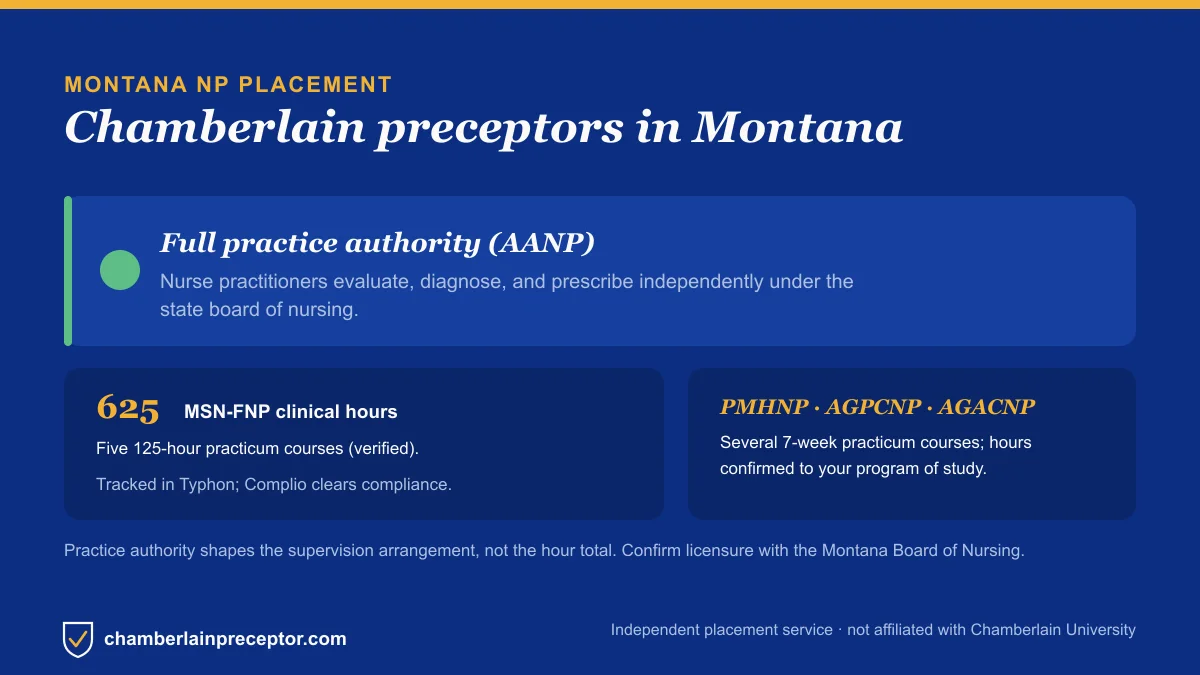
Full practice authority, and what it changes day to day
The American Association of Nurse Practitioners lists Montana as a full practice state. Licensed NPs there evaluate patients, diagnose, order and interpret diagnostic tests, and initiate and manage treatment, including prescriptions, under the sole licensure authority of the state board of nursing. State law does not require a physician collaboration or supervision agreement for an NP to practice or prescribe.
For a practicum student the practical effect is a wider preceptor pool. Montana NPs can own their clinics, staff them, and prescribe on their own license, so you are not limited to practices built around a supervising physician. Many of the family, psychiatric, and adult-gerontology providers in smaller Montana towns are independent NPs, and each one is a potential preceptor if they meet Chamberlain's requirements for your course.
The Montana Board of Nursing, in brief
The Montana Board of Nursing operates within the state Department of Labor and Industry and licenses RNs, LPNs, and advanced practice registered nurses, along with nursing assistants and medication aides. In Montana an APRN holds an RN license with an APRN specialty endorsement, and the board recognizes four roles: certified nurse practitioner, clinical nurse specialist, certified registered nurse anesthetist, and certified nurse midwife.
Prescriptive authority rides with the APRN license rather than with any physician agreement. Applicants can request it on the initial APRN application or add it later through the state's online licensing portal, and the board expects graduate coursework in advanced pharmacology and differential diagnosis or disease management, plus ongoing pharmacology continuing education to keep the authority current.
Two board tools matter for students. The licensee lookup lets you verify that a prospective preceptor holds a current, unencumbered Montana license before you nominate them in Typhon, and the board's APRN pages are the right place to confirm current rules rather than trusting a summary, ours included.
Finding a Chamberlain preceptor in Montana
Chamberlain students secure their own preceptors. You find the provider, they agree, you nominate the site and preceptor in Typhon, and the university approves or denies the nomination. Chamberlain's Experiential Learning Team does offer a Practicum Commitment backstop, but it engages only after three documented preceptor denials. That is the 3-denial rule, and it means the official safety net catches you late, after weeks you cannot get back.
Our service runs the search from denial zero instead, so the backstop never has to come into play. If you are already behind, start with the fast-track page; if you have been striking out on your own, this is the playbook.
Billings and the east
Montana's largest city and the referral hub for the eastern half of the state. The deepest bench of family practice, acute care, and psychiatric sites.
Missoula and the west
Western Montana's medical anchor, with a strong community-clinic and behavioral-health presence that suits FNP and PMHNP rotations alike.
Bozeman, Helena, Butte
The Gallatin Valley's growth keeps opening new clinics, while Helena and Butte add steady family-practice and public-sector volume.
Great Falls, Kalispell and the Flathead Valley, and dozens of frontier towns round out the map. Much of Montana is rural by any definition, served by critical access hospitals and community health centers where one NP may be the entire primary care presence. Those sites can be excellent placements with remarkable hands-on breadth, but many have never hosted a Chamberlain student, which means the paperwork starts from zero. Begin the search a full term ahead if you can.
Chamberlain practicum requirements, viewed from Montana
| Program | What your Montana placement must cover |
|---|---|
| MSN-FNP | 625 supervised clinical hours across five 125-hour practicum courses, typically in family practice and primary care settings. |
| PMHNP, AGPCNP, AGACNP | Several 7-week practicum courses; hours are confirmed to your program of study rather than a single published total. |
| DNP | A scholarly-project site and mentor rather than a set hour total. |
Whatever the track, the mechanics are the same. Your preceptor and site go through Typhon nomination, you clear Complio compliance onboarding, which covers the background check, drug screen, and immunizations, and Chamberlain signs an affiliation agreement with the site before hours can begin. In Montana the affiliation agreement is the usual bottleneck, because small independent clinics rarely have one on file. The full checklist lives at Chamberlain preceptor requirements, with program detail on the FNP, PMHNP, AGPCNP, AGACNP, and DNP pages.
Virtual or in person in Montana
Telehealth is woven into Montana care because the distances are real; a psychiatric NP in Billings may carry patients who live three hundred miles away. Some practicum experiences can include telehealth encounters and some cannot, and acceptability varies by course and specialty. Confirm with your Chamberlain program before you count on virtual hours, then treat any approved telehealth rotation as a bonus rather than the plan.
Ready for a Montana match
If you would rather spend your energy on patients than on cold calls, tell us your track, your upcoming practicum courses, and your corner of Montana. The placement review is free, you pay only when matched, and we hold ourselves to a 14-day match commitment. Start at the consult form, or read how it works and what it costs first. Other states are covered on the states index.
Answered.
Is Montana a full practice state for nurse practitioners?
Yes. The AANP State Practice Environment map classifies Montana as full practice, meaning NPs evaluate, diagnose, order and interpret tests, and manage treatment, including prescribing, under the licensure authority of the Montana Board of Nursing, with no physician collaboration agreement required.
Does Chamberlain find my Montana preceptor for me?
Not at first. Chamberlain students secure their own preceptors and nominate them in Typhon. The Experiential Learning Team's Practicum Commitment assists only after three documented preceptor denials. Our service runs the search from day one instead; see what to do when you cannot find a preceptor.
How many clinical hours will I complete in Montana as a Chamberlain FNP student?
The MSN-FNP program requires 625 supervised clinical hours across five 125-hour practicum courses, the same in Montana as anywhere else. PMHNP, AGPCNP, and AGACNP students complete several 7-week practicum courses with hours confirmed to their program of study. Details are on the FNP page and the requirements checklist.
Can I use a rural clinic or critical access hospital in Montana for my practicum?
Often yes, and the breadth of practice there can be a real advantage. The preceptor must meet Chamberlain's requirements for your course, the nomination must clear Typhon, and the site must sign an affiliation agreement, which takes longest at small sites without one on file. Start early and keep Complio current so compliance never holds up an approved site.
Do telehealth hours count toward my Montana practicum?
Sometimes. Telehealth is common in Montana because of the distances involved, but whether virtual encounters count varies by course and specialty. Confirm with your Chamberlain program before relying on virtual hours, and see how our matching works for both in-person and telehealth-friendly sites.
Get your Chamberlain practicum handled.
A free placement review. No payment until you're matched. Tell us your track and term, and we map the whole placement.