New Jersey Preceptor Matching for Chamberlain NP Students
New Jersey certifies its nurse practitioners as Advanced Practice Nurses and still sits in the AANP's reduced practice column, even as a 2026 law moves many primary care and behavioral health APNs to independent practice. Here is how the state's rules, its Board of Nursing, and its crowded clinical market shape a Chamberlain practicum search, and how to lock in a preceptor without waiting on the 3-denial rule.
Start your Chamberlain placement
Start your placement
A free placement review. No payment until you're matched.
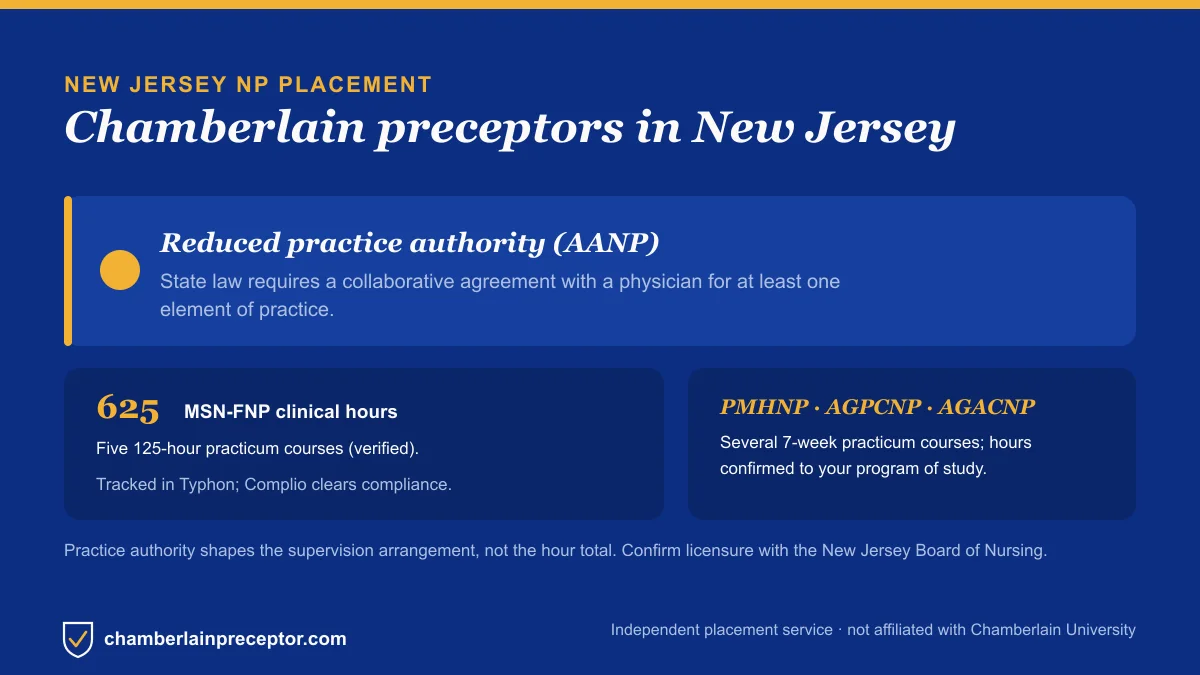
Where New Jersey stands on NP practice authority
The AANP classifies New Jersey as a reduced practice state. In plain terms, state law has long allowed Advanced Practice Nurses to assess, diagnose, and treat patients, but required a joint protocol with a collaborating physician before an APN could prescribe medications or devices.
That picture is changing. In March 2026 the governor signed S2996, which makes independent practice permanent for qualifying APNs who provide primary care or behavioral health care, removing the joint protocol requirement for that group. The rollout is still fresh, so the Board of Nursing remains the authority on how the law applies to any individual APN. Treat the transition as live and confirm current requirements at the source.
For you as a Chamberlain student, none of this changes the ground rules of practicum. Students always work under the supervision of an approved preceptor at an approved site, whatever that preceptor's own practice authority looks like. What the shift does affect is the preceptor pool itself. As more New Jersey APNs run their own primary care and psychiatric practices, more NP-owned sites become realistic practicum options, and those practices tend to answer student inquiries faster than hospital credentialing offices do.
The New Jersey Board of Nursing, in brief
Nursing in the state is regulated by the New Jersey Board of Nursing, part of the Division of Consumer Affairs. Since November 1, 1999, New Jersey's title for nurse practitioners has been Advanced Practice Nurse, so an NP here holds APN certification layered on an RN license rather than a separate NP license.
- APN certification requires a current New Jersey RN license, official graduate transcripts, and proof of passing a national certification exam.
- The graduate program must include a 3-credit pharmacology course or at least 45 integrated pharmacology hours, and older coursework triggers a continuing education refresh.
- Joint protocol standards for prescribing sit in the Board's regulations, and Board guidance is where the 2026 changes will be spelled out in practice.
Two practical uses while you search: verify a prospective preceptor's APN certification or physician license through the Division of Consumer Affairs, and let the Board's website settle any question about supervision rules that a clinic answers vaguely.
Finding a preceptor across New Jersey
Chamberlain expects you to secure your own preceptor and nominate the site in Typhon. The university's backstop, the Practicum Commitment through the Experiential Learning Team, only engages after three documented preceptor denials. That is help arriving late in the story. We run the search from denial zero instead, which matters in a state this competitive.
North Jersey
Newark, Jersey City, Hackensack, Paterson, and Morristown hold the densest concentration of clinics and health systems, but New York area NP programs compete for the same doors. Expect polite denials and slow replies without a warm introduction.
Central Jersey
New Brunswick, Edison, Princeton, Trenton, and Toms River mix academic medicine with large suburban group practices. Strong territory for FNP students, and commutable from most of the state.
South Jersey
Camden, Cherry Hill, Vineland, and Atlantic City sit across the river from Philadelphia's programs, which thins the pool. Shore towns and rural Pinelands communities are underserved and often more welcoming to students.
If your own outreach has stalled, see what to do when you cannot find a preceptor before the denials pile up.
Chamberlain practicum requirements, seen from New Jersey
| MSN-FNP | 625 supervised clinical hours across five 125-hour practicum courses |
|---|---|
| PMHNP | Several 7-week practicum courses, hours confirmed to your program of study |
| AGPCNP and AGACNP | Several 7-week practicum courses, hours confirmed to your program of study |
| DNP | Scholarly-project site and mentor rather than a set hour total |
Whatever the track, the paperwork sequence is the same. Your preceptor and site go into Typhon for nomination and approval, your compliance file clears in Complio (background check, drug screen, immunizations), and Chamberlain must hold an affiliation agreement with the site before hours count. In New Jersey the agreement step deserves respect: large systems route contracts through credentialing offices that move on their own calendar, while independent APN practices can often sign within days. Nominate early either way, and review the full Chamberlain preceptor requirements before you approach anyone.
A note on virtual hours
Telehealth is a routine part of New Jersey care delivery, and some placements include virtual visits alongside in-person clinic time. Whether telehealth hours count toward a specific practicum course varies, so confirm with your program before you build a rotation around it. When a placement blends both, the in-person portion is the safer planning anchor.
If you would rather not gamble the search
Cold outreach in North Jersey can burn a whole session before it produces a yes. We keep it simple: a free placement review of your track, courses, and location, then a search that starts the day you engage us, not after your third denial. You pay when matched, and we hold ourselves to a 14-day match commitment. See how it works and what it costs, or request your free placement review below.
Answered.
Is New Jersey a full practice or reduced practice state for NPs?
The AANP currently lists New Jersey as reduced practice because prescribing has required a joint protocol with a collaborating physician. A law signed in March 2026 removes that requirement for qualifying APNs in primary care and behavioral health, so the environment is moving toward independence. Check the New Jersey Board of Nursing for how the rules apply today.
How many clinical hours does Chamberlain require for New Jersey students?
The MSN-FNP track requires 625 supervised clinical hours across five 125-hour practicum courses, the same in New Jersey as anywhere else. PMHNP, AGPCNP, and AGACNP students complete several 7-week practicum courses with hours confirmed to their program of study, and DNP students need a scholarly-project site and mentor. Details are on our requirements page.
What has to happen before I can start hours at a New Jersey site?
Three things: your preceptor and site are nominated and approved in Typhon, your Complio compliance file (background check, drug screen, immunizations) is complete, and Chamberlain holds an affiliation agreement with the site. New agreements with large New Jersey systems can take weeks, so nominate as early as your program allows.
Do I have to collect three denials before anyone helps me?
That is how Chamberlain's own backstop works: the Practicum Commitment through the Experiential Learning Team engages only after three documented preceptor denials. We work differently and run the search from day one. If your clock is already short, start with need a preceptor fast or request a free placement review.
Get your Chamberlain practicum handled.
A free placement review. No payment until you're matched. Tell us your track and term, and we map the whole placement.