North Carolina Preceptors for Chamberlain NP Students
Chamberlain's NP coursework is online, but your practicum happens inside a real North Carolina clinic, under North Carolina rules. Here is how restricted practice shapes the preceptor search in this state, and how we run that search for you from day one.
Start your Chamberlain placement
Start your placement
A free placement review. No payment until you're matched.
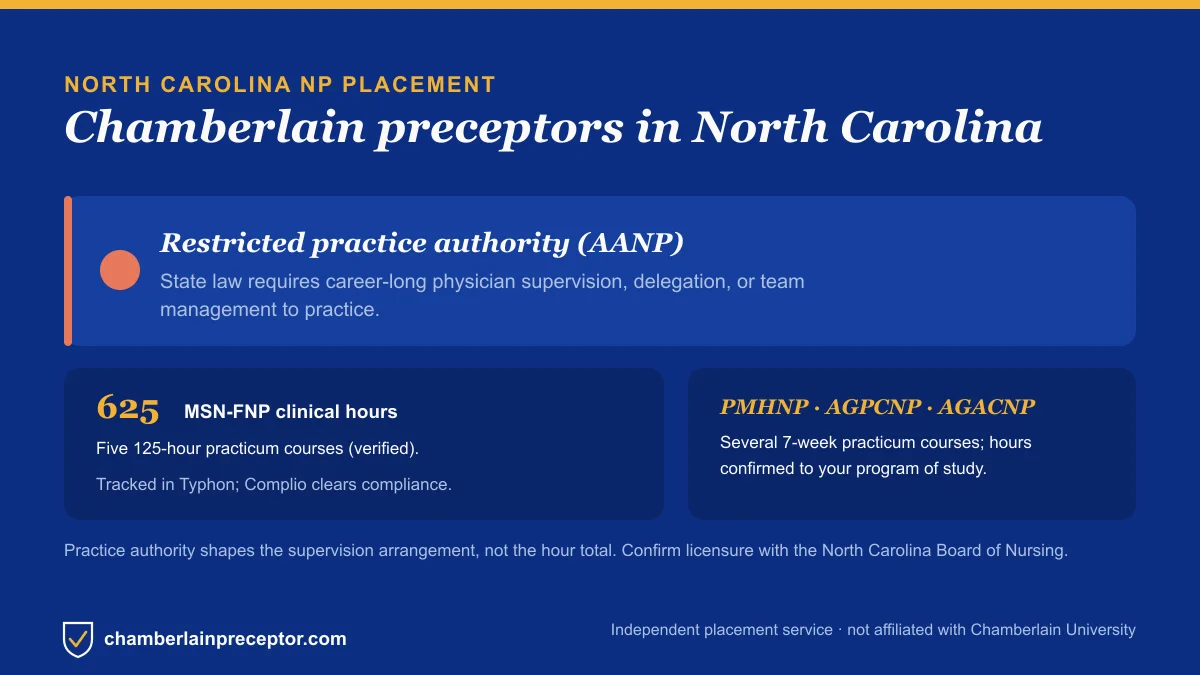
Restricted practice, explained for students
The American Association of Nurse Practitioners places North Carolina in its restricted practice category. A nurse practitioner here does not practice on licensure alone. NC requires an approval to practice, and that approval is tied to a collaborative practice agreement with a supervising physician.
The collaborative practice agreement spells out what the NP may do at a specific practice site, including prescribing, and it must be reviewed, signed, and dated by both the NP and the supervising physician every year. When an NP changes supervising physicians, the Board of Nursing must issue a new approval to practice notification before the NP sees patients again. Supervision in North Carolina is ongoing for the length of an NP's career in the state, which is exactly what the AANP restricted label means.
For a Chamberlain student, this matters in two practical ways. First, most NP preceptors you approach in North Carolina are themselves practicing under a collaborative agreement, so they are used to documentation, oversight, and defined scope. That culture tends to make sites careful about paperwork, including student affiliation agreements. Second, physicians remain deeply woven into NC primary care, so MD and DO preceptors are a realistic option alongside experienced NPs. Your program of study defines who qualifies, so check the Chamberlain preceptor requirements before you nominate anyone.
The North Carolina Board of Nursing
The North Carolina Board of Nursing (NCBON) licenses the state's nurses and, together with the North Carolina Medical Board, oversees nurse practitioner approval through joint rules. NP registration and approval to practice both run through the board, and national certification must be maintained for approval to stay active.
- Confirm any potential preceptor's license and NP approval status through the board's verification tools before you nominate them in Typhon.
- The board's NP pages explain the collaborative practice agreement, prescribing, and scope questions in detail, and they are the authority when a clinic asks what a student may observe or perform.
- If you plan to work as an RN in North Carolina while you study, the board also handles RN licensure questions, including multistate privileges.
When a site's compliance office and a rule seem to disagree, the board's published rules win. Point site administrators to the NCBON website rather than debating from memory.
Where placements actually happen in North Carolina
North Carolina is a big, uneven map for clinical placement. Demand is heaviest where the students are, and preceptor capacity does not always line up with it.
Charlotte metro
The state's largest city carries dense hospital systems and hundreds of primary care and behavioral health practices, but also the thickest competition from local NP programs. Early outreach matters most here.
The Triangle
Raleigh, Durham, and Chapel Hill concentrate academic medicine and community clinics. Family practice and psych placements exist, though academic sites often reserve slots for their own students.
Triad, coast, and mountains
Greensboro and Winston-Salem offer steady community practice options. Wilmington, Fayetteville, Greenville, and Asheville have fewer sites per student, and rural counties east and west often welcome students precisely because clinicians are scarce.
Chamberlain expects you to secure your own preceptor. The university's Practicum Commitment, through the Experiential Learning Team, steps in only after three documented preceptor denials, the 3-denial rule. That backstop is real, but it engages late, after you have already burned weeks collecting rejections. We run the search from denial zero instead, working our North Carolina contacts while you keep up with coursework. If you are already behind, start with the fast-track page.
Chamberlain practicum requirements, viewed from North Carolina
The requirements below are Chamberlain's and follow you into any state. North Carolina adds its own layer through site credentialing and the affiliation agreement.
| MSN-FNP hours | 625 supervised clinical hours across five 125-hour practicum courses. See the FNP page for course-by-course detail. |
|---|---|
| PMHNP, AGPCNP, AGACNP | Several 7-week practicum courses. Hour totals are confirmed to your program of study, so verify yours in your plan rather than relying on a published number. Track pages: PMHNP, AGPCNP, AGACNP. |
| DNP | A scholarly project site and mentor rather than a preceptored hour total. See DNP support. |
| Typhon | Chamberlain's practicum portal. You nominate the North Carolina site and preceptor here and log hours here once approved. |
| Complio | Compliance onboarding: background check, drug screen, and immunizations, all cleared before you touch a patient. |
| Affiliation agreement | Required between Chamberlain and each clinical site. New-to-Chamberlain NC sites need lead time for legal review, so nominate early. |
Virtual or in person?
Some North Carolina rotations, especially psych-mental health, may include telehealth encounters, and telehealth is widely used across the state's rural counties. Whether virtual hours count toward a given practicum course is a program decision, not a state one, so confirm with your Chamberlain program before accepting a telehealth-heavy site.
If you would rather not cold-call clinics
We are an independent placement service, not part of Chamberlain University, and matching NP students with vetted preceptors is the whole job. The placement review is free, you pay only when matched, and our match commitment is 14 days. Tell us your track, your practicum course dates, and where in North Carolina you can drive, and we will bring you a preceptor ready for Typhon nomination. Start at the consult form or read how it works first.
Sources
Answered.
Does North Carolina's restricted practice status limit where I can do clinical hours?
Not directly. Restricted practice governs how licensed NPs work, chiefly the collaborative practice agreement with a supervising physician, not where students train. Any North Carolina site can host you if the preceptor meets Chamberlain's criteria and the site signs an affiliation agreement. The practical effect is cultural: NC sites are paperwork-careful, so start nominations early. Details are on the preceptor requirements page.
Who can serve as my preceptor in North Carolina?
It depends on your program of study. Physicians and experienced nurse practitioners are the most common choices for Chamberlain students in North Carolina. Because NC nurse practitioners hold an approval to practice under a collaborative practice agreement, verify a prospective preceptor's status through the North Carolina Board of Nursing before nominating them in Typhon.
How many clinical hours does the Chamberlain FNP require?
625 supervised clinical hours, completed across five 125-hour practicum courses. That total is set by Chamberlain and applies in North Carolina just as anywhere else. PMHNP, AGPCNP, and AGACNP students complete several 7-week practicum courses with hours confirmed to their program of study. See the FNP overview for the course sequence.
What is the 3-denial rule, and why not just wait for it?
Chamberlain's Practicum Commitment has the Experiential Learning Team assist only after you document three preceptor denials. Waiting for that backstop costs weeks in a state where affiliation agreements already need lead time. We begin the search from denial zero, so most students we help never trigger the rule. More on this at can't find a preceptor.
Do I pay anything before I'm matched?
No. The placement review is free, and payment is due only when you are matched with a preceptor. Our match commitment is 14 days. Pricing detail lives on the cost page, and the consult form starts the free review.
Get your Chamberlain practicum handled.
A free placement review. No payment until you're matched. Tell us your track and term, and we map the whole placement.