Ohio Clinical Placement for Chamberlain NP Students
Ohio is a reduced practice state, and Chamberlain expects you to find your own preceptor there before its safety net ever engages. Here is how NP clinical placement really works in Ohio, and how we take the search off your plate from day one.
Start your Chamberlain placement
Start your placement
A free placement review. No payment until you're matched.
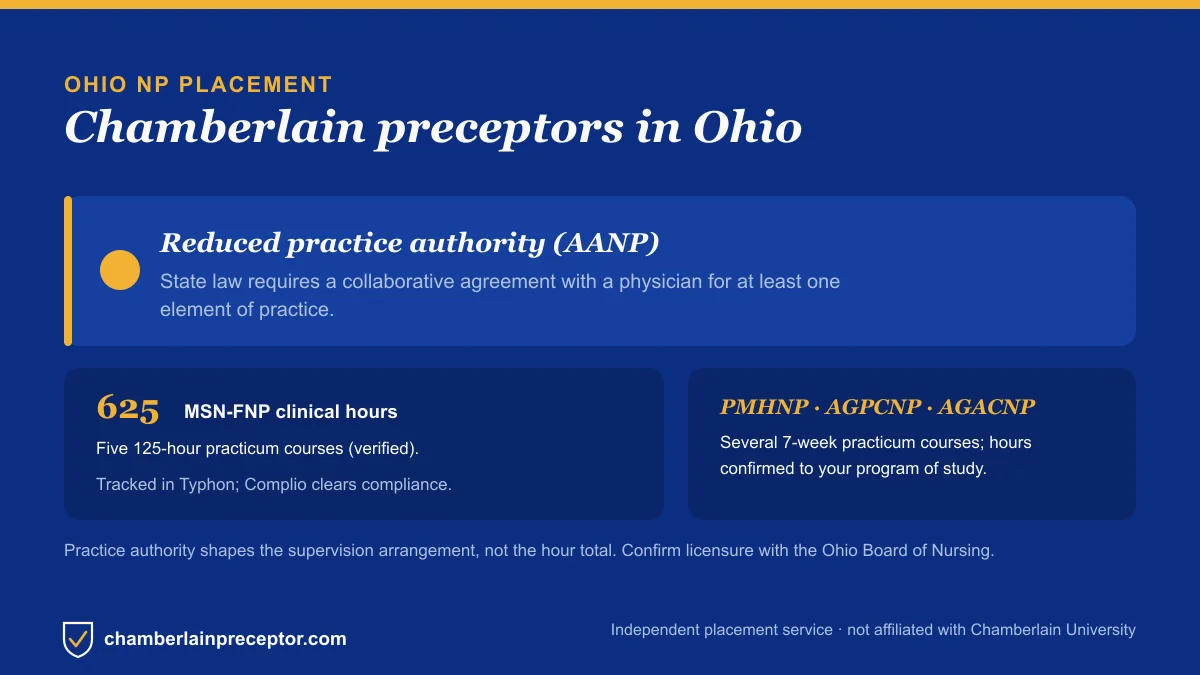
Ohio is a reduced practice state, here is what that means
The American Association of Nurse Practitioners places Ohio in its reduced practice category. Ohio NPs assess, diagnose, and prescribe, but state law ties that authority to a formal, regulated relationship with a physician.
That relationship is called a standard care arrangement. Under Section 4723.431 of the Ohio Revised Code, an APRN designated as a certified nurse practitioner may practice only in accordance with a standard care arrangement entered into with a collaborating physician or podiatrist. The employer keeps a copy of the arrangement on file, and the Ohio Board of Nursing may review it for compliance.
As a Chamberlain student you will not sign a standard care arrangement. That comes after graduation, national certification, and Ohio APRN licensure. You will feel its effects anyway: Ohio preceptors practice inside collaboration agreements, their clinics are used to formal paperwork, and most sites want the affiliation agreement squared away before a student sets foot in the building. Expect process, and start early.
Where Chamberlain students actually find preceptors in Ohio
Chamberlain requires every NP student to secure their own preceptor and site, then nominate both in Typhon for approval. The Practicum Commitment, run by the Experiential Learning Team, only steps in after you document three preceptor denials. That is a late backstop, not a search partner, and it is why so many Ohio students spend a term cold-calling clinics.
The good news is that Ohio is a big, varied market. Where you look changes your odds:
Columbus and central Ohio
The state's largest metro, with broad primary care, pediatric, and retail-clinic networks. Plenty of potential preceptors, but also the heaviest student demand in the state, so lead time matters.
Cleveland, Akron and Canton
Dense hospital systems and specialty depth across the northeast. Strong for acute care and psychiatric rotations, with real competition from local NP programs.
Cincinnati and Dayton
A busy family practice and urgent care corridor in the southwest. Independent practices here often say yes faster than large systems, if the affiliation paperwork is handled for them.
Toledo, Youngstown and rural Ohio
Smaller markets and the Appalachian southeast, where primary care shortages are real. Preceptors are fewer but frequently more welcoming, and rotations here can mean richer hands-on volume.
If you have already been turned down, do not wait to accumulate three denials before getting help. See what to do when you cannot find a preceptor.
Know your regulator: the Ohio Board of Nursing
The Ohio Board of Nursing, based in Columbus, licenses the state's RNs and APRNs and enforces the Nurse Practice Act, Chapter 4723 of the Ohio Revised Code. For NP students planning to practice in Ohio, three things are worth knowing now:
- Ohio NPs hold an APRN license with a certified nurse practitioner designation, layered on top of the RN license.
- Any Ohio license can be verified through the state's eLicense look-up, which shows status, expiration, and discipline. The portal covers other boards too, so a collaborating physician can be checked in the same place.
- The practice rules that shape day-to-day NP work, including the standard care arrangement requirement, live in Chapter 4723 and the board's administrative rules.
Make eLicense part of your practicum routine: run your prospective preceptor's license before you nominate them in Typhon. An expired or disciplined license will stall your approval weeks after you thought the search was over.
Chamberlain practicum requirements, viewed from Ohio
Your requirements come from Chamberlain, not from the state you sit in. Ohio changes the environment, not the checklist.
| MSN-FNP | 625 supervised clinical hours across five 125-hour practicum courses, each needing an approved preceptor and site. |
|---|---|
| PMHNP, AGPCNP, AGACNP | Several 7-week practicum courses, with hours confirmed to your program of study. |
| DNP | A scholarly project site and mentor rather than a set hour total. |
| Every track | Preceptor and site nomination in Typhon, compliance clearance in Complio (background check, drug screen, immunizations), and an affiliation agreement between Chamberlain and the Ohio site. |
Build in slack for the paperwork. Complio clearance and affiliation agreements each take time, and large Ohio health systems often add their own onboarding, from badge access to EMR training. The full checklist is on our Chamberlain preceptor requirements page.
Virtual or in-person hours?
Telehealth is well established in Ohio care delivery, and some rotations include virtual visits. Whether telehealth hours count toward a specific practicum course varies, so confirm with your program before accepting a virtual preceptor. In-person remains the default that approvals move fastest on.
Let us run the Ohio search from day one
You could work the phones across Columbus, Cleveland, and Cincinnati yourself, and many students do for months. Our matching team does this daily: we identify Ohio preceptors open to Chamberlain students, handle the outreach, and support the Typhon and affiliation steps through approval. The placement review is free, you pay when matched, and our match commitment is 14 days. Start with the consult form, or see how it works and what it costs. In a hurry? Read need a preceptor fast.
Answered.
Is Ohio a full practice authority state for nurse practitioners?
No. The AANP classifies Ohio as a reduced practice state. Certified nurse practitioners in Ohio practice under a standard care arrangement with a collaborating physician or podiatrist, as set out in Section 4723.431 of the Ohio Revised Code. See the AANP State Practice Environment for the current map.
Do Chamberlain students need a standard care arrangement in Ohio?
No. The standard care arrangement applies to licensed APRNs in practice, not to students. During practicum you work under your approved preceptor. You will encounter standard care arrangements after graduation, when you hold an Ohio APRN license with a CNP designation.
How many clinical hours does Chamberlain's MSN-FNP require?
625 supervised clinical hours, completed across five 125-hour practicum courses, in Ohio and everywhere else. Each course needs a preceptor and site nominated and approved in Typhon. Details are on our FNP placement and requirements pages.
What if Ohio preceptors keep turning me down?
Chamberlain's Practicum Commitment assists only after three documented preceptor denials, which can cost you a session. We start the search from denial zero instead, across Columbus, Cleveland, Cincinnati, and the rest of the state. See what to do when you cannot find a preceptor or start at the consult form.
Can my Ohio preceptor be an NP, or does it have to be a physician?
It depends on the course and specialty, so check your program of study before you commit. Many Ohio NPs precept students, and because they practice under collaboration agreements, a physician colleague is usually close by. Whoever you choose must clear license verification and Typhon approval. Our requirements guide covers who qualifies.
Get your Chamberlain practicum handled.
A free placement review. No payment until you're matched. Tell us your track and term, and we map the whole placement.