Oklahoma Clinical Placement for Chamberlain NP Students
Oklahoma is a restricted practice state, and that shapes both where NPs work and who is free to precept you. Here is how Chamberlain students line up practicum sites from Oklahoma City to the Panhandle, and what to do when the search stalls.
Start your Chamberlain placement
Start your placement
A free placement review. No payment until you're matched.
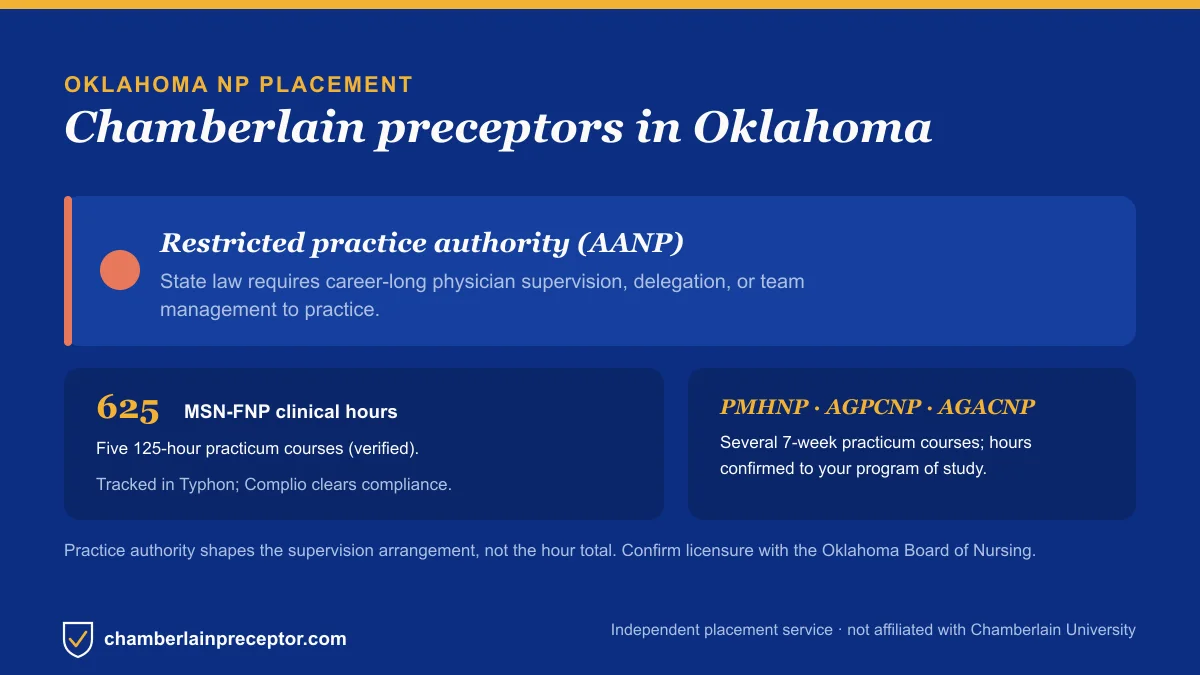
Restricted practice, explained for students
The AANP classifies Oklahoma as a restricted practice state, meaning state law restricts at least one element of NP practice and requires ongoing oversight arrangements for some functions, most visibly prescribing.
For most Oklahoma NPs, prescriptive authority has historically required a formal agreement with a supervising physician on file with the Oklahoma Board of Nursing. That picture shifted on November 1, 2025, when House Bill 2298 took effect. APRNs who complete 6,240 hours of clinical practice under supervised prescriptive authority can now apply for independent prescriptive authority, including Schedule III through V controlled substances, without a physician signature. Oklahoma still sits in the restricted column on the AANP map, but the ground is moving.
What does this mean for your practicum? Two practical things. First, many of the NPs you might ask to precept you work inside physician-supervised structures, so their clinics already handle oversight paperwork and an affiliation agreement rarely surprises anyone. Second, those supervising relationships mean Oklahoma practices tend to think in teams, and a clinic pairing an experienced physician with an NP can be an unusually good training ground.
The Oklahoma Board of Nursing
The Oklahoma Board of Nursing administers the Oklahoma Nursing Practice Act and licenses both RNs and Advanced Practice Registered Nurses. Certified Nurse Practitioners have been recognized in the Act since 1980. APRN licensure today requires graduate education and a board-approved national certification exam, with an endorsement pathway for nurses already licensed in another state.
- Licensure, renewal and practice guidance live on the board's site at oklahoma.gov/nursing.
- Prescriptive authority is a separate recognition. Supervised prescriptive authority requires a filed physician agreement, and a change of supervising physician must be reported to the board within 30 days.
- The board offers a written verification of APRN licensure request form, handy when a clinical site or your program wants formal proof of a preceptor's credential.
Before you nominate anyone in Typhon, spend two minutes confirming the preceptor's Oklahoma license is active and unencumbered. It is the cheapest insurance in the entire placement process.
Finding a preceptor across Oklahoma
Chamberlain expects you to secure your own preceptor and nominate the site and provider in Typhon well before the course starts. The Practicum Commitment through the Experiential Learning Team only steps in after three documented preceptor denials, which usually means a lost session or two before help arrives. Our service runs the search from denial zero instead, so the safety net never has to catch you.
Oklahoma City metro
OKC, Edmond, Norman, Moore and Midwest City hold the state's densest mix of family practice, urgent care, behavioral health and specialty clinics. The catch: students from several NP programs are asking the same providers.
Tulsa metro
Tulsa, Broken Arrow, Owasso, Jenks and Bixby offer a second deep market, with strong primary care and psychiatric outpatient options for FNP and PMHNP rotations.
Regional hubs
Lawton, Enid, Stillwater, Ardmore, Muskogee, McAlester and Durant have fewer sites but far less competition. A well-timed ask here often gets a faster yes than a cold email in OKC.
Rural and tribal Oklahoma
Community health centers, rural health clinics and tribal health systems serve the Panhandle and the southeastern counties. Onboarding steps vary by organization, so start conversations early.
Wherever you search, sequence matters: identify the provider, confirm the clinic will sign an affiliation agreement with Chamberlain, then nominate in Typhon with time to spare for review.
Chamberlain practicum requirements, viewed from Oklahoma
| Program | What the practicum involves |
|---|---|
| MSN-FNP | 625 supervised clinical hours across five 125-hour practicum courses. |
| PMHNP, AGPCNP, AGACNP | Several 7-week practicum courses; hours are confirmed to your specific program of study. |
| DNP | A scholarly-project site and mentor rather than a set hour total. |
Whatever the track, the mechanics are identical in Oklahoma: nominate the site and preceptor in Typhon, clear Complio compliance onboarding (background check, drug screen, immunizations), and make sure the site signs an affiliation agreement with Chamberlain before day one. Smaller Oklahoma clinics that have never signed one may need extra lead time, so build that into your calendar. The full checklist lives at Chamberlain preceptor requirements.
Virtual or in person in Oklahoma
Telehealth is a real part of care delivery in a state this spread out, and some rotations can include virtual visits. Acceptability varies by course and population focus, so confirm with your program before counting on virtual hours. For assessment-heavy FNP courses, an in-person site remains the simplest path; a hybrid arrangement can bridge the distance if you live hours from a metro.
If you would rather not gamble the semester
Cold-calling clinics between work shifts is how most searches stall. We start with a free placement review, match you with a vetted Oklahoma preceptor under a 14-day match commitment, and you pay only when matched. If the deadline is already close, see need a preceptor fast, or go straight to the consult form and tell us your course and city. Details on pricing sit at cost and the process at how it works.
Answered.
Is Oklahoma a full practice state for nurse practitioners?
No. The AANP lists Oklahoma as a restricted practice state. House Bill 2298, effective November 2025, lets APRNs with 6,240 supervised prescriptive-authority hours apply for independent prescriptive authority, but the state remains in the restricted category. See the AANP State Practice Environment map for the current classification.
Who can precept a Chamberlain student in Oklahoma?
Eligibility is set by your program and confirmed during Typhon nomination, so check the requirements before approaching anyone. As a rule of thumb, licensed providers actively practicing in your population focus are the strongest candidates, and verifying an Oklahoma license through the Board of Nursing takes minutes.
How many clinical hours does Chamberlain's FNP program require?
The MSN-FNP requires 625 supervised clinical hours across five 125-hour practicum courses, the same in Oklahoma as anywhere else. Other tracks such as PMHNP and AGACNP run several 7-week practicum courses with hours confirmed to your program of study. Details at our FNP page.
What happens after three preceptor denials?
Chamberlain's Practicum Commitment engages the Experiential Learning Team only after three documented denials, so document every decline in Typhon. That backstop arrives late in the timeline, which is why we begin the search on day one instead. More on this at can't find a preceptor.
Can you place me outside Oklahoma City and Tulsa?
Yes. We work statewide, including Lawton, Enid, Stillwater, Ardmore, Muskogee and rural communities across the Panhandle and southeastern Oklahoma. Tell us your course, timeline and city through the consult form and we will start the review free.
Get your Chamberlain practicum handled.
A free placement review. No payment until you're matched. Tell us your track and term, and we map the whole placement.