Find a Chamberlain NP Preceptor in Pennsylvania
Pennsylvania licenses nurse practitioners as CRNPs and expects the medical side of the role to run through a collaborative agreement with a physician, which quietly shapes where students train and who signs off on their hours. Here is how Chamberlain students line up preceptors across the Commonwealth, and how we take that search off your plate from day one.
Start your Chamberlain placement
Start your placement
A free placement review. No payment until you're matched.
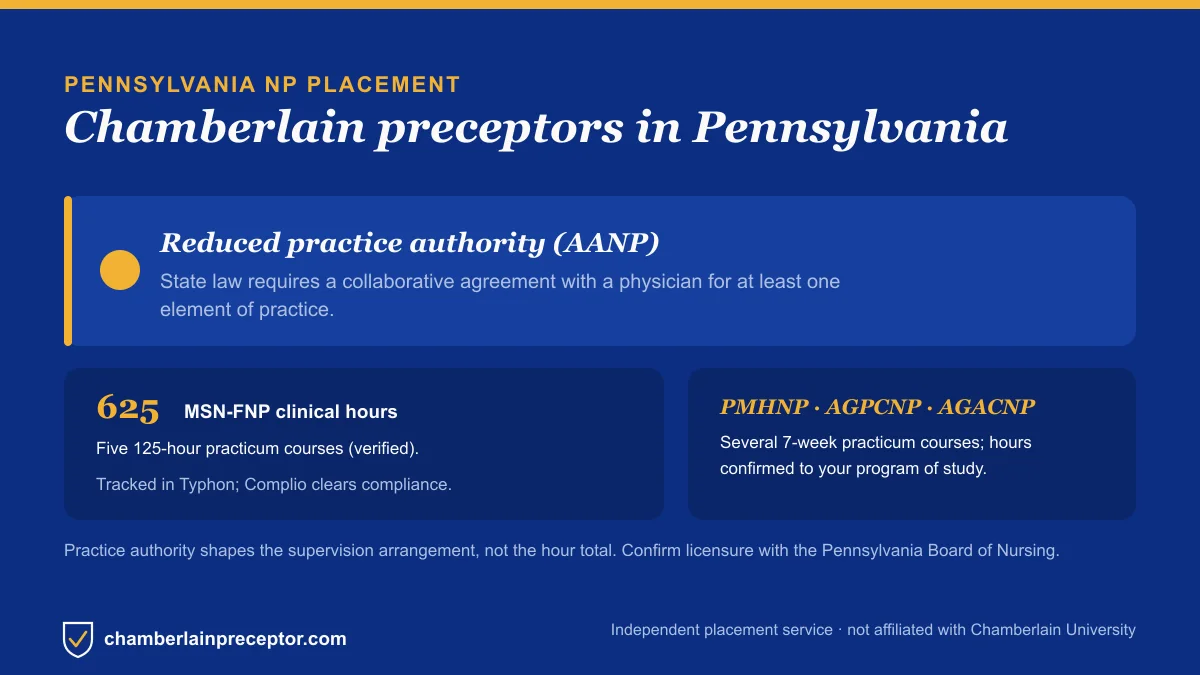
Pennsylvania is a reduced practice state, and that shapes your practicum
The AANP classifies Pennsylvania as a reduced practice environment. Nurse practitioners here hold the title Certified Registered Nurse Practitioner, CRNP, and they diagnose and prescribe in collaboration with a licensed physician. A CRNP who prescribes also files a separate prescriptive authority collaborative agreement with the state, naming the physician they work with.
For a student, this is mostly background hum rather than an obstacle. Pennsylvania has one of the deepest benches of NPs, physicians, and clinics in the Northeast, and the collaborative structure does not stop a qualified CRNP from precepting. What it does mean in practice: your preceptor's work already sits inside a defined written agreement, so Pennsylvania clinics are used to paperwork, and they will expect your school's paperwork, the affiliation agreement, to be fully executed before your first shift.
The Pennsylvania State Board of Nursing, and what it controls
The State Board of Nursing sits inside the Pennsylvania Department of State's Bureau of Professional and Occupational Affairs. It licenses RNs, certifies CRNPs, approves the graduate programs that feed the role, and handles discipline. Becoming a CRNP takes a current, unrestricted Pennsylvania RN license or a multistate equivalent, a graduate degree from a board-approved NP program, and national certification in your population focus.
- Prescriptive authority is its own application. The collaborating physician must hold a current Pennsylvania license, and both the CRNP and the physician complete their portions through the board's online licensing portal.
- CRNPs renew every two years with 30 hours of continuing education, and at least 16 of those hours must be pharmacology when the CRNP holds prescriptive authority.
- Before you commit to any preceptor, you can verify their RN, CRNP, or physician license through the board's online license verification system.
When a site asks a scope question your program cannot answer, the board is the referee. Send the question there instead of guessing.
Where Chamberlain students actually find preceptors in Pennsylvania
Chamberlain's model is direct: you secure your own preceptor, then nominate the site and preceptor in Typhon for approval. The Practicum Commitment through the Experiential Learning Team only engages after three documented preceptor denials, which is late in the game when your course start is weeks away. We run the search from denial zero instead, so the 3-denial rule stays a backstop you never need to touch.
The good news is that Pennsylvania gives you real room to work:
Philadelphia and the southeast
Dense primary care, pediatrics, and behavioral health across the city plus Bucks, Montgomery, Chester, and Delaware counties. Competitive because of the region's many nursing schools, so start early.
Pittsburgh and the west
Large health systems anchor the city, while independent family practices in the suburbs and river towns are often more open to students.
The center of the state
Harrisburg, Lancaster, York, and State College run on community clinics and family practices that frequently welcome the students big cities turn away.
Allentown and the Lehigh Valley, Scranton and Wilkes-Barre, Erie, Reading, and the rural northern tier round out the map. Rural counties have fewer NPs to ask, but the preceptors there tend to say yes more often, and a rural family practice rotation is strong clinical experience. Large systems usually route students through a placement office, which adds lead time; independent practices can move in days.
Chamberlain practicum requirements, viewed from Pennsylvania
| MSN-FNP | 625 supervised clinical hours across five 125-hour practicum courses. |
|---|---|
| PMHNP | Several 7-week practicum courses; hours are confirmed to your program of study. |
| AGPCNP and AGACNP | Several 7-week practicum courses; hours are confirmed to your program of study. |
| DNP | A scholarly-project site and mentor rather than a set hour total. |
Every placement follows the same Chamberlain sequence. You nominate the site and preceptor in Typhon, clear compliance in Complio, background check, drug screen, and immunizations, and Chamberlain executes an affiliation agreement with the site. Pennsylvania sites often add their own onboarding on top, and child abuse clearances are a common ask here, so read the site's checklist the day you get it. See the full preceptor requirements before you nominate, because a rejected nomination costs weeks.
Virtual or in person in Pennsylvania
Telehealth is an everyday part of Pennsylvania primary care and psychiatric care, and some preceptors offer hybrid schedules. Whether virtual hours count toward a given practicum course varies by program and course, so confirm with Chamberlain before accepting a telehealth-heavy placement. If in-person options near you are thin, say so when you contact us; a slightly longer drive to a confirmed preceptor beats a virtual placement your program will not accept.
If the search is stalling, hand it to us
We place Chamberlain NP students across Pennsylvania every term, from Philadelphia rowhouse clinics to family practices outside Erie. The review of your situation is free, you pay only when matched, and our match commitment is 14 days. Tell us your course start date and your county, and we start calling the same day. Request your free placement review, or read how it works and what it costs first.
Answered.
Is Pennsylvania a full practice state for nurse practitioners?
No. The AANP lists Pennsylvania as a reduced practice state. CRNPs diagnose and prescribe in collaboration with a licensed physician, and prescriptive authority requires a collaborative agreement filed with the State Board of Nursing. This does not prevent Pennsylvania NPs from serving as preceptors.
Who finds my preceptor for a Pennsylvania rotation, me or Chamberlain?
You do. Chamberlain students secure their own preceptor and nominate them in Typhon. The university's Practicum Commitment team assists only after three documented preceptor denials. We run the search for you from day one instead; see how it works or start at can't find a preceptor.
How many clinical hours will I complete in Pennsylvania as a Chamberlain FNP student?
The MSN-FNP requires 625 supervised clinical hours across five 125-hour practicum courses. PMHNP, AGPCNP, and AGACNP students complete several 7-week practicum courses with hours confirmed to their program of study. Every hour is logged in Typhon under an approved preceptor.
Can any of my Pennsylvania practicum hours be done through telehealth?
Sometimes. Telehealth is common in Pennsylvania primary care and psychiatric settings, but whether virtual hours count toward a specific practicum course depends on your program. Confirm with Chamberlain before you accept a telehealth-heavy placement, and we can prioritize in-person sites if needed.
How fast can you place me if my Pennsylvania course start is close?
Our match commitment is 14 days, and the placement review is free; you pay only when matched. If you are up against a deadline, start at need a preceptor fast or go straight to the consult form on this page.
Get your Chamberlain practicum handled.
A free placement review. No payment until you're matched. Tell us your track and term, and we map the whole placement.