Find Your Chamberlain Practicum Preceptor in South Dakota
South Dakota grants nurse practitioners full practice authority, yet the preceptor search still runs on two very different halves: the clinic-dense East River counties around Sioux Falls and the wide open West River country beyond the Missouri. Here is how Chamberlain students get placed in both, without waiting on the three-denial backstop.
Start your Chamberlain placement
Start your placement
A free placement review. No payment until you're matched.
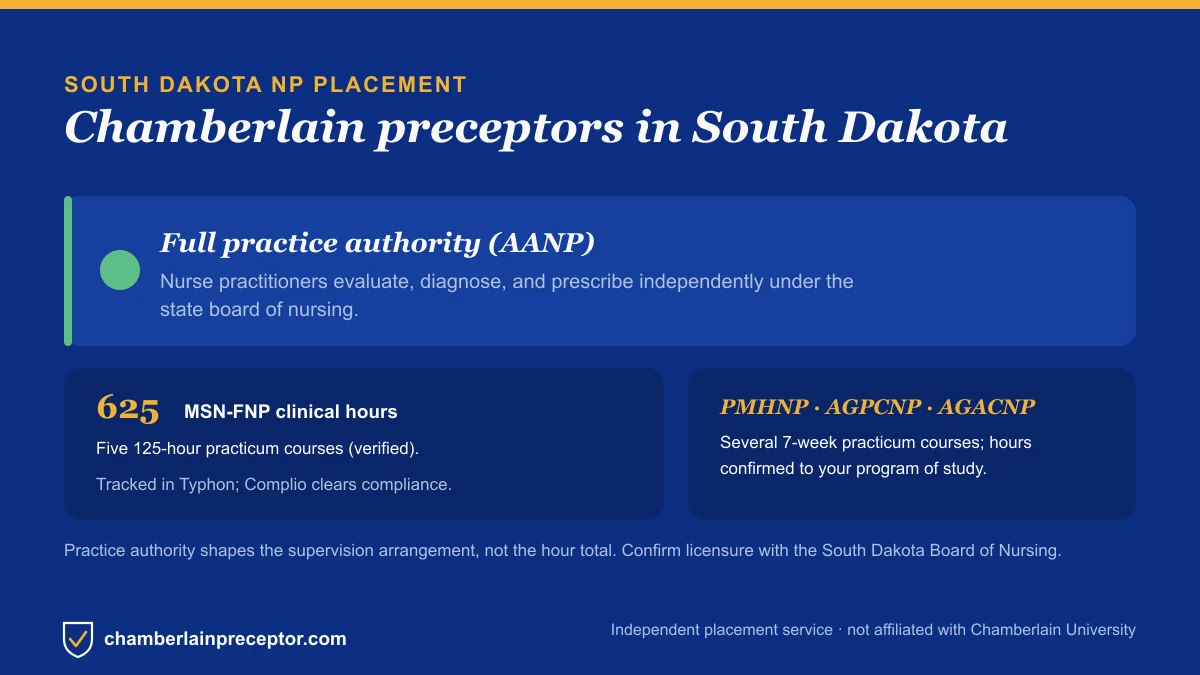
Where South Dakota stands on NP practice
South Dakota sits in the full practice category on the AANP State Practice Environment map. State law lets certified nurse practitioners, the CNP credential used here, evaluate patients, diagnose, order and interpret tests, and prescribe, controlled substances included, under the sole authority of the state nursing board.
The state adopted this framework in 2017, becoming the 22nd state to do so, with one transition rule attached: a newly licensed CNP practices under a written collaborative agreement with a South Dakota physician, CNP, or certified nurse midwife until 1,040 practice hours are verified, then files a practice verification form with the board to retire the agreement.
Why should a practicum student care? Because the preceptor pool widens in a state like this. Seasoned CNPs run their own panels and staff rural clinics solo, and they can host a student without arranging physician sign-off first. The hard part is finding one with room for you.
The real South Dakota placement map
Placement here is a tale of two halves. East River holds most of the population and most of the clinics; West River is the Black Hills and a long list of small towns. Four searches we actually run:
Sioux Falls metro
Two large health systems are headquartered here alongside independent family practice, psychiatric, and urgent care offices. The deepest preceptor pool in the state, and the one local nursing programs draw from too, so ask early.
Rapid City and the Black Hills
A regional hospital system, VA clinics, and Indian Health Service facilities anchor West River care. Fewer sites and slower credentialing at federal facilities, but preceptors who tend to keep taking students once they start.
Aberdeen, Watertown, Brookings
The northeastern hubs mix hospital-owned clinics with small private practices. Paperwork often moves faster here than in the metro systems, which matters when a term start is close.
Pierre, Mitchell, Yankton, Huron
Smaller cities where an NP is often the backbone of primary care. Wide scope, varied case logs, and clinics that remember what needing clinical hours felt like.
Chamberlain's process puts the search on you: find a willing preceptor, then nominate the site and preceptor in Typhon for approval. The Practicum Commitment backstop through the Experiential Learning Team exists, but it engages only after three documented preceptor denials, which can burn most of a term. We do not wait for that. Our team opens the South Dakota outreach with your first request, confirms interest and licensure, and hands you a nomination-ready preceptor. The process page shows each step, and this guide helps if your own search has already stalled.
Know your board: the South Dakota Board of Nursing
The South Dakota Board of Nursing, operating under the state Department of Health from its Sioux Falls office, licenses the state's RNs, LPNs, and advanced practice nurses and fields scope of practice questions for all of them. A few habits worth adopting during your search:
- Run every prospective preceptor through the board's public license verification before the Typhon nomination goes in. An expired or encumbered license discovered late can cost you a course start.
- Bookmark the board's CNP practice page. It covers collaborative agreement mechanics, the practice verification step at 1,040 hours, and the prescribing rules your preceptor works under.
- When a question concerns your own future licensure rather than your practicum, ask the board directly rather than relying on summaries.
Chamberlain decides who may precept your course. The board decides who may practice. You need both answers to line up.
Chamberlain requirements do not change at the state line
Whether your rotation happens in a Sioux Falls specialty office or a Yankton family clinic, the program structure travels with you. The MSN-FNP requires 625 supervised clinical hours across five 125-hour practicum courses. PMHNP, AGPCNP, and AGACNP students complete several 7-week practicum courses, with hour totals confirmed to the program of study. DNP students need a scholarly project site and mentor rather than a set hour count.
| Checkpoint | What it involves |
|---|---|
| Typhon nomination | Submit your preceptor and site for Chamberlain approval, then log your hours there through the rotation |
| Complio onboarding | Background check, drug screen, and immunization records cleared before you set foot on site |
| Affiliation agreement | A signed agreement between Chamberlain and each site; first-time sites need extra weeks for contracting |
The preceptor requirements page lists what your nominee must provide. Share it with a prospective preceptor early; clinics say yes faster when the ask is specific.
A word on telehealth hours
Video visits are ordinary medicine in a state where the next clinic can be an hour's drive, and some South Dakota preceptors split their week between in-person and virtual care. Whether those virtual encounters count toward your hours is a Chamberlain course question, not a state one, so confirm with your program before committing to a telehealth-heavy site. Courses that assess hands-on skills will need in-person patient contact regardless.
Ready when you are
The placement review is free, payment is due only when you are matched, and once we take a search we commit to a match within 14 days. Tell us your track, your term dates, and whether you are East River, West River, or willing to drive, at the consult form. Pricing sits on the cost page, and if your deadline is already uncomfortable, start at the fast placement page.
Independent placement service for students. Independent of Chamberlain University.
Answered.
Is South Dakota a full practice authority state for NPs?
Yes. The AANP State Practice Environment map places South Dakota in the full practice category, which it joined in 2017 as the 22nd state. Licensed CNPs practice and prescribe under the South Dakota Board of Nursing alone once an initial transition period is complete.
What is the 1,040 hour rule and does it affect my practicum?
It is a licensure transition for new CNPs, not a student requirement. After you are licensed in South Dakota, you practice under a written collaborative agreement with a physician, CNP, or certified nurse midwife until 1,040 hours are verified, then ask the board to retire the agreement. For students it mainly means experienced CNPs, your likely preceptors, already practice independently.
Who finds my preceptor, me or Chamberlain?
You do, at least at first. Chamberlain students secure their own preceptor and submit the nomination in Typhon; university placement help through the Practicum Commitment begins only after three documented denials. We run the search from your first request instead. See how the process works.
How many practicum hours will I complete as a Chamberlain FNP student in South Dakota?
625 supervised clinical hours, split across five 125-hour practicum courses, the same in every state. PMHNP, AGPCNP, and AGACNP students complete several 7-week practicum courses with hours confirmed to the program of study, and DNP students work with a scholarly project site and mentor.
Can a South Dakota CNP precept me, or do I need a physician?
CNPs precept Chamberlain students routinely, and full practice authority makes NP-run sites common across South Dakota. Eligibility for your specific course is set by Chamberlain and checked at Typhon nomination, so review the preceptor requirements and verify the license with the board before you nominate.
Get your Chamberlain practicum handled.
A free placement review. No payment until you're matched. Tell us your track and term, and we map the whole placement.