Finding a Chamberlain Preceptor in Texas
Texas trains and employs a huge share of the country's nurse practitioners, yet it remains one of the most tightly regulated states to practice in. Here is what that means for your Chamberlain practicum, and how to line up a preceptor in Houston, Dallas, San Antonio, or anywhere else in the state.
Start your Chamberlain placement
Start your placement
A free placement review. No payment until you're matched.
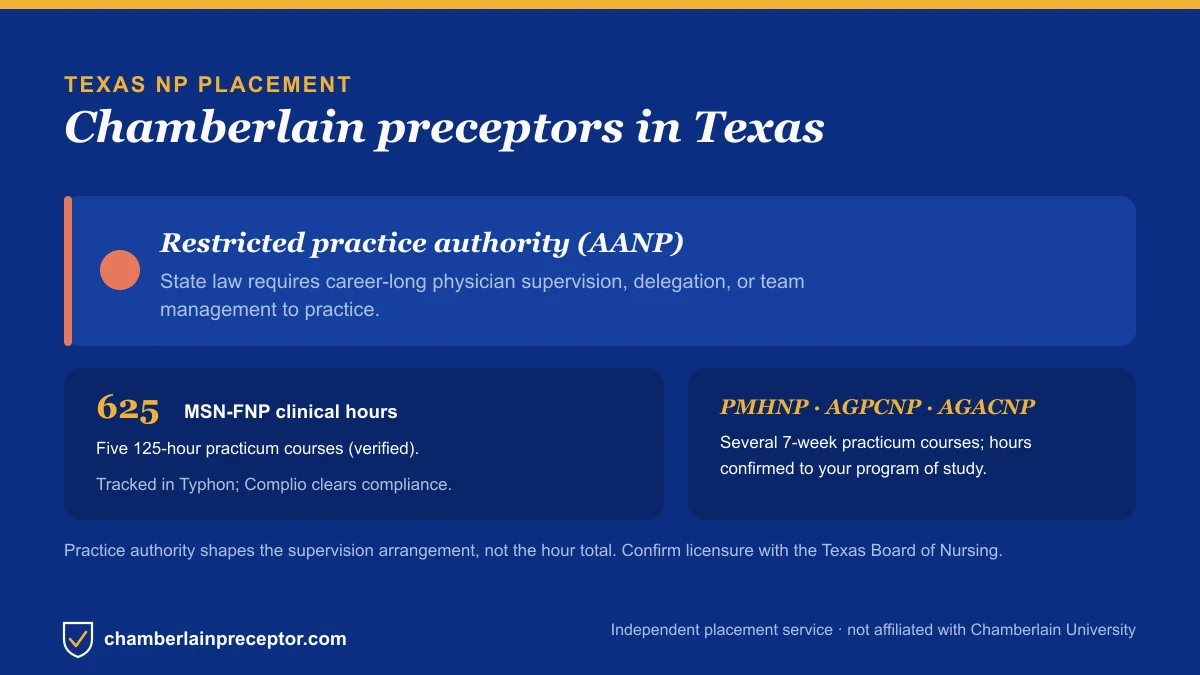
Texas is a restricted practice state. Here is the practical version
The American Association of Nurse Practitioners classifies Texas as a restricted practice environment, the tightest of its three categories. State law requires career-long supervision, delegation, or team management by another health provider for at least one element of NP practice.
In Texas that plays out through physician delegation. Nurse practitioners provide the medical aspects of care under a delegating physician, most often through a written prescriptive authority agreement, or through a facility-based protocol in hospital and long-term care settings. Prescriptive delegation is registered with the Texas Medical Board, and the Texas Board of Nursing publishes detailed FAQs on how the agreements work in daily practice.
Why does this matter to a student? Because it shapes who can precept you and how stretched they are. A Texas NP who takes you on is already practicing under a delegation agreement, and delegating physicians carry their own panels plus that oversight. None of this blocks your placement. It simply means preceptor asks in Texas take more persistence and earlier outreach than students expect.
The Texas Board of Nursing, and what it controls
The Texas Board of Nursing (BON) licenses and regulates both RNs and APRNs statewide. APRN licensure in Texas sits on top of an active RN license and requires graduate nursing education and current national certification in a role and population focus. The board also handles prescriptive authority registration on the nursing side and maintains the rules that govern delegation agreements and facility protocols.
Two habits worth building before you nominate anyone in Typhon:
- Run your prospective preceptor through the board's online license verification and confirm the license is active and unencumbered.
- Check that an NP preceptor's population focus lines up with your practicum course. A family NP preceptor for a family practicum course is a clean match, and mismatches are a common reason nominations stall.
Board rules change through the legislature and rulemaking, so treat bon.texas.gov as the current source rather than any summary.
Finding a preceptor across Texas
Texas is enormous, and your search strategy should match your region. The state has deep clinician density in its metro areas and genuine shortage zones between them.
Houston and the Gulf Coast
The Texas Medical Center anchors a huge concentration of clinics, systems, and specialty practices. High demand from competing NP programs, so start early.
Dallas and Fort Worth
The Metroplex offers strong family practice and psychiatric options across a wide suburban ring, from Plano and Frisco to Arlington and Denton.
San Antonio and Hill Country
A large military and civilian health footprint plus community clinics reaching into Boerne, New Braunfels, and Kerrville.
Austin and Central Texas
Fast-growing systems and independent practices, with reach into Round Rock, San Marcos, Temple, and Waco.
El Paso and West Texas
Fewer sites spread across long distances, including Midland, Odessa, and Lubbock. Sites here often welcome students who commit early.
South Texas and the Valley
Corpus Christi, Laredo, McAllen, and Harlingen serve high-need communities where preceptors can be both scarce and deeply invested in students.
Now the Chamberlain reality. You secure your own preceptor, then nominate the site and preceptor in Typhon for approval. The university's Practicum Commitment through the Experiential Learning Team steps in only after you document three preceptor denials, the 3-denial rule, which means the backstop engages late, after weeks of outreach have already gone nowhere. We flip that timeline and run the Texas search from denial zero while you stay focused on coursework. Mid-search and stuck? See can't find a preceptor, or need a preceptor fast for compressed timelines.
Chamberlain practicum checkpoints, viewed from Texas
The program requirements travel with you. What changes in Texas is the paperwork rhythm around them.
| MSN-FNP hours | 625 supervised clinical hours across five 125-hour practicum courses. See the FNP placement page for the course-by-course picture. |
|---|---|
| PMHNP, AGPCNP, AGACNP | Several 7-week practicum courses. Hour totals are confirmed to your specific program of study, so verify yours rather than relying on a published number. |
| DNP | A scholarly project site and mentor rather than a traditional preceptorship. Details on the DNP page. |
| Typhon | Chamberlain's practicum portal. You nominate your Texas site and preceptor here and log hours here once approved. |
| Complio | Compliance onboarding: background check, drug screen, and immunization records, cleared before you touch a patient. |
| Affiliation agreement | Required between Chamberlain and each Texas site. Large systems may already hold one; independent practices usually need a new agreement, which adds lead time. |
The affiliation agreement is the quiet schedule-killer. A solo practice in Amarillo that has never hosted a Chamberlain student can absolutely precept you, but the agreement must be executed first, so build in that buffer. Full checklist on the requirements page.
Virtual or in-person in Texas?
Telehealth is heavily used across Texas, particularly for psychiatric care and rural coverage, so telehealth preceptorships genuinely exist here. But whether a virtual experience counts toward a given practicum course is a program decision, not a state one. Confirm with your program before nominating a telehealth site in Typhon, and treat in-person placement as the default for hands-on assessment courses.
If Texas is where you need a preceptor
We place Chamberlain NP students with vetted preceptors across Texas, from the Metroplex to the Valley. The placement review is free, you pay only when matched, and our match commitment is 14 days. Tell us your practicum course, your city, and your deadline through the consult form, or read how it works and what it costs first. Placements for every state are indexed on the states page.
Answered.
Does Texas have full practice authority for nurse practitioners?
No. The AANP classifies Texas as restricted practice. Texas NPs provide medical aspects of care under physician delegation, usually through a written prescriptive authority agreement, with delegation registered through the Texas Medical Board. Day to day the care looks similar, but your preceptor practices inside that framework.
How many clinical hours does Chamberlain's MSN-FNP require in Texas?
The same as everywhere: 625 supervised clinical hours across five 125-hour practicum courses. Texas does not change the total. Other tracks such as PMHNP and AGPCNP run several 7-week practicum courses with hours confirmed to your program of study. Details are on the FNP page and the requirements page.
Can my Texas preceptor be a physician instead of an NP?
Often yes. Chamberlain approves each nominated preceptor in Typhon against your specific practicum course requirements, and many students rotate with physicians or a mix of clinicians. Confirm the Typhon approval before committing to a schedule, and verify the clinician's Texas license first.
What happens if three Texas preceptors turn me down?
After three documented denials, Chamberlain's Practicum Commitment through the Experiential Learning Team assists with placement. That is the 3-denial rule, and it activates late. We start from denial zero instead, which is the whole point of the service. If you are already deep in a stalled search, start with the can't find a preceptor guide or the consult form.
Do you place students outside the big Texas metros?
Yes. We work placements in smaller markets like Lubbock, Tyler, Waco, and the Rio Grande Valley, where sites are fewer but often more welcoming. If a local match is genuinely thin, ask your program whether a telehealth practicum is acceptable for your course before widening your radius.
Get your Chamberlain practicum handled.
A free placement review. No payment until you're matched. Tell us your track and term, and we map the whole placement.