Chamberlain Preceptor Help in Utah, a Full Practice State
Utah gives nurse practitioners full practice authority, and its fast growing communities need every clinician they can get. Chamberlain students still secure their own preceptors here, so this page walks through how NP practicum placement really works in Utah and where we come in.
Start your Chamberlain placement
Start your placement
A free placement review. No payment until you're matched.
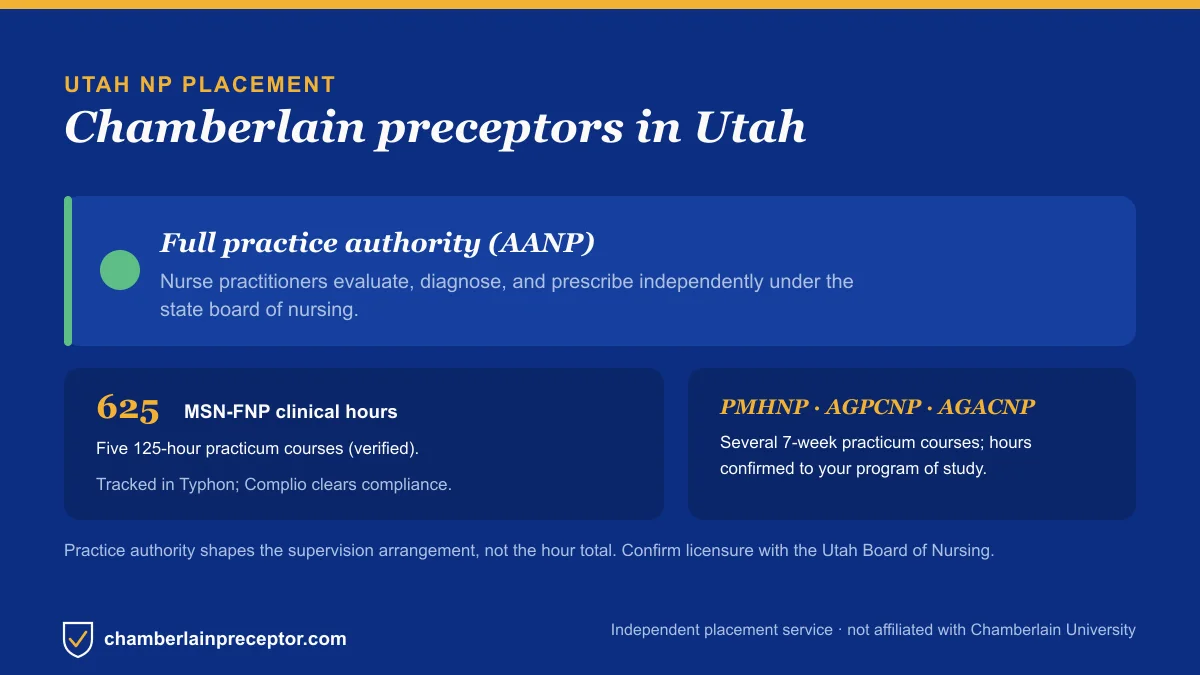
Utah is a full practice state, and that changes your preceptor math
The American Association of Nurse Practitioners classifies Utah as a full practice environment. Licensed NPs here evaluate patients, diagnose, order and interpret diagnostic tests, and initiate and manage treatments, including prescriptions, under the licensure authority of the state nursing regulator, with no mandated physician contract.
It was not always this way. Utah moved into the full practice column in March 2023, when Senate Bill 36 was signed into law and the state became the 27th to grant NPs full practice authority. The bill eliminated the state mandated physician agreement that used to sit underneath an APRN license.
For a Chamberlain student, the practical upside is a wider preceptor pool. Utah has NP owned clinics in family practice and psychiatric care that can host practicum students in their own right, alongside the large health systems. A search here is not limited to physician anchored offices, which matters most for FNP and PMHNP students hunting primary care and psych hours.
Who regulates NPs in Utah
Nursing licensure in Utah runs through the Division of Professional Licensing, usually shortened to DOPL, inside the Utah Department of Commerce, with the Utah Board of Nursing overseeing practice questions. APRN is its own license classification here, and applicants document graduate coursework in patient assessment, diagnosis and treatment, and pharmacotherapeutics.
- License applications, renewals and verification all live at dopl.utah.gov/nursing, the official .gov source for anything licensure related in the state.
- Utah also issues an APRN Intern license, a bridge credential DOPL describes for new graduates finishing the last steps toward full APRN licensure.
- APRN licenses in Utah expire on January 31 of even numbered years, a detail worth knowing if a preceptor's renewal window lands in the middle of your rotation.
Look up any prospective preceptor's license status through DOPL before you nominate them in Typhon. It takes minutes and can save weeks of rework.
Where Chamberlain students actually find preceptors in Utah
Utah's population is unusually concentrated, which shapes the search. Roughly three quarters of the state lives along one urban corridor, and the rest is spread across small cities and true frontier country.
Wasatch Front
Salt Lake City, West Valley City, Ogden, Provo and Orem hold most of the state's clinics. Large integrated systems dominate here, and their clinicians are often already committed to students from local programs, so expect credentialing queues and early asks.
Southern Utah
St. George and Cedar City sit in one of the fastest growing corners of the country. New primary care and behavioral health clinics keep opening, and newer practices are often more open to a first time preceptor relationship.
Cache Valley and rural Utah
Logan, Vernal, Price and Moab anchor communities where NP run clinics are a fixture of daily care. Full practice authority makes these strong teaching sites, though commute and lodging deserve a hard look before you commit.
Now the Chamberlain reality. You are expected to secure your own preceptor and nominate the site and preceptor in Typhon. The Practicum Commitment through the Experiential Learning Team engages only after three documented preceptor denials, the 3-denial rule, which means the school's safety net tightens late in the game. We run the Utah search from denial zero instead, so the backstop never has to matter. If you are already stuck, start with what to do when you cannot find a preceptor or see how our process works.
Chamberlain practicum requirements, seen from Utah
| MSN-FNP | 625 supervised clinical hours across five 125 hour practicum courses, typically in family practice settings. |
|---|---|
| PMHNP | Several 7 week practicum courses, with hours confirmed to your program of study rather than a single published total. |
| AGPCNP and AGACNP | Several 7 week practicum courses, hours confirmed to your program of study, in adult gerontology primary or acute care sites. |
| DNP | A scholarly project site and mentor rather than a set clinical hour total. |
Every Utah site you use must hold an affiliation agreement with Chamberlain, and you clear compliance in Complio, which covers the background check, drug screen and immunization records. If your clinic has never hosted a Chamberlain student, the agreement gets executed before you start, so build that lead time into your Typhon nomination. A Utah clinic that says yes in week one of the term can still fall through if the paperwork starts too late.
Virtual or in person hours in Utah
Telehealth is a normal part of care across Utah's rural stretches, and some practicum arrangements include virtual visits. Whether telehealth hours count toward a given course varies by program and track, so confirm with Chamberlain before accepting a virtual heavy site. We place both formats where the program allows, and if the clock is against you, the fast track option exists for exactly that situation.
If you would rather not gamble a semester on cold outreach
Cold calling Wasatch Front clinics between care plans and shift work is how most students lose a session. We already know which Utah practices precept, what their credentialing asks look like, and how to move an affiliation agreement along. The review of your placement situation is free, you pay only when you are matched, and we work under a 14-day match commitment. Pricing is on the cost page, and the short form at the consult section below starts the conversation.
Answered.
Is Utah a full practice state for nurse practitioners?
Yes. The AANP State Practice Environment map lists Utah as full practice. Senate Bill 36, signed in March 2023, removed the state mandated physician contract and made Utah the 27th full practice state, so licensed NPs practice and prescribe under the authority of their own license.
How many clinical hours does the Chamberlain FNP program require?
The MSN-FNP track requires 625 supervised clinical hours completed across five 125 hour practicum courses. Details on what preceptors must provide are on our Chamberlain preceptor requirements page, and the FNP placement page covers the search itself.
What is Chamberlain's 3-denial rule and how does it play out in Utah?
Chamberlain expects you to secure your own preceptor and nominate them in Typhon. The Practicum Commitment through the Experiential Learning Team assists only after you document three preceptor denials. In practice that means weeks of solo outreach to Utah clinics before help arrives. We start the search from day one instead, see what to do when you cannot find a preceptor.
Can my Utah preceptor be a nurse practitioner, or do I need a physician?
Chamberlain defines acceptable preceptor credentials course by course. Because Utah is a full practice state, NP owned practices can host students wherever the course allows an NP preceptor, which widens the pool considerably. Confirm the required credential for your specific course against your program of study before nominating in Typhon.
Do telehealth practicum hours count in Utah?
Telehealth is common across rural Utah, but whether virtual hours count toward your practicum depends on your program and course. Confirm with Chamberlain before committing to a virtual heavy site. We place students in both in person and virtual arrangements where the program allows, and our process flags the format with the site up front.
Get your Chamberlain practicum handled.
A free placement review. No payment until you're matched. Tell us your track and term, and we map the whole placement.