Washington Preceptors for Chamberlain NP Students
Washington grants nurse practitioners full practice authority, and that makes it one of the friendlier preceptor markets a Chamberlain student can work in. Here is how ARNP licensure, Typhon nomination, and the 625-hour FNP practicum come together in the Evergreen State, and how to secure a preceptor without waiting on three denials.
Start your Chamberlain placement
Start your placement
A free placement review. No payment until you're matched.
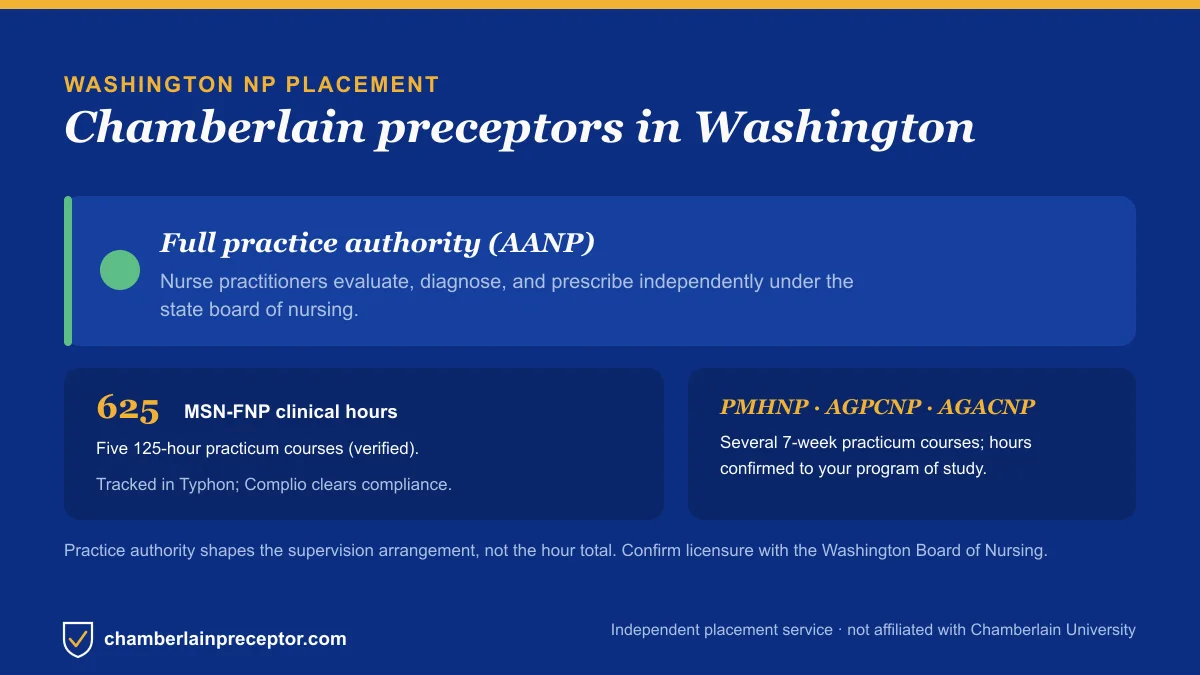
What full practice Washington means for your practicum
The American Association of Nurse Practitioners places Washington in its full practice category. Licensed NPs there evaluate patients, diagnose, order and interpret diagnostic tests, and initiate and manage treatments, including prescriptions, under the licensure authority of the state nursing board alone. State law requires no physician collaboration or supervision agreement.
For your clinical year, that matters in a concrete way. Washington NPs can own and run their own practices, which widens the preceptor pool well beyond hospital systems. NP-owned primary care offices, psychiatric medication management practices, and rural clinics across the state all hold potential preceptors who can supervise your hours without a physician co-signature. The catch is the same as everywhere else: Chamberlain still expects you to find that preceptor yourself, and every site must clear the university's paperwork before your first patient encounter.
The Washington State Board of Nursing, in brief
Advanced practice licensure in Washington runs through the Washington State Board of Nursing at nursing.wa.gov. The state uses the title Advanced Registered Nurse Practitioner, or ARNP, and the nurse practitioner role is one of four ARNP designations, alongside certified nurse midwives, nurse anesthetists, and clinical nurse specialists.
- ARNP licensure requires an active RN license, a completed graduate nursing program, and national certification in the role and population focus.
- Prescriptive authority is added to the ARNP license and carries its own pharmacology education requirement.
- The board publishes ARNP practice guidance and an online license lookup, which is the fastest way to confirm a potential preceptor's credential before you nominate them.
None of this is homework you can skip. Chamberlain collects your preceptor's licensure details during nomination, and a lapsed or encumbered license discovered late can cost you a practicum term.
Finding a preceptor across Washington
Chamberlain students secure their own preceptors. You research sites, make the asks, and submit the site and preceptor nomination in Typhon, Chamberlain's practicum portal. The university's Practicum Commitment, handled by the Experiential Learning Team, engages only after you document three preceptor denials. That is a late backstop, not a plan, which is why we run the search from day one instead. Where you look matters as much as when you start.
Puget Sound corridor
Seattle, Tacoma, Bellevue, and Everett hold the state's densest concentration of clinics and health systems. Competition from local NP programs is real here, so ask early and ask widely.
Eastern Washington
Spokane, the Tri-Cities, and Yakima offer steady family practice and behavioral health volume with fewer competing students, and rural sites often welcome the extra help.
Southwest and north
Vancouver, Olympia, and Bellingham sit near borders and cross-market care patterns. If an out-of-state site tempts you, settle the licensure and affiliation questions before you commit.
If a Washington ask comes back as a no, document it. Denials only count toward Chamberlain's three-denial threshold when they are recorded, and a paper trail keeps your options open either way. More on that at what to do when you cannot find a preceptor.
Chamberlain practicum requirements, seen from Washington
| MSN-FNP | 625 supervised clinical hours across five 125-hour practicum courses. |
|---|---|
| PMHNP | Several 7-week practicum courses; hours are confirmed to your program of study. |
| AGPCNP and AGACNP | Several 7-week practicum courses; hours are confirmed to your program of study. |
| DNP | A scholarly-project site and mentor rather than a set hour total. |
Three systems govern every Washington placement. Typhon is where you nominate the site and preceptor and later log hours. Complio handles compliance onboarding, including the background check, drug screen, and immunization records, and many Washington sites layer their own onboarding on top. Finally, every site needs an affiliation agreement with Chamberlain before you start, so a brand-new site can take longer to activate than one already in the university's network. The full checklist lives at Chamberlain preceptor requirements.
Virtual or in person in Washington
Telehealth is a routine part of care delivery in Washington, especially in behavioral health and for communities east of the Cascades. Whether telehealth encounters may count toward your practicum hours is a program decision, not a state one, and it varies by course and specialty. Confirm the rules with your program before you build a schedule around virtual visits, and treat in-person capacity as the core of any placement plan.
Get matched in Washington
If you would rather not spend your search window cold-calling clinics from Spokane to Seattle, we will run it for you. We contact Washington providers on your behalf, screen them against Chamberlain's requirements, and hand you a nomination that is ready for Typhon. The placement review is free, you pay when matched, and we work on a 14-day match commitment. Start at the consult form, read how it works and what it costs, or jump straight to the fast-track option if your term start is close. Placement pages for other states are at the states index.
Answered.
Is Washington a full practice state for nurse practitioners?
Yes. The AANP State Practice Environment map lists Washington as full practice, so licensed NPs evaluate, diagnose, and treat patients, including prescribing, under the state nursing board's authority without a required physician agreement.
Who licenses nurse practitioners in Washington?
The Washington State Board of Nursing. Washington issues the Advanced Registered Nurse Practitioner (ARNP) credential, which requires an active RN license, a graduate nursing program, and national certification. Prescriptive authority is added to the license separately.
How many clinical hours does Chamberlain's MSN-FNP require?
625 supervised clinical hours, completed across five 125-hour practicum courses. Other tracks such as PMHNP and AGACNP use several 7-week practicum courses with hours confirmed to your program of study. Details on the FNP page.
What if Washington preceptors keep telling me no?
Chamberlain's Experiential Learning Team assists only after three documented preceptor denials, so record every no. We do not wait for that threshold; our search starts the day you engage us. See what to do when you cannot find a preceptor.
Can telehealth hours count toward my practicum in Washington?
Sometimes. Telehealth is common in Washington care delivery, but whether virtual encounters count toward practicum hours depends on your course and specialty track. Confirm with your program before relying on virtual hours, and keep in-person capacity at the center of your plan.
Get your Chamberlain practicum handled.
A free placement review. No payment until you're matched. Tell us your track and term, and we map the whole placement.