Finding a Wisconsin Preceptor as a Chamberlain NP Student
Wisconsin sits in the reduced practice column today, and a new APRN law arrives on September 1, 2026. Here is what both facts mean for your Chamberlain practicum, and how to secure a preceptor from Milwaukee to the Northwoods before the calendar tightens.
Start your Chamberlain placement
Start your placement
A free placement review. No payment until you're matched.
The short answer for Wisconsin
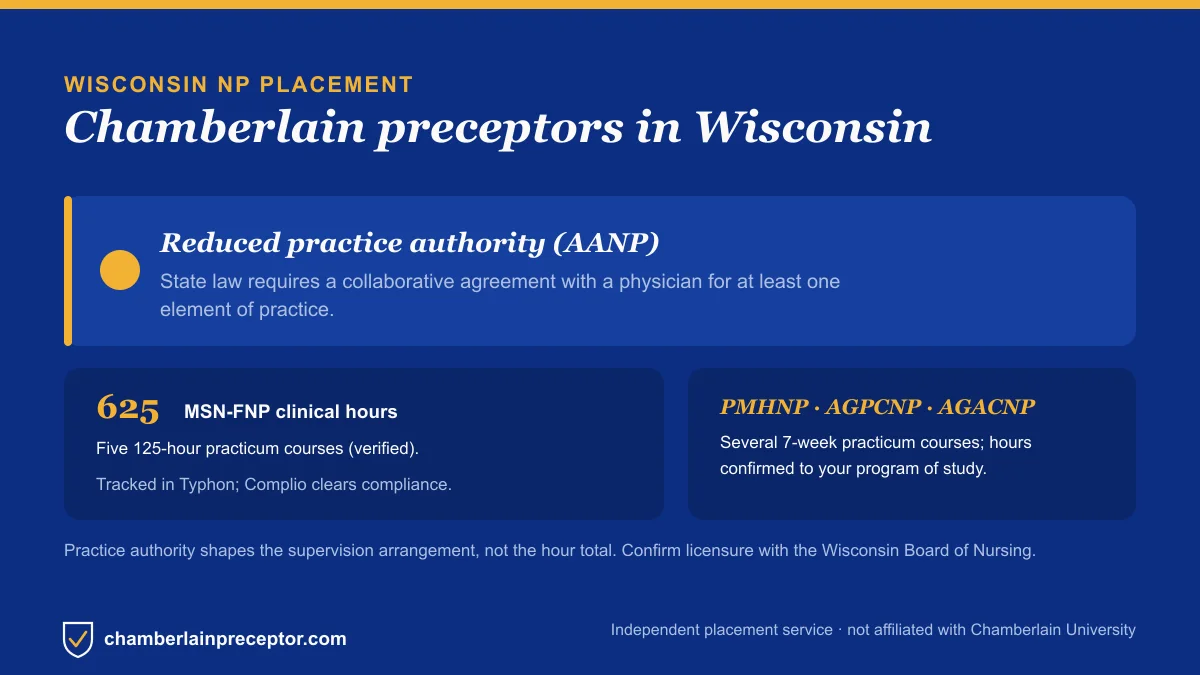
The AANP classifies Wisconsin as a reduced practice state. Nurse practitioners here work on an RN license plus an Advanced Practice Nurse Prescriber certificate, the APNP, and a written collaborative relationship with a physician is the legal basis for prescribing.
Day to day, that means the NPs who might precept you already work alongside collaborating physicians, clinics are fluent in supervision paperwork, and hosting a student is a familiar ask. It also means the clinicians best positioned to say yes are concentrated inside large health systems, where student placement moves through formal channels. Wisconsin is not unfriendly to Chamberlain students; it is process heavy, and process rewards an early start.
One more thing sets this state apart right now: the rules are about to change.
September 1, 2026: the APRN Modernization Act arrives
In August 2025, Wisconsin enacted 2025 Wisconsin Act 17, the APRN Modernization Act. When it takes effect on September 1, 2026, the state replaces the APNP certificate with a dedicated APRN license covering nurse practitioners, certified nurse midwives, nurse anesthetists, and clinical nurse specialists.
The headline change is an independent practice pathway. As enacted, an APRN who completes 3,840 clinical hours over at least 24 months in the role, with a physician or dentist available for consultation during that period, may then practice without a collaborative agreement. Final administrative rules come from the Board of Nursing, so confirm specifics there as the date approaches. For a Chamberlain student, three practical notes:
- Your program does not change. Practicum structure and hour requirements are set by Chamberlain, not by Wisconsin.
- New graduates still begin in collaborative arrangements, because independence must be earned through experience first.
- Seasoned Wisconsin NPs may find precepting easier to fit in once the law settles, but clinicians tend to be cautious about new commitments during a transition. Ask early.
The Wisconsin Board of Nursing, in plain terms
The Board of Nursing sits inside the Wisconsin Department of Safety and Professional Services, usually shortened to DSPS, and draws its authority from Chapter 441 of the Wisconsin Statutes. It licenses RNs and LPNs, certifies APNPs under the current framework, and will administer the new APRN license once Act 17 is in force.
- Use the DSPS online credential lookup to confirm a prospective preceptor's Wisconsin license and APNP status before you nominate them in Typhon. A ten minute check prevents a rejected nomination.
- The board publishes disciplinary orders. If anything about a potential site or supervisor feels off, the public record is where to verify.
Where placements actually happen in Wisconsin
Chamberlain students secure their own preceptors, and in Wisconsin the search usually runs through one of two terrains.
The metro corridors
Milwaukee, Madison, Green Bay, Kenosha, Racine, and the Fox Valley cities of Appleton and Oshkosh hold most of the state's clinical volume. Systems such as Froedtert, UW Health, Advocate Aurora, Ascension Wisconsin, Bellin, and ThedaCare dominate here, and most route student requests through centralized placement offices that expect an affiliation agreement before anything moves.
Rural and northern Wisconsin
Eau Claire, La Crosse, Wausau, Superior, the Driftless Area, and the Northwoods run on smaller clinics, critical access hospitals, and regional groups such as Marshfield Clinic and Gundersen. Preceptors here often answer faster, especially for family practice rotations, though drive times deserve a hard look before you commit.
The Chamberlain mechanics are identical either way. You find the preceptor, submit the nomination in Typhon, Chamberlain approves the site and supervisor, and an affiliation agreement is signed with the practice. The university's Practicum Commitment support through the Experiential Learning Team engages only after three documented preceptor denials, which is late if your term start is fixed. Our service closes that gap: we run the Wisconsin search from denial zero, so the 3-denial rule stays a backstop you never need. Already behind? Start with the fast track or read what to do when nobody says yes.
Chamberlain requirements, viewed from Wisconsin
| Program | What placement involves |
|---|---|
| MSN FNP | 625 supervised clinical hours across five 125-hour practicum courses, spanning family practice and population focused settings. See the FNP overview. |
| PMHNP | Several 7-week practicum courses in psychiatric settings; hours are confirmed to your program of study. See PMHNP placement. |
| AGPCNP and AGACNP | Several 7-week practicum courses in adult gerontology primary or acute care; hours are confirmed to your program of study. See AGPCNP and AGACNP. |
| DNP | A scholarly project site and project mentor rather than a traditional preceptorship. See DNP placement. |
Whatever the track, three gates apply before you see a patient: the Typhon nomination for your site and preceptor, Complio compliance onboarding covering your background check, drug screen, and immunizations, and a signed affiliation agreement between Chamberlain and the practice. Wisconsin's larger systems often layer their own onboarding on top. Full detail lives at Chamberlain preceptor requirements.
Virtual rotations, and a word on timing
Telehealth precepting exists in Wisconsin, particularly in psychiatric mental health, and some students blend virtual hours with in person time. Acceptability varies by course and by program, so confirm with your program before building a schedule around a virtual preceptor.
If you would rather not gamble a graduation date on cold outreach, we can carry the search. The placement review is free, you pay only when matched, and our match commitment is 14 days. Tell us your track and target term at the consult form, or see how it works and what it costs first. Comparing states? Start at the state directory.
Answered.
Is Wisconsin a full practice authority state for nurse practitioners?
Not yet. The AANP lists Wisconsin as reduced practice, meaning a written collaborative relationship with a physician underpins NP prescribing. The APRN Modernization Act takes effect September 1, 2026 and creates an independent practice pathway for experienced APRNs. See the AANP State Practice Environment map for current status.
How many clinical hours does Chamberlain's FNP program require in Wisconsin?
The same as everywhere: 625 supervised clinical hours across five 125-hour practicum courses. Wisconsin does not change Chamberlain's totals. Other NP tracks confirm hours to the program of study; see preceptor requirements.
Can I use a virtual preceptor for a Wisconsin rotation?
Sometimes. Telehealth rotations are most common in psychiatric mental health, but acceptability varies by course and program. Confirm with your program before you plan around one, and treat in person placement as the default for FNP clinicals.
What happens if three Wisconsin preceptors turn me down?
After three documented denials, Chamberlain's Experiential Learning Team assists through the Practicum Commitment. That help arrives late if your term start is fixed, which is why we run the search from day one instead. See what to do when nobody says yes.
How do I verify a Wisconsin preceptor's license before nominating them in Typhon?
Use the DSPS online credential lookup to confirm the RN license and APNP certificate, then submit the Typhon nomination. The Wisconsin Board of Nursing site also lists disciplinary orders worth a quick scan.
Get your Chamberlain practicum handled.
A free placement review. No payment until you're matched. Tell us your track and term, and we map the whole placement.